
Microsoft’s offensive to trap the user in Copilot is a super app for vibe coding, Office and autonomous agents
Microsoft has presented a restructuring of its AI ecosystem that redefines (once again) What is the position that Copilot occupies within companies?. The company does not want its assistant to be a secondary complement integrated into traditional office tools.
Rather, it seeks to turn the platform into a superapp that centralizes the entire working day. The new interface will be able to retain the employee in a single operational environment, forcing him to channel communication, document analysis, process delegation and many other tasks through the LLM.
Office programs join Copilot
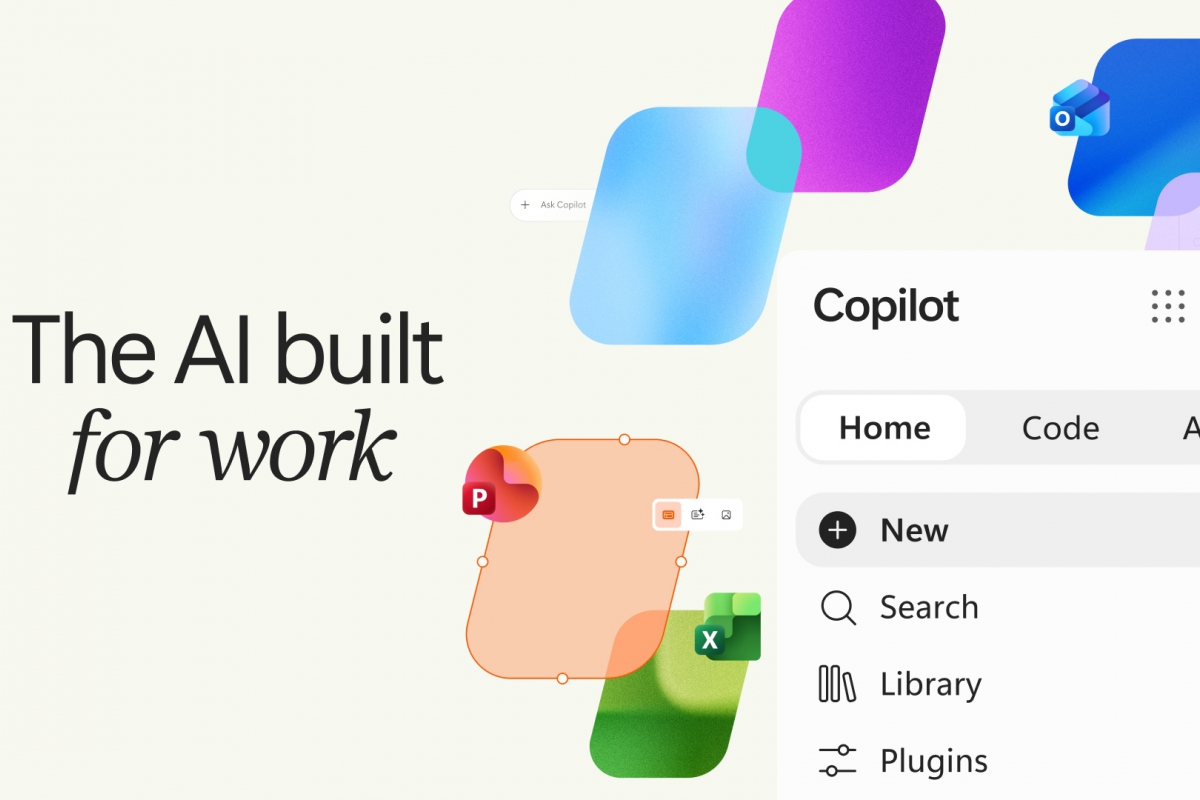
The nerve center of this new proposal is the Home section. We can say that it is the starting point that combines conversation with the delegation of complex tasks in Cowork. It should be noted that this section incorporates Office applications, allowing you to write reports, create presentations or modify spreadsheets without switching between independent programs.
Documents are synchronized in real time with the rest of the team members. Microsoft says that this way the AI always works with updated context. But wait, because there is more news.
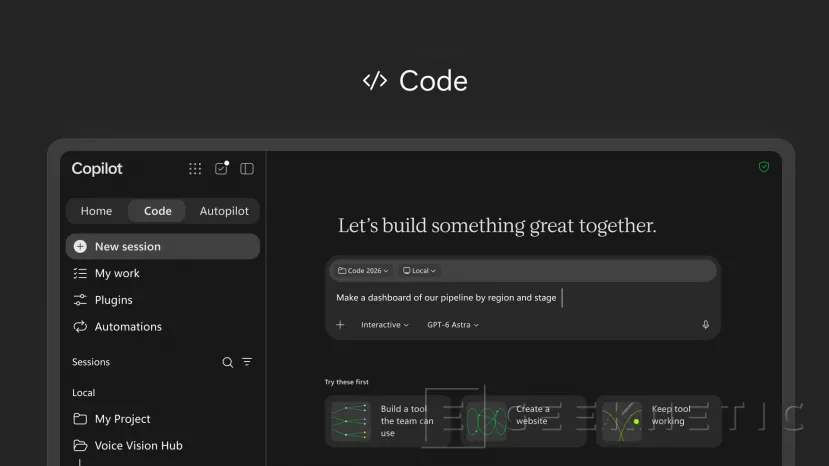
For better or worse, we live in the midst of the emergence of vibe coding. Therefore, it is logical that the other novelty is Code, an environment based on GitHub Copilot. What exactly is it for? It’s not really for creating great applications. Rather, Microsoft explains that the tool can generate interactive dashboards, desktop widgets, or automated workflows without having any idea of programming.
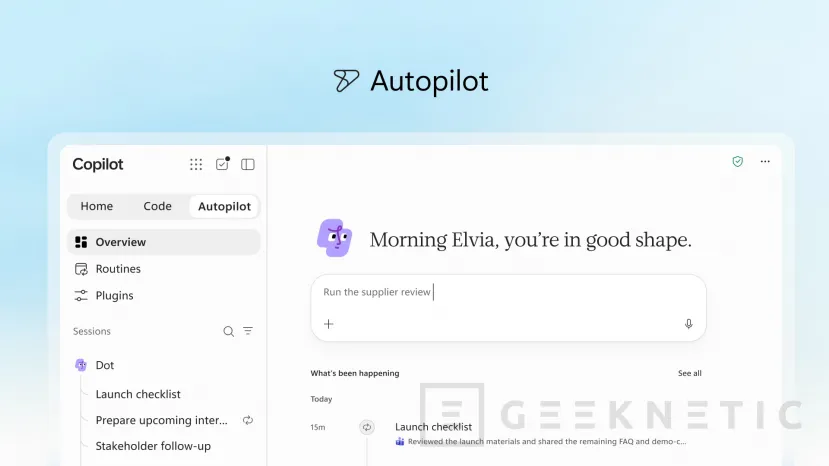
Finally, Microsoft has also released Autopilot. You probably imagine it, but this is an agent previously known as Scout who operates in the background within the environment. This digital assistant has its own identity in Teams and Outlook to coordinate calendars, request updates from suppliers or manage meetings without waiting for direct orders from the user.
The system assumes the execution of recurring projects in an unattended manner, notifying progress only when it detects deviations or requires human validation. In addition, the precision of these tasks is achieved thanks to Microsoft IQ, a data layer that connects business models with more than twenty million semantic models in Power BI through Fabric IQ.
Additionally, the environment will begin integrating data from Dynamics 365 and Power Platform in the coming weeks. A unified catalog of add-ons will facilitate centralized management for IT administrators, allowing third-party connectors and verified extensions to be enabled for the entire workforce.
