
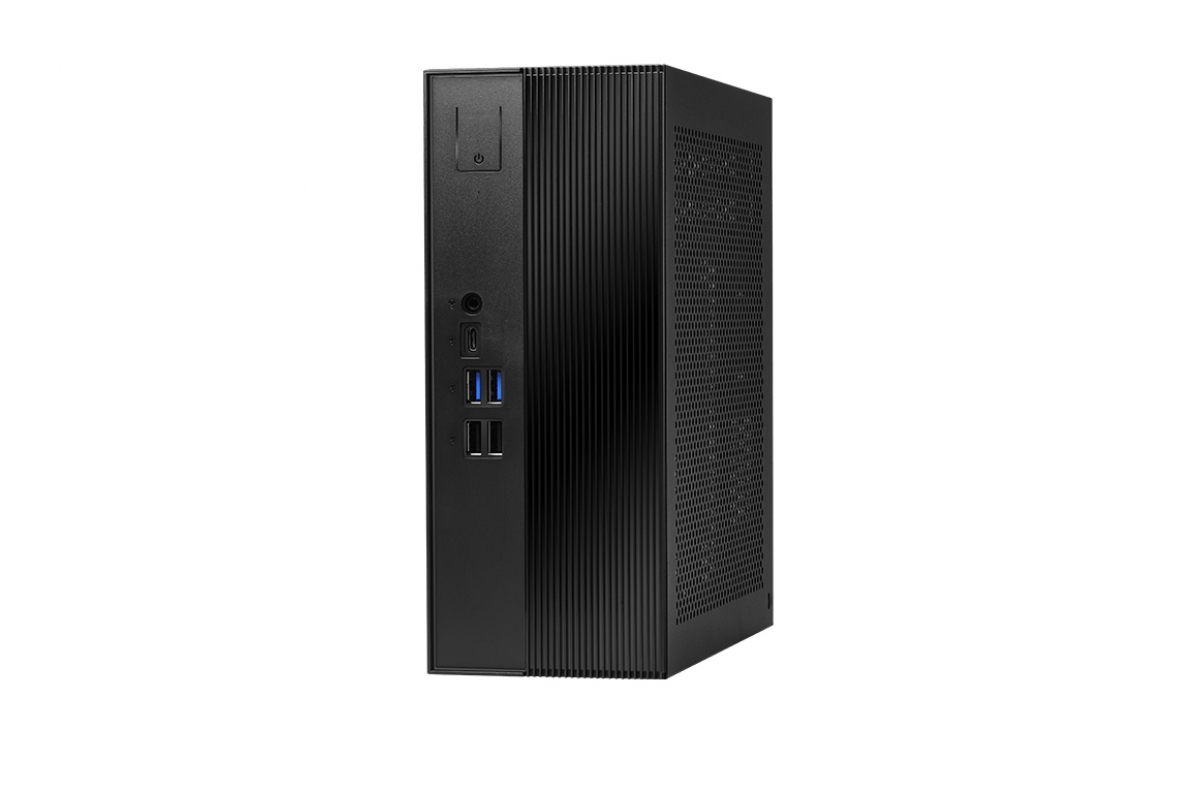
ASRock launches the 5-liter DeskSlim X600 and B760 mini PCs with support for NVIDIA RTX PRO Blackwell graphics
ASRock has launched the global distribution of its two new compact devices, the DeskSlim X600 and the DeskSlim B760. If they sound familiar to you, we confirm that they are two teams that we were able to meet during Computex 2026.
Then the manufacturer showed us some of its specifications, but now the official announcement clears up all doubts. With this five-liter chassis, the company wants its two workstations to fit into those positions where space is a problem.
When we were in stand of the brand in Taipei, we saw an X600 model with an Intel Arc Pro B50 card, but the dimensions of the PCIe port and the specifications of the B760 model remained to be clarified. The official documentation provided after the announcement now confirms that the PCIe 5.0 x16 slot supports low-profile, dual-slot cards up to 200 millimeters. The main novelty is the validation of the NVIDIA RTX PRO 4000 Blackwell SFF and RTX PRO 2000 Blackwell professional GPUs, guaranteeing specialized next-generation graphic acceleration for technical calculations.
Likewise, the manufacturer has also clarified the thermal support of the processors, a critical variable in such a tight volume chassis. The DeskSlim X600 for AMD AM5 socket supports Ryzen 9000, 8000 and 7000 series chips with a maximum consumption of 120W.
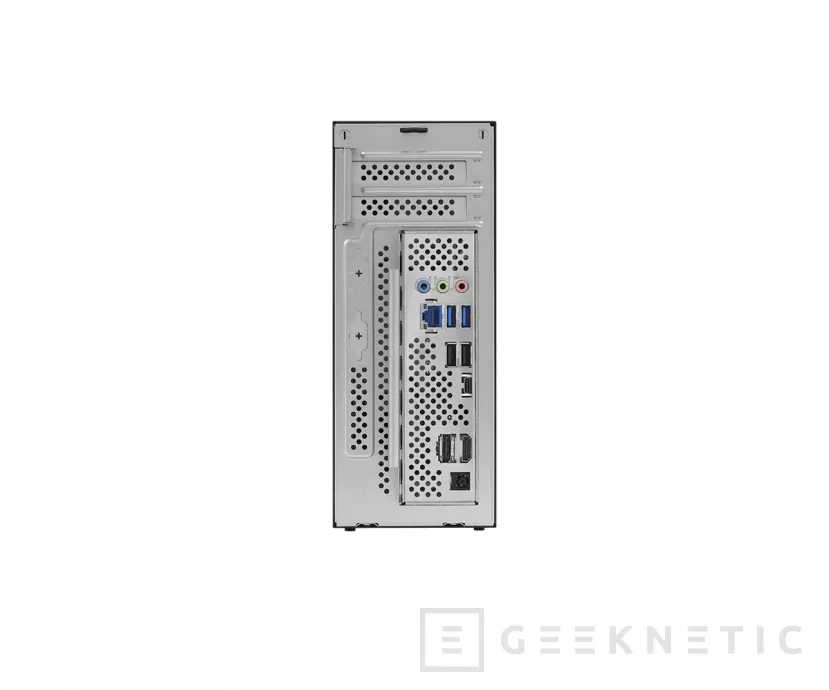
For its part, the DeskSlim B760 offers compatibility with processors 12th, 13th, and 14th Intel Core generation in LGA1700 socket up to a ceiling of 125 W, allowing the integration of conventional desktop processors compared to the usual soldered chips in mini PCs.
Comparative technical sheet between Intel and AMD variants
Beyond the processor, both boards present important differences in secondary storage and external connectivity that were not specified during the show. While the B760 chassis has two M.2 ports limited to PCIe 4.0 and DisplayPort 8K video output, the X600 variant adds an M.2 PCIe 5.0 x4 slot and a rear USB4 port.
In both cases, System memory reaches 256 GB via four DDR5 slotsproviding an unusual memory margin in such contained form factors. Here we leave you the complete specifications table:
| Specification | DeskSlim B760 | DeskSlim X600 |
|---|---|---|
| Format and volume | 5 liter chassis (235 x 95 x 220 mm) | |
| Socket and processor | Intel LGA1700 (12th, 13th and 14th Gen, up to 125W) | AMD AM5 (Ryzen 9000, 8000 and 7000, up to 120W) |
| Graphics expansion slot | 1x PCIe 5.0 x16 (low profile, dual slot, up to 200mm) | |
| Validated professional GPUs | NVIDIA RTX PRO 4000 Blackwell SFF / RTX PRO 2000 Blackwell | |
| Maximum RAM memory | Up to 256 GB DDR5 in 4 UDIMM slots (up to 7200+ MHz OC) | |
| M.2 NVMe slots | 2x M.2 2280 PCIe Gen4x4 | 1x M.2 2280 PCIe Gen5x4 + 1x M.2 2280 PCIe Gen4x4 |
| SATA storage | 2x SATA 6 Gb/s ports | |
| Rear video outputs | 2x DisplayPort (8K at 60 Hz) + 1x HDMI (4K at 60 Hz) | 1x HDMI + 1x DisplayPort 1.4 + 1x USB4 Type-C |
| Network connectivity | 1x 2.5G LAN + M.2 slot for Wi-Fi module | |
| Front ports | 1x USB-C 3.2 Gen1, 2x USB-A 3.2 Gen1, 2x USB 2.0 | |
| Availability | ASRock Global Distribution Network | |
Local AI is on everyone’s lips, also on ASRock’s
Surely you think that we are repeating ourselves with this local AI, but in reality we are only telling you what the market trends are. ASRock says that the combination of 256 GB of DDR5 memory with Blackwell professional accelerators positions these computers in an intermediate segment between the office mini PC and the server tower.
And, as it could not be otherwise, These systems are interesting for the execution of local AI models. In addition to the goal of all brands, which is to run models without depending on the cloud, the brand also talks about CAD design workflows and the possibility of installing SteamOS and turning these little ones into computers for gaming.
What is evident is that, by supporting low-profile professional graphics cards and standard non-soldered memory modules, both devices have greater modularity than traditional compact mini PCs. Thus, companies and users can optimize the equipment according to the use they are going to give it.
