
AMD chips made by Samsung? Lisa Su returns to Seoul and confirms that they continue exploring that route
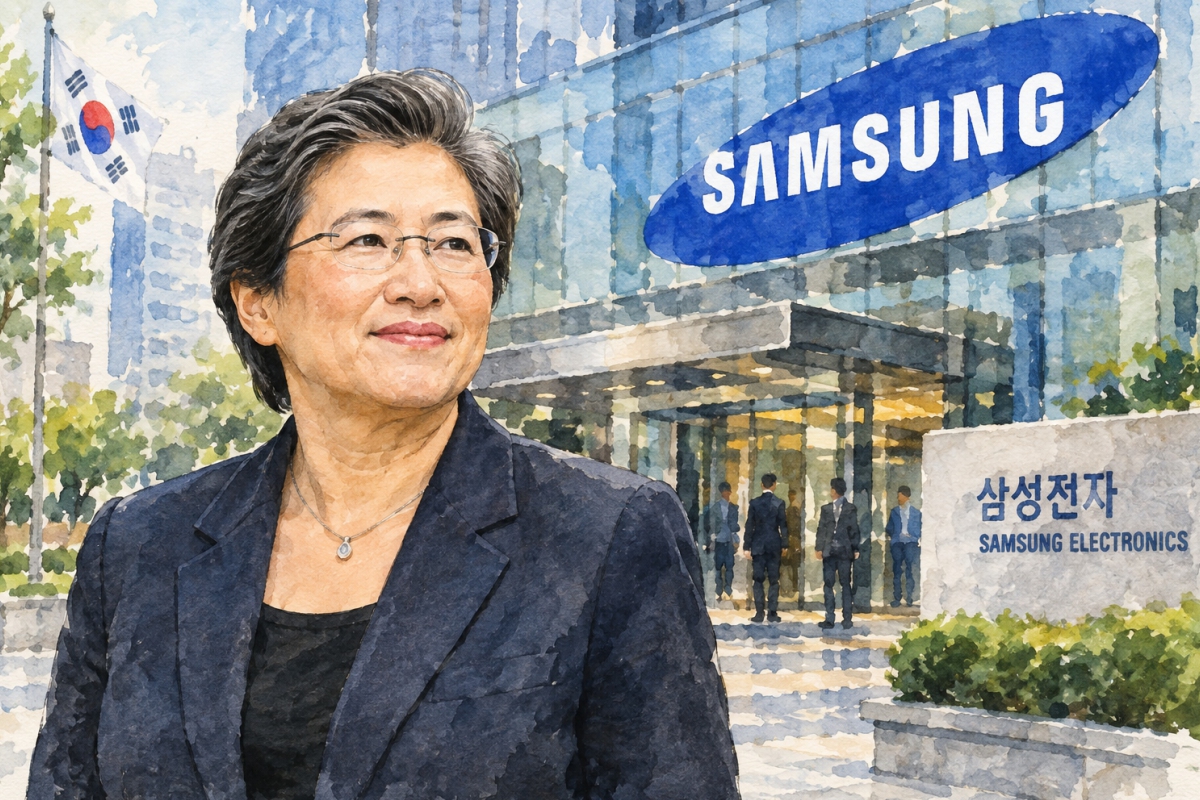
AMD President and CEO Lisa Su returned to Samsung’s headquarters in Seoul on October 7. And he did so seven months after his previous visit. There she met with Jun Young-hyun, vice president of Samsung and head of its semiconductor division, accompanied by Jack Huynh and Joseph Macri, also AMD executives. Before entering, he told reporters that they would discuss their “broader partnership” and declined to clarify whether he would also see Lee Jae-yong, Samsung’s president.
The meeting has issues related to memory as a starting point. AMD has already started shipping its MI455 and Helios systems, which use HBM4, and Su claimed to have great support from Samsung and SK hynix. Your Instinct MI455X accelerator incorporates 432GB HBM450% more than the 288 GB of HBM3E in the MI355X, so each unit sold requires significantly more memory than before.
In addition, the supply is fair. Analysis firm TrendForce estimated that HBM and conventional DRAM share limited advanced production capacity. He also stated that the offer will remain adjusted until next year. Su explained that AMD works with its customers to optimize memory usage and asks its partners to increase production as soon as possible.
TSMC, the factory that today produces AMD chips
In March, during Su’s previous visit, the two companies signed a memorandum to expand your collaboration in memory for AI. Samsung remained one of the key suppliers of HBM4 to the MI455X and both parties agreed to study the manufacture of future AMD products in Samsung’s foundry division, that is, in its custom chip factories. Jun then highlighted that Samsung can offer memory, manufacturing and packaging, the process that joins several chips into a single product.
That second part is the one that requires the most procedures. AMD produces its advanced CPUs and GPUs at TSMC, including the MI455X, and adding another manufacturer requires checking performance, percentage of valid chips and delivery times. Really, it would be a complication for AMD. In fact, the sources consulted remember that AMD itself warned in its annual report last year that Moving production of some products to a new manufacturer could delay launches and reduce performance. A move that would aggravate the existing bottleneck.
Likewise, asked about the foundry, the AMD CEO responded that her company has grown a lot in recent years, that a broad supply chain is very important and that she continues to explore opportunities with Samsung. He added that he plans with his partners for three or five years.
His agenda in Korea also included a meeting with SK hynix and another with Ryu Je-myung, second vice minister of Science and ICT, as well as a round table with 13 local AI chip and infrastructure companies. There was talk of a research center and combining AMD CPUs and GPUs with Korean AI processors.
