

Mistral launches Mistral Large 4, a trillion-parameter model trained in Europe with 3,800 NVIDIA Grace Blackwel chips
Mistral, the French AI laboratory, has just caught up. He has done it with his new model Mistral Large 4internally baptized with the nickname Le Chonk. This is the most advanced development to date for this company.
The system has a trillion-parameter architecture and will release its open weights at the end of October. With this deployment, The French laboratory seeks to consolidate a sovereign European alternative in the face of closed American platforms and open solutions from China.
a model made in Europe
The model repeats the MoE architecture or mix of experts that activates 49 billion parameters for each inference process. This technique is used precisely to increase the efficiency of the model. According to the company, its design supports native multimodal capabilities ready to process technical engineering drawings, high-resolution geospatial images and analysis of complex financial documents.
Another important detail is that The training has been carried out entirely in European data centers. And it has acquired its own cluster equipped with 3,800 NVIDIA Grace Blackwell GPUs. Along the same lines, the company wanted to make it very clear that the development complies with European Union regulations and covers more than 160 languages. Furthermore, being free to use, it allows organizations to deploy it on their local servers without depending on the cloud.
How does this model compare to the competition?
Although benchmarks are still synthetic tests that offer synthetic results, they do help to be clear about where a model stands with respect to the competition. In any case, the data we have is provided by Mistral itself. That’s a detail to keep in mind, not only with this release, but with any one.
Be that as it may, in the field of cybersecurity, Mistral Large 4 reaches 82% in the AA Cyber index by reproducing and correcting real vulnerabilities in open source. This metric exceeds the behavior of proprietary models such as GPT-6 Astra or Claude Opus 5.5, whose filters usually block this type of tests as a precaution. For digital defense tasks, Access to a system with open weights avoids unforeseen blockages during containment of critical security breaches.
In general software engineering tests, the model scores 61.7% in the DeepSWE v1.1 benchmark and 59.9% in AutomationBench for Office Flows. Furthermore, in blind evaluations coordinated by the firm Surge AI, human evaluators placed the European proposal in second place overall with a score of 3.74 out of 5.
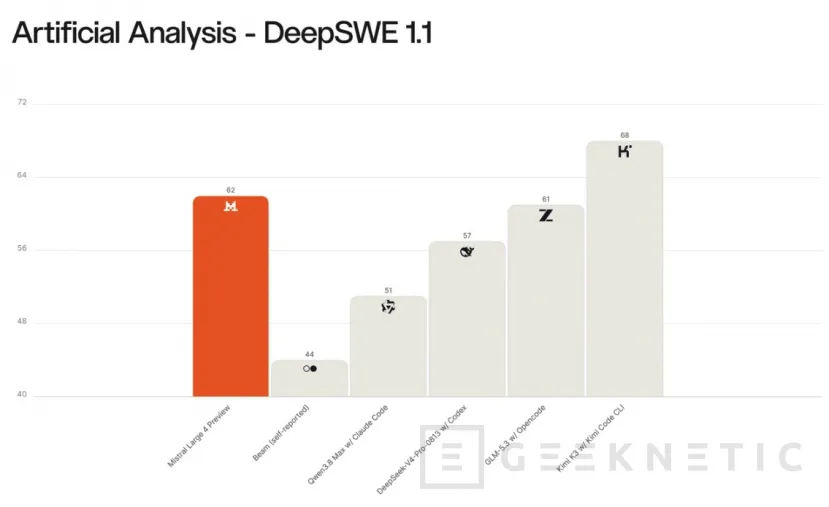
These records confirm that we are facing a true frontier model that looks face to face with the heavyweights in the sector.
First in the API, then in open
Although this will be an open model, it is initially only available through an API. All of this will be while they complete the audit protocols with public administrations and cyber defense experts. In statements given to TechCrunchMistral’s VP of Science, Pierre Stock, explained that they collaborate “with trusted partners and governments to ensure that open weights are used for defense and not malicious attacks.”
In practice this means that The company will delay the release of the pesos for three weeks to certify your containment barriers. Stock defended the profitability of its development, with a cost scale “between two and three times lower than that of Chinese competitors and significantly lower than that of closed models.”
In fact, it is precisely this approach that has attracted companies like Samsung, which are optimizing semiconductor design with Mistral Large.
