
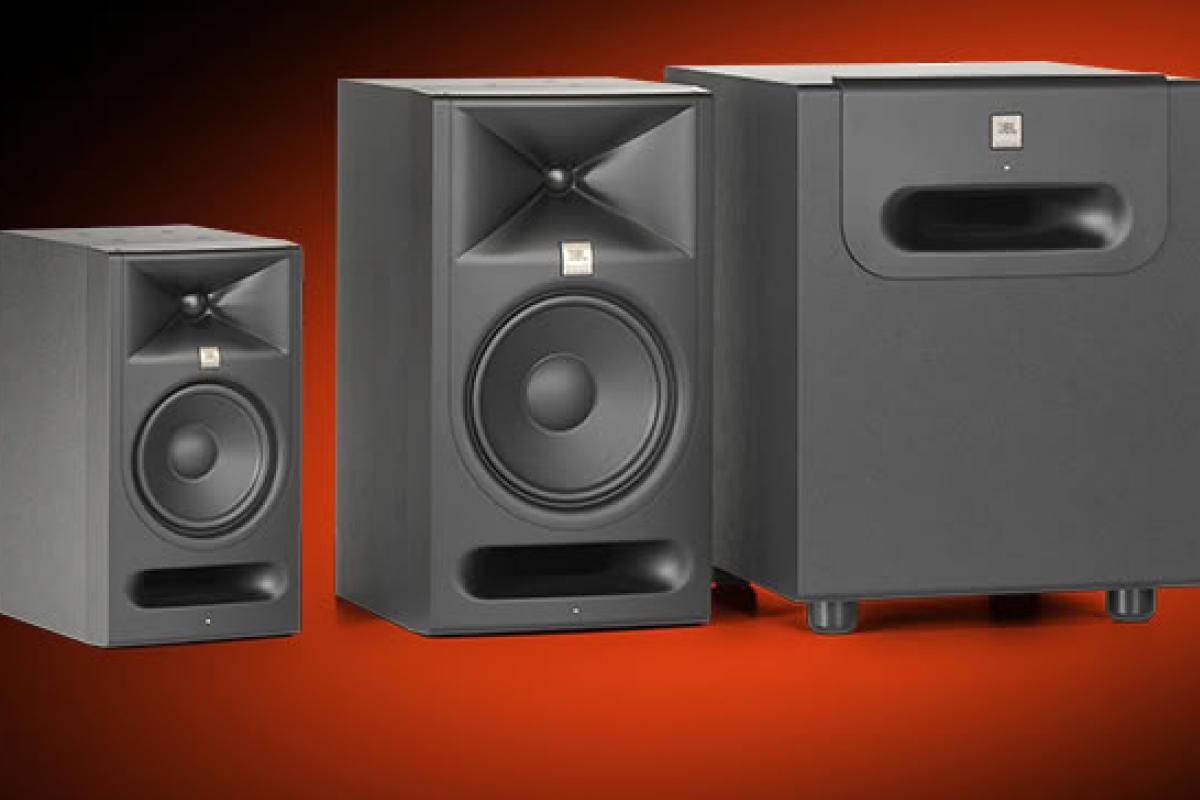
JBL renews its 3 Series studio speakers with front port and 81 equalization combinations
JBL has introduced the 3 Series MkIII family, consisting of the 305P MkIII, 306P MkIII and 308P MkIII powered studio monitors and the 310S MkIII subwoofer. The renovation affects the drivers and amplification, and incorporates a front bass port and new controls to adjust response to speaker placement.
The three monitors use 5-inch, 6.5-inch, and 8-inch woofers, respectively. They share a two-way configuration and Class D amplification, while the subwoofer adds a 10-inch, 300W transducer. JBL targets this family for music production, video editing and content creation positions, with mounting options for multi-channel systems.
New drivers and front bass port
JBL has redesigned the treble transducer and waveguide Image Control Waveguide. The brand seeks to maintain a more uniform stereo image when the listener moves from the center position, with a larger listening area.
In the bass, the new woofers use Stiffer cones, revised magnet assemblies and aluminum shorting rings. The manufacturer attributes these changes to a greater ability to work with power and a reduction in distortion.
The Slipstream bass reflex port is now located on the front. JBL associates that arrangement with more predictable bass behavior when the monitors are placed on a table or near a wall, two common locations in a home studio.
Amplification also changes in this generation. Each monitor has independent stages for bass and treble: the 305P adds 86 W, divided into two 43 W amplifiers, and the 306P and 308P models reach 110 W, with 55 W for each channel.
What changes between the three sizes
The 305P MkIII is the smallest model. His 5 inch woofer is combined with a maximum advertised sound pressure of 109 dB and bass extension of 45 Hz, measured at −10 dB. The specified response within a range of ±3 dB is from 55 Hz to 27 kHz. The box measures 320 × 175 × 250 mm and weighs 5.3 kg.
He 306P MkIII increases the 6.5 inch woofer and the maximum sound pressure at 112 dB. The lower extension reaches 43 Hz at −10 dB, while the ±3 dB response spans 52 Hz to 27 kHz. Your box measures 370 × 210 × 290 mm and weighs 6.7 kg.
Above is the 308P MkIIIwith woofer 8 inchesup to 113 dB peak sound pressure and bass extension from 41 Hz to −10 dB. The ±3 dB band starts at 49 Hz and ends at 27 kHz. Its dimensions are 444 × 249 × 296 mm and its weight reaches 8.8 kg.
The extension figures at −10 dB indicate how far each model reaches with a level drop from its reference. The ±3 dB margin describes a more uniform band and makes it easier to compare the response of the three monitors using the same criteria.
Four controls and 81 equalization combinations
Each monitor incorporates Four adjustment controls allow for 81 equalization combinations. They act on the placement of the speaker, its proximity to the walls and the balance of bass and treble.
The adjustments are made on the equipment itself, without calibration software. They allow the response to be adapted to different installations, such as a couple resting on the desk or monitors separated from the table by supports.
The input uses a balanced Neutrik combo connector. Sensitivity can be selected between +4 dBu and −10 dBV to match the input level to that of audio interfaces, mixers, and other playback equipment.
The monitors also incorporate eight M4 mounting points, distributed between the top and bottom, with a pattern of 75 × 75 mm. They allow installation on compatible supports, walls or ceilings, in addition to their conventional placement next to a work table.
310S MkIII subwoofer adds bass up to 26 Hz
He 310S MkIII use a 10-inch downward-facing transducer and a 300W class D amplifier. JBL advertises a maximum sound pressure of 116 dB and bass extension down to 26 Hz at −10 dB.
To combine it with the monitors, you can choose a crossover frequency of 80, 100 or 120 Hz. It also has a bypass mode for an external system to manage the distribution of bass in surround or immersive audio installations.
The calendar communicated by JBL places the start of availability in Europe, Asia-Pacific, the Middle East and Africa on November 3, 2026. The United States and Canada will have to wait until January 7, 2027. The announcement does not specify sales prices for Spain.
