
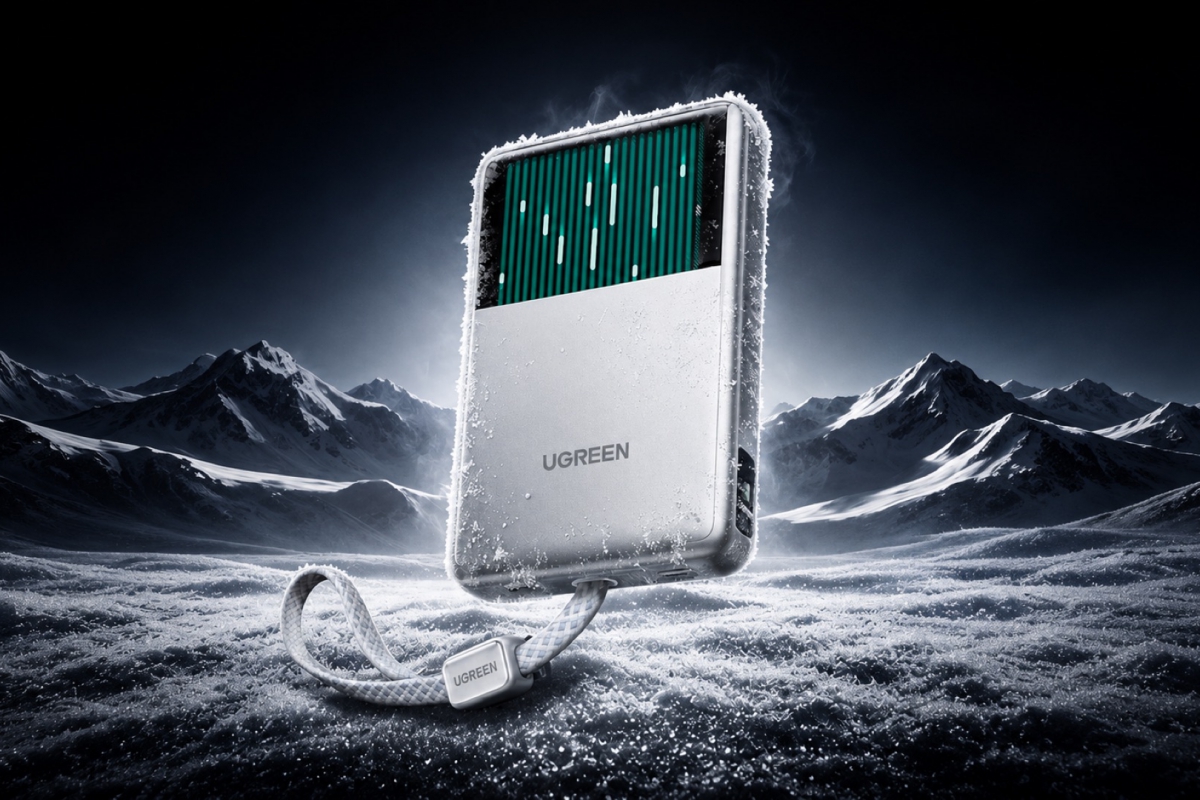
UGREEN incorporates liquid cooling to a 10,000 mAh and 45 W magnetic battery
UGREEN has presented in China the P8a 10,000 mAh magnetic external battery that incorporates liquid cooling using a micropump. The device combines an integrated USB-C cable of up to 45W with 15W wireless charging and a TFT screen to view information during operation.
The particularity is in the thermal system. UGREEN claims to reduce the maximum temperature by 13°C and improve dissipation by 38%. Both figures come from the manufacturer and describe their commercial comparison; There is still a lack of independent tests that allow us to know the behavior of the battery in different conditions of use.
A micropump to move heat inside the battery
The design uses a liquid cooling circuit with active circulation. The micropump moves the fluid to transport heat from the areas where it is concentrated to the surfaces that can dissipate it. It’s the same general thermal transfer principle used in other electronic equipment, adapted here to a wearable accessory.
Wireless charging introduces losses in energy transfer between the battery and phone coils. Part of that energy is converted into heat, to which is added that generated by the power electronics. The physical proximity of both devices makes temperature especially relevant during prolonged charges.
Better heat distribution can help avoid thermal concentrations in certain points. However, the micropump still needs that heat to end up being released into the environment through the assembly. The outside temperature, placement of the phone, and available ventilation all affect that exchange.
The announced reduction of 13 °C must be read within that comparison. The information available does not establish a fixed operating temperature for any mobile phone nor does it allow us to calculate how many additional minutes it will maintain maximum power. Nor is it equivalent to a 13°C reduction in the temperature of the smartphone’s internal battery.
The brand had already presented a MagFlow magnetic battery with micropump cooling at IFA 2026. That ad mentioned 25W Qi2 wireless charging. The P8 described now has a 15W wireless outputso it is advisable to keep the specifications of each product separately.
Built-in 45W cable and 15W magnetic charging
Wired connection reaches up to 45W via integrated USB-C. Having the cable attached to the accessory itself avoids depending on an additional one to use that output, although the final speed will continue to be limited by what the connected device accepts and by the negotiated protocol.
Magnetic wireless charging compatible with MagSafe reaches 15 W. This figure expresses the maximum power advertised for that mode and should not automatically be added to the 45 W to give the product a simultaneous output of 60 W. Distribution between connections requires its own specification.
Among the protocols listed are USB Power Delivery and PPSalong with charging systems used by other manufacturers, such as QC, AFC, SCP and FCP. That compatibility expands connection options, but different phones may apply different limits even when using the same USB-C connector.
The difference in power between both modes also changes the intended use. The cable allows you to power compatible devices with higher demand, while the magnetic attachment makes it easy to carry the phone and battery together when recharging. The physical compatibility with magnets and the accepted power are issues that must be checked on the specific mobile.
The 45 W also does not mean that the battery delivers that power throughout the entire process. Devices reduce current as they approach full charge, and thermal controls can change it sooner. Refrigeration intervenes in one of these limits, but does not eliminate the load curve of the receiving equipment.
773 Wh/l cells and display to check the load
UGREEN attributes to its cells a energy density of 773 Wh/l. It is a measure of energy stored per cell volume. It does not describe the density of the finished product, where the case, magnetic system, screen and cooling components also take up space.
The 10,000 mAh capacity does not allow you to transfer that entire amount to the phone either.. The energy goes through voltage conversions and, in wireless mode, an inductive transfer. To estimate complete recharges, it is necessary to consider these losses and the energy of the mobile battery, expressed in comparable conditions.
TFT screen shows real-time charging data. This way you can check the status of the accessory while it works, although this information does not replace a measurement of the energy delivered to compare efficiency or autonomy with other external batteries.
The P8 has an announced price in China of 459 yuan (62 euros more or less) and is scheduled for December 3. The launch information consulted does not specify a marketing date in Spain.
