
First benchmarks of the exynos 2600: 2 Nm gaa process and an almost identical performance of the Snapdragon 8 Elite Gen 5
Samsung had been trying to be competitive again in the field of high -end mobile processors. After several generations with unequal results against Qualcomm and Mediatek, the announcement of exynos 2600 aroused enough expectation, especially because it is about First chipset manufactured with GAA technology in 2 nanometers of the company. Now, the first performance leaks begin to shape that promise, and the numbers paint much better than we had seen in previous years.
A design with ten cores and improved NPU
The company did not give many details when the chip officially presented: it barely confirmed that its Neural Processing Unit (NPU) would offer an important leap in artificial intelligence. Little was discussed then the gross performance of CPU and GPU. However, a new filtration has put more concrete information on the table, starting with the CPU cluster: ten nuclei in total, with the fastest reaching 3.80 GHz.
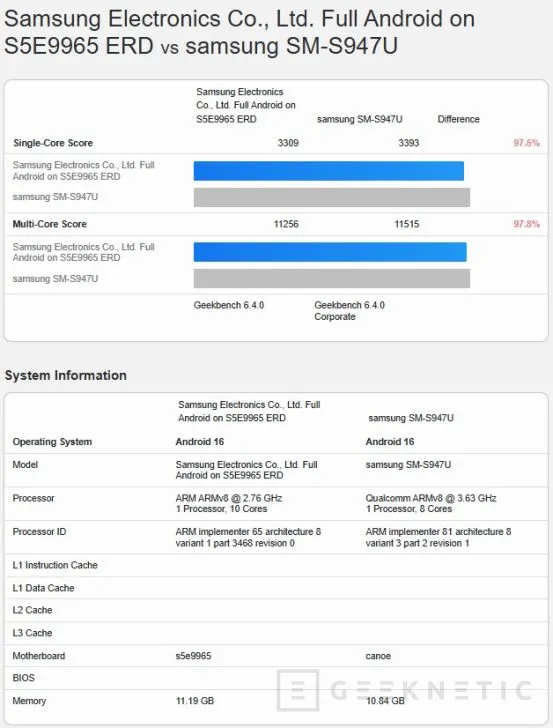
In the leaked benchmarks of Geekbench 6the exynos 2600 registered 3309 points in Mononúcle and 11256 in Multinukle. Figures that, for the first time in a long time, place an exynos at the level of the large rivals of the highest range.
How compared to Snapdragon and Dimensity
To put the results in context, it is enough to see how it is in front of other reference chips. On the one hand, Clearly overcomes Dimensity 9500what is already a milestone. But the most striking thing is the close thing that is placed from the future Snapdragon 8 Elite Gen 5, which until recently was known as Elite Gen 2.
The new Qualcomm flagshiptested in a Galaxy S26 Edge, He achieved 3393 points in Mononúcle and 11515 in Multinukle. The difference with respect to exynos 2600 is minimal: just 2.5 % advantage for Qualcomm. And that, in that concrete test, the Snapdragon performance nuclei worked at 4.00 GHz, below the 4.74 GHz that marks the serial configuration. That is, it still had a margin of improvement.
A very significant evolution
Beyond direct comparison, the most important thing is in internal improvement. If previous tests of the Samsung platform are taken as a reference, the jump is huge: We talk about 53.5 % more yield in mononucle and multinucole with respect to previous results. A difference that is not achieved with simple adjustments, but with a deep redesign of architecture and with the jump to the GAA process of 2 Nm.
This explains why there is some optimism within Samsung. The exynos 2600, although it is still in the polishing phase, already has shown that it has enough muscle to compete. And with frequency and consumption settings, it could even more approach the top of Qualcomm or even overcome it in specific scenarios.
What remains to be demonstrated
Obviously, synthetic benchmarks are only part of the story. It remains to be seen how this chip behaves on a day -to -day basis, with real loads and under prolonged conditions of use. Energy consumption will be one of the keys, especially since Samsung plans to integrate exynos 2600 in several models of the next Galaxy S26 family. If you manage to combine power efficiently, the perception of the exynos could change radically.
For now, what we have are very solid indications: a chip that leaves behind criticism and that, at least on paper, finally sits on the same table as the best in the industry. The final battle will come when we see it in front of an Snapdragon 8 Elite Gen 5 in its full potential, but the conclusion is clear: Samsung returns to the fight, and does so with a processor that promises much more than expected.
