
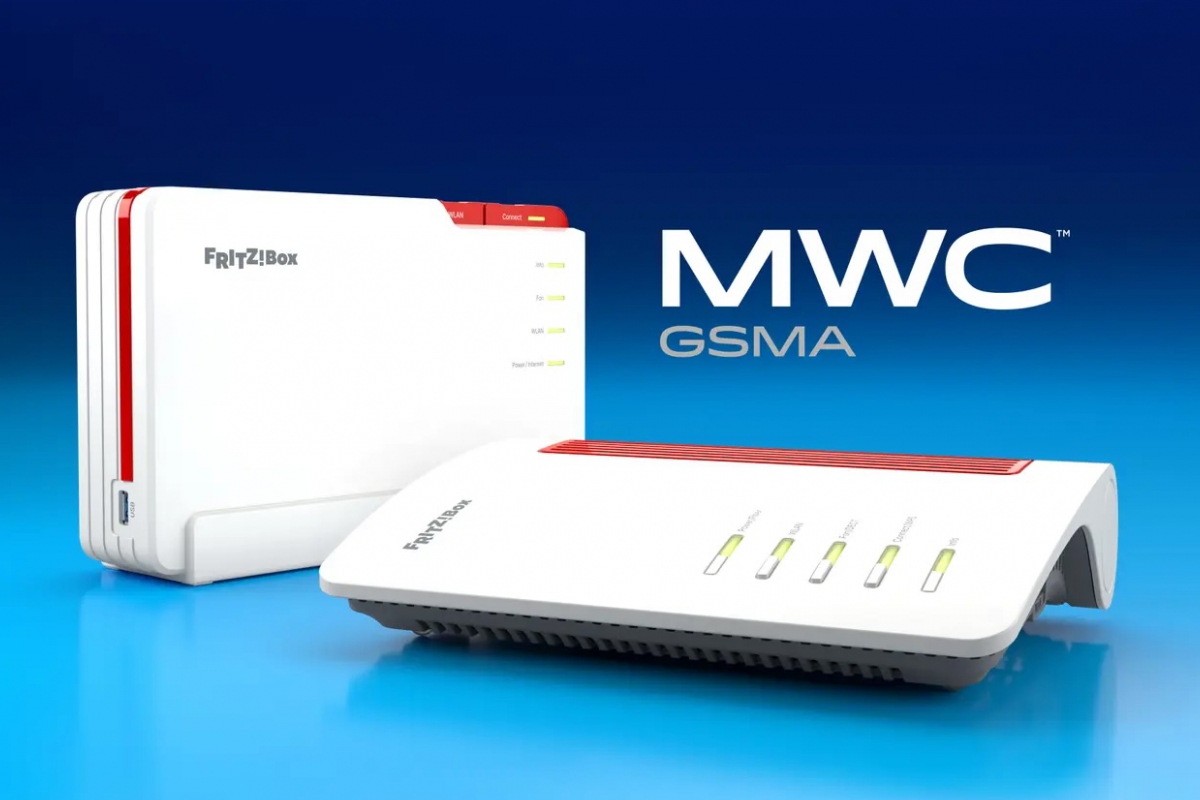
This has been the deployment of FRITZ networks! at MWC 2026
The Mobile World Congress in Barcelona goes far beyond mobile phones and smartphones. In fact, in our coverage, we are discovering many new developments with reference to networks, such as MediaTek’s alliance with Starlink or Huawei’s commitment to AI in this segment. In this 2026 edition, the European manufacturer FRITZ! It has also presented an extensive renewal of its device catalog. The company’s main focus is on facilitating transition to faster networksprioritizing the deployment of the WiFi 7 standard and support for extreme capacity fiber optic connections.
Along with fixed solutions, the technology firm has paid special attention to mobile connectivity alternatives. The new proposals seek to cover the internet access needs in regions with traditional broadband gaps. To do this, they are betting on hardware that takes advantage of 5G and 4G infrastructures, offering flexible configurations that can be powered through standard USB-C connections, an ideal format for constantly moving environments.
Technical comparison of the new FRITZ!Box routers
Here we leave you a table with the key specifications of the four new router models announced during the technology fair. The offer is clearly divided between two fiber optic devices and two terminals aimed at fixed and mobile wireless access.
| Specification | FRITZ!Box 5630 XGS | FRITZ!Box 5630 | FRITZ!Box 6835 5G | FRITZ!Box 6825 4G |
|---|---|---|---|---|
| Primary connectivity | XGS-PON Fiber (10 Gbps) | GPON Fiber (2.5 Gbps) / AON | 5G/4G (up to 2Gbps) | 4G (up to 300 Mbps) |
| Wireless standard | Wi-Fi 7 (Dual band) | Wi-Fi 7 (Dual band) | Wi-Fi 7 (Dual band) | Wi-Fi 6 (2.4 GHz Band) |
| Maximum WLAN speed | Up to 3.5 Gbps | Up to 3.5 Gbps | Up to 3.5 Gbps | Up to 600Mbps |
| Main LAN ports | 1x 10Gbps, 3x 1Gbps | 1x 2.5Gbps, 3x 1Gbps | 1x 2.5Gbps, 1x 1Gbps | 1x 1Gbps |
| Feeding | Standard current | Standard current | USB-C port | USB-C port |
| Other functions | DECT Telephony, Smart Home | DECT Telephony, Smart Home | Support eSIM, Nano-SIM | nano-SIM slot |
The jump to fiber with extreme speeds and 5G mobility
The new family for wired connections is headed by the FRITZ!Box 5630 XGS. This equipment is designed to withstand the rates of most demanding fiber opticsreaching speeds of up to 10 Gbps through the XGS-PON standard. Its little brother, the FRITZ!Box 5630, is positioned one step below, offering direct support for GPON networks of up to 2.5 Gbps and AON connections of 1 Gbps, thus covering the current spectrum of European infrastructures.
Both fiber optic models incorporate the WiFi 7 standard in a dual-band configuration, allowing rates of transfer up to 3.5 Gbps wirelessly. In addition to managing the network, these terminals function as integral switchboards for the home. They have support for telephony through DECT and allow the control of home automation devices through the Smart Home protocol integrated into the manufacturer’s operating system.
In the field of mobility, the presentation of the FRITZ!Box 6835 5G stands out. This device allows access to the internet through mobile networks with downloads up to 2 Gbps. Its most notable feature is its power flexibility, as it connects via a USB-C port, allowing it to operate using a portable external battery. It incorporates compatibility with both physical nano-SIM cards and the eSIM digital standard.
Completing the line of routers is the FRITZ!Box 6825 4G, a more modest device focused on LTE networks. It reaches 300 Mbps downloads and uses Wi-Fi 6 in the 2.4 GHz band. Both this model and its 5G variant are compatible with the FRITZ! system Failsafe. This software solution allows mobile routers to be used as an automatic backup connection if the main fiber or cable line suffers an unexpected outage.
New devices to expand the wireless ecosystem
Beyond the main routers, the manufacturer has dedicated space to the expansion of the local network. The most forceful advertisement in this segment is the new FRITZ!Repeater 6700 Pro. It is a wireless signal repeater that adopts a quad-band Wi-Fi 7 configuration, operating at 6 GHz frequencies, two 5 GHz bands and one 2.4 GHz band, seeking optimal performance in highly saturated environments.
This repeater is designed to manage the traffic of a multitude of simultaneous devices, reaching a rate of 18 Gbps combined data. To avoid bottlenecks in the internal network, the hardware includes a 10 Gbps and a 2.5 Gbps LAN port. This facilitates the physical connection of home computers or servers that demand high bandwidth in a constant and stable manner.
Finally, the company has presented a direct solution for upgrading older computers. He FRITZ!WLAN Stick 6700 is a USB adapter that provides tri-band Wi-Fi 7 connectivity to laptops and desktops. This small peripheral reaches speeds of up to 2.8 Gbps and supports the 6 GHz band, allowing legacy hardware to take advantage of the advantages of new routers without the need to make complex internal modifications.
