
OpenAI extends GPT-5.6 with Sol, Terra and Luna, focusing on efficiency, security and controlled deployment
As planned, OpenAI has expanded the deployment of GPT-5.6its new family of models divided into Sol, Terra and Luna, after an initial phase limited to a small group of trusted partners. The company maintains Sol as its reference model, presents Terra as a balanced option for daily work and places Luna as the fastest and most affordable variant. The move comes just a few days after OpenAI confirmed that access to GPT-5.6 would start in a restricted manner, in a launch highly conditioned by issues of cybersecurity and institutional supervision.
According to OpenAI itself, GPT-5.6 Sol is its most powerful model to datewith improvements in programming, biology and cybersecurity. In Terminal-Bench 2.1, a test focused on real command-line workflows, Sol achieves 88.8%, while Sol Ultra climbs to 91.9% thanks to the use of subagents to speed up complex tasks. Terra remains at 82.5% and Luna at 84.3%, figures that place the intermediate and entry models in a competitive position for less demanding or more cost-sensitive loads.
One of the most striking data has been provided by Sam Altman in statements to CNBC. The manager assured that GPT-5.6 Sol is 54% more token efficient in agentic programming tasks, an improvement that directly connects with one of the great current concerns of the business market: not only how much a model performs, but how much it costs to put it to work in production. Altman defended precisely that idea by pointing out that companies no longer look only at capacity, but also at the real value they obtain for each dollar invested.
Sol focuses on code and cybersecurity, while Terra and Luna complete the range
The new family also reorganizes the OpenAI catalog in a more readable way. In this scheme, the number 5.6 marks the generation, while Sol, Terra and Luna now identify levels of capacity with own routes. Terra is presented as an alternative to GPT-5.5 at half the cost, with a price of $2.50 per million tokens for entry and $15 per million for exit. Luna, for its part, drops to $1 for entry and $6 for exit, which makes it the gateway for tasks where speed and budget prevail.
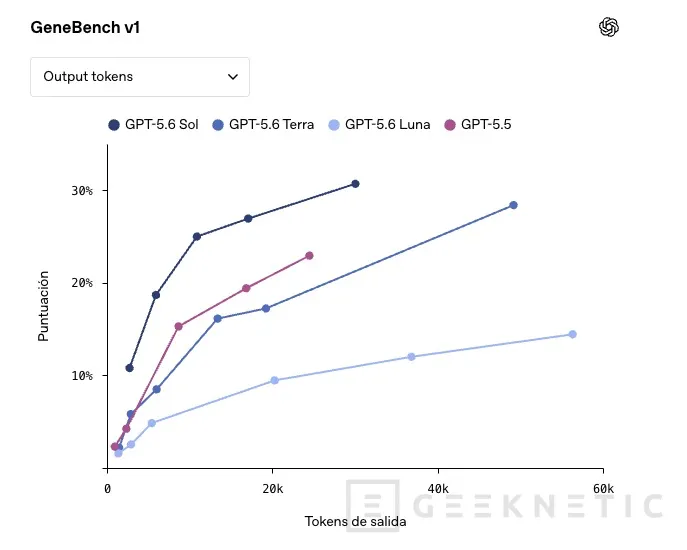
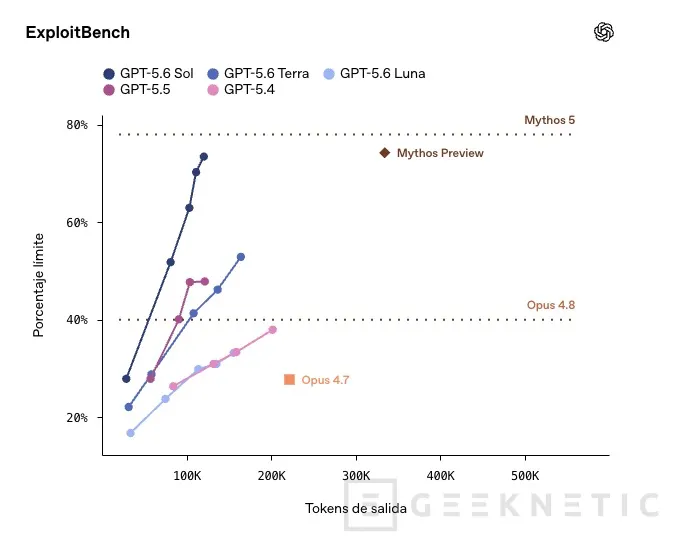
OpenAI also maintains that Sol also improves in biology, where GeneBench v1 attributes better results than GPT-5.5 with fewer output tokens. In cybersecurity, the company speaks of clear advances in vulnerability research and exploitation, with competitive performance against strong market models. In ExploitBench, Sol is compared to proposals like Mythos Preview using about a third of the output tokens, while in ExploitGym both Sol and Terra and Luna show improvements as reasoning increases.
Now, OpenAI insists that GPT-5.6 Sol does not exceed its Cyber Critical threshold within the Preparedness Framework. The company explains that the model has been able to identify errors and exploitation primitives in browsers such as Chromium and Firefox, but did not autonomously produce a complete functional exploit under the conditions evaluated. Even so, this same leap in capabilities is what justifies the launch being done in a staggered manner and with more controls than in previous iterations.
More layers of security and a still very guarded launch
OpenAI presents GPT-5.6 with its most robust security stack yet. The company talks about measures trained on the model itself, real-time classifiers during generation, account-level review, differentiated access, monitoring and application of standards. In higher risk cases, a generation can be paused so that a larger reasoning model reviews the conversation and determines if the response should be blocked before reaching the user.
The company has also placed a lot of emphasis on automated network teaming. According to OpenAI, it has dedicated the equivalent of over 700,000 hours of A100 GPU to look for universal jailbreaks and other generalizable attack patterns. Added to this is the work of external human evaluators, with the idea of strengthening defenses against creative evasion attempts that an automated test may not anticipate. The company admits that during this phase there may be legitimate requests blocked or slower responses due to additional checks.
Of course, the political context remains relevant. Altman explained to CNBC that OpenAI worked with Trump Administration officials before the deployment, including Howard Lutnick, Scott Bessent and Sean Cairncross. The goal, according to Altman, was to support safety claims of the model before opening access. OpenAI had already made it clear that it doesn’t want this type of pre-review with the government to become the norm, especially since it gives the impression that this is an unreliable technology to build on top of.
During this new phase, GPT-5.6 will be available through the API, Codex and progressively more OpenAI productswhile Sol is also preparing to hit Cerebras with speeds of up to 750 tokens per second in July for select customers.
