
NVIDIA patents an AI that generates scripts to discover why an application is wasting the GPU
NVIDIA has published a patent application that describes a conversational assistant capable of answer questions about the performance of programs running on a GPU. The system combines language models, profiling reports, and analysis tools so that a developer can explain in natural language why a load is running slower than expected, where the bottleneck is, or what changed between two versions of a kernel.
The documentation corresponds to the US application US20260277953A1. Its content fits closely with the features NVIDIA already provides through Nsight Copilot within Nsight Compute, although the patent does not use that trade name. It also does not announce a new product or guarantee that all variants described will reach public software.
The wizard generates code to view performance reports
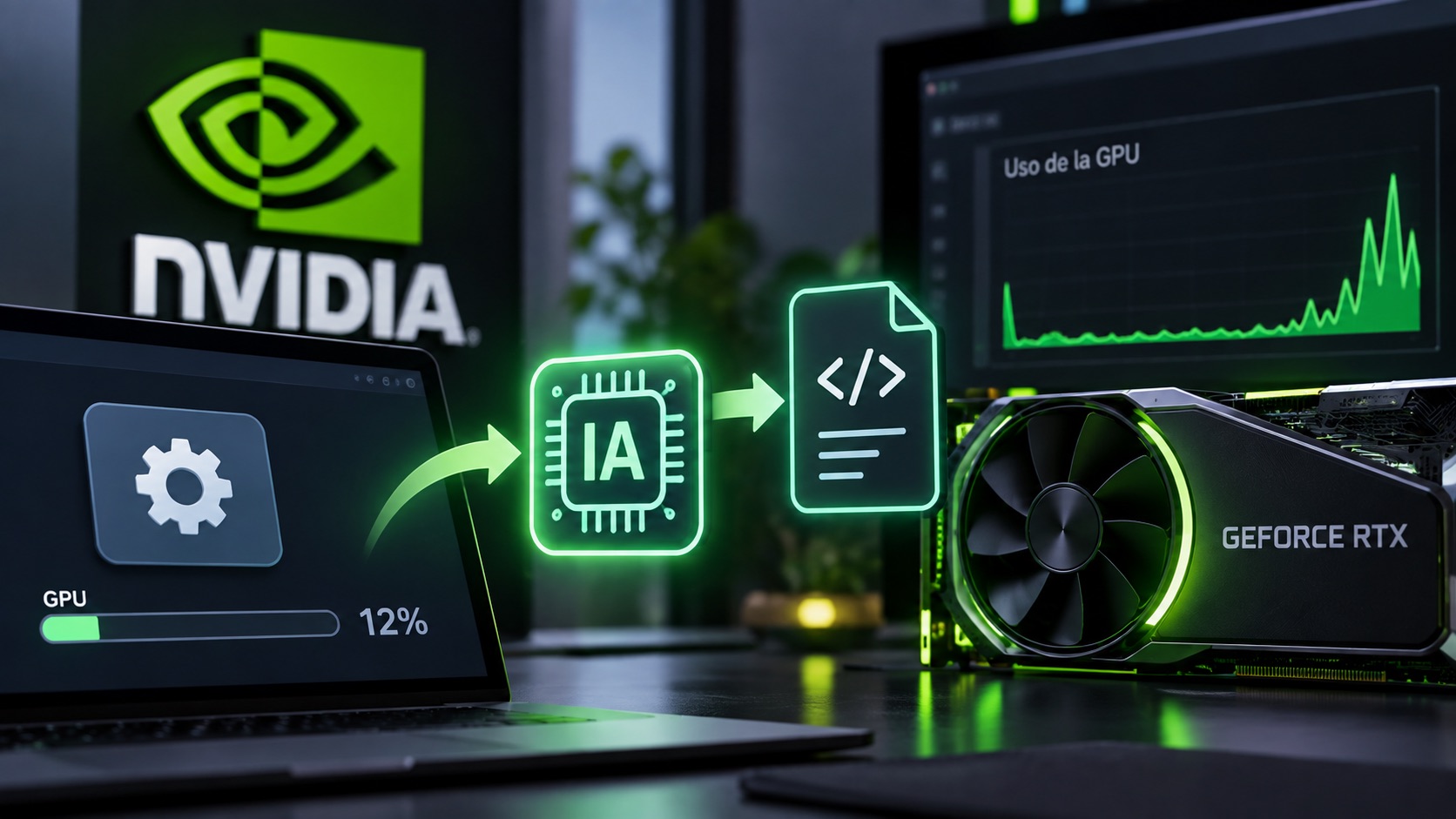
The proposal begins with a written or spoken question and, optionally, an associated profiling result. A router decides whether the query needs a general agent, intended for GPU architecture documentation and concepts, or an agent specialized in report data. That second agent can create and run scripts to extract only the necessary metrics before composing a response.
The application includes a Python-based reporting interface, an occupancy calculator, mathematical tools, and a profiler. The model generates code, executes it, and uses the result to inform the analysis. Examples include questions about GPU utilization, hot spots, occupancy limiters, per-instruction metrics, and speed differences between two kernels.
The profiler could also open automatically to collect missing data. The agent would then locate problem areas and suggest available library functions or programming features to improve the kernel.
RAG, technical documentation and various specialized agents
To reduce invented responses, the design uses recovery augmented generation, known as RAG. The wizard can view profiler documentation, programming guides, API references, and GPU architecture data. It also includes searches on web resources when a query requires external context.
The flow can distribute the work between several agents. One answers general questions, another interprets the reports and a supervisor selects which one should intervene. The system could adapt the explanation to the user level, defining the metrics for a beginner or responding more directly to a specialist.
The responses could be compared with reference results obtained manually using the profiler. The current Nsight Copilot documentation warns that a language model can make mistakes and asks to review each recommendation before modifying the code.
Sensitive information can be analyzed locally
One of the sections describes the local execution of the generated scripts. The processor can read and manipulate the reports without sending those entire files to an external service. This is especially relevant when the profile contains information about unreleased code or internal company uploads.
Nsight Copilot requires saving the report to disk to attach as context and requires source code to be imported during profiling if questions affect specific lines. NVIDIA clarifies that certain metrics and summaries are sent to the model, although the complete file is not loaded.
The patent opens the door to local, remote or hybrid configurations. It mentions saved histories, several parallel sessions, references to the documents used and the possibility of preserving the created scripts. They are elements that appear, with different degrees of implementation, in the documented Nsight Copilot interface.
Fits with Nsight Compute and differs from G-Assist
NVIDIA distributes Nsight Compute as a profiler for CUDA and OptiX. Collect hardware metrics, relate memory issues to lines of code, and compare results between runs or architectures. Nsight Copilot adds a chat that accepts reports as context and explains metrics and possible optimizations.
The patent system shares this purpose and several interface details, such as progressively transmitted responses, the button to repeat a query, positive or negative ratings, and history saving. The application provides the technical description of the work that occurs behind the conversationincluding the generation of scripts and the distribution of questions between agents.
Its purpose is different from NVIDIA’s Project G-Assist application for GeForce users. G-Assist reports on FPS, consumption, frequencies and utilization, in addition to changing graphic settings or device profiles. The wizard described in the patent works with code, kernels and profiling reports aimed at developers.
The application is still pending and does not in itself grant definitive rights or confirm future roles. NVIDIA has not announced another product, price or calendar from it either. The document details how a conversation can be converted into executable queries on real performance data to produce specific recommendations for a particular load and GPU.
