
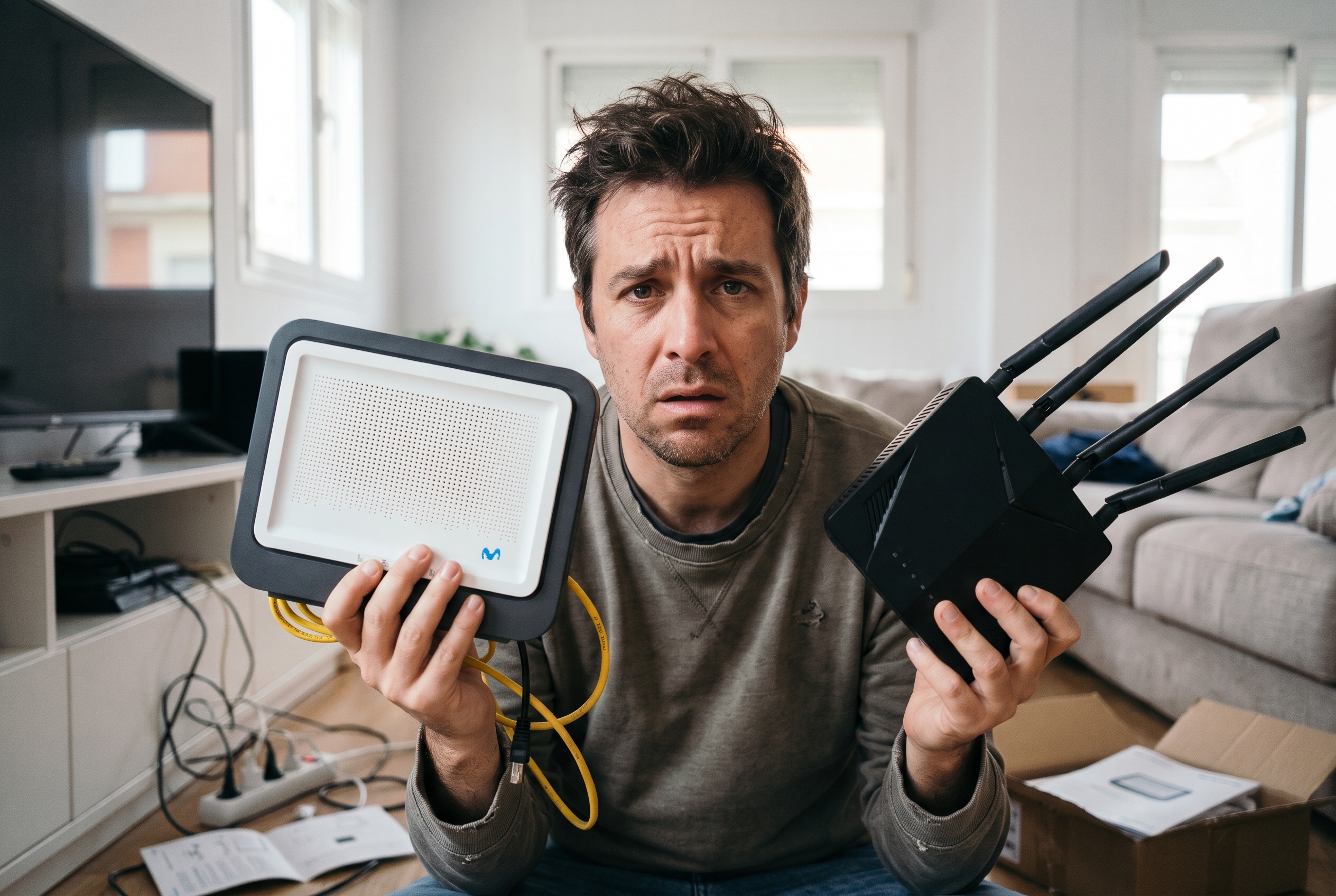
In Spain you are not free to choose your router: why do you need your operator’s to use yours?
It all starts with Movistar
On June 25, 2026, some Movistar customers opened their email and found a message that began like this: “Hello, this is important to you.” They were not randomly selected customers.
In reality, they were those who had unplugged the operator’s router to connect their own directly to the fiber. And the warning was clear and clear. Simply put, as of September 15, that equipment would stop working. The alternative did not have much mystery either. It was enough to go back to the Movistar router or, at most, connect yours behind it. That is to say, two devices turned on to do the work of one. Does it make sense?
The measure affects any router with an integrated ONT that does not come from the operator, such as the FRITZ!Box Fiber or the TP-Link XX230v and also the ONTs in SFP format that are tapped into routers with that port. For our part, we took advantage of IFA 2026 to ask manufacturers about it, including FRITZ! itself.
Next, we suggest you dig a little deeper into this matter, find out the exact chronology and try to elucidate the reasons behind all this.
What is ONT and why can’t you use whatever you want?
The fiber that reaches your home carries light, but your devices speak in electrical signals. The ONTthat is to say, Optical Network Terminalis, so to speak, the translator between both channels. In addition, it identifies itself to the central office so that the operator allows it to enter the network.
For years it was a separate little white box. In fact, there are still some operators that work like this. However, at Movistar that changed in 2015, when the company began to install the HGUa device that combines ONT and router in a single device.
Stay with this point, because it is in that change where we find the main problem. If the ONT is from the operator and goes inside your router, You can’t do without one without giving up the other..
The two ways to use your own router today
Today you have two paths, and they are separated by the line between what the law allows and what Movistar has decided to block:
- Behind the operator’s router. You put the HGU in single-user or bridge mode (bridge) so that it only acts as an ONT and you connect your router to it. It is what the law protects.
- Replacing it completely. You connect a router with an integrated ONT to the fiber, such as the FRITZ!Box Fiber, or your own ONT. This is what Movistar has begun to block.
“The ONT you have connected will stop working”
To put ourselves in the situation, it is important to know what Movistar said at the time. Therefore, here we leave you the full message that those affected began to receive by email, which BandaAncha provided at the time and which later also arrived by SMS:
Hello, this is important to you:
As of 09/15/26, the ONT that you have connected to the fiber input of your home will stop working.
So that you can continue enjoying your Movistar Fiber normally, you need to disconnect the ONT and connect the Movistar Router with integrated ONT, which we already provided at the time of installation. If you need help, call us at 1002 and we will give you a solution.
If you don’t have the Movistar Router, call us at 1004 or come to your Movistar store. We will inform you of the characteristics of the available model and its price.
Thank you for your collaboration and trust,
Movistar Team
As you may have noticed, there is not a single line that explains why, although they do talk about paying in the event that you no longer have your router. What some brands have told us about this is that they do not see any argument, neither technical, nor commercial, nor of any other type.
What has happened since September 15?
In short, the appointed day arrived and nothing much happened. But, although it seems like it, it was not a bluff either. As of September 18, media such as BandaAncha or RedesZone began to collect cases of offline clients for using non-certified ONTs. Shortly after, O2, which operates on the same network, joined the blockade.
Movistar talks about a “gradual withdrawal of non-certified ONTs” to “guarantee an optimal experience.” What is clear is that the operator has the upper hand. Each ONT registers with the OLT, the exchange equipment your fiber comes from, and if it doesn’t agree with what it sees, it can reject it.
Manufacturers see no technical reasons for making this decision
One of the keys to this whole matter is that many teams, such as those already mentioned from FRITZ! or TP-Link, Yes, they work on the fiber of many other countries and at no time have they caused any problems. They are developed following standards that all manufacturers must respect.
For example, Ralf Muntean, from FRITZ!, the biggest loser is the user. “Of course it affects. First of all, it affects the consumer,” he mentions. According to his point of view, being able to replace the operator’s router, instead of placing a better one behind it, “was an advance for the end customer.” In Spain, that progress has vanished.
What remains then? If there is no technical reason, it is worth asking what other interest lies behind it. Muntean points in that direction, although he limits himself to asking that “if there really is a technical reason behind it, then at least they contact the manufacturers.” This way, they can take appropriate measures.
An argument in favor of Movistar
On the other hand, it must be made clear that one of the main arguments in favor of Movistar is not an invention. We mean that in GPON networks the same fiber is distributed among several homes, so you and your neighbors share the same OLT port. Technically, a faulty piece of equipment could affect everyone.
The thing is that really There is no public avenue for a manufacturer to approve their router. The only known procedure is between operators. For example, in 2016, the CNMC forced Telefónica to approve an Orange ONT, and Telefónica itself estimated a year of process in the best of cases. Currently, manufacturers have no door to knock on.
Why is this legal in Spain and not in Germany?
He Regulation (EU) 2015/2120 recognizes your right to use the terminal equipment of your choice. Just like you choose your mobile, you should be able to choose your router. The nuance is where the operator’s network ends and where your home begins.
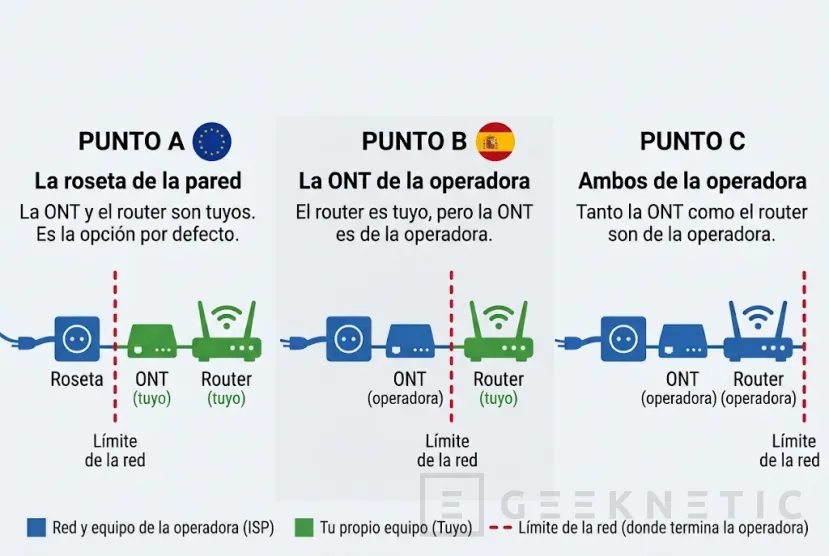
The BEREC guidelines contemplate three options:
- Point A. The wall rosette. The ONT and the router are yours. It is the default option.
- Point B. The router is yours, but the ONT belongs to the operator.
- Point C. Both are from the operator.
Each country decides. Germany, Finland, the Netherlands and Belgium choose the rosette, also in the fiber. There you buy a FRITZ!Box Fiber, connect it to the wall and forget about it.
In Spain that is not like that. Although it is usually attributed to the CNMC, the criterion is set by the Ministry for Digital Transformation, through the Secretary of State for Telecommunications (SETELECO).
Its 2025 net neutrality report, at the bottom of page 14, places the termination point “at the output of the modem (ONT equipment in the case of FTTH networks…).” That is, the point B.
With that criterion, the operator can impose its router as long as it allows you to connect yours behind it. And since the ONT goes inside the router, This is equivalent to having to keep the operator’s device always on.
How to use your own router with each operator
To put your router behind the operator’s, something they are required to allow, you need the VLAN and, if the operator uses PPPoE, a username and password. Currently, the thing is like this:
| Operator | Situation |
| Digi | Provide PPPoE username and password if you ask customer service. |
| Movistar / O2 | PPPoE credentials are generic and public (adslppp@telefonicanetpa / adslppp, VLAN 6). |
| Vodafone / Lowi | You have to ask for credentials. |
| Orange / Jazztel / Simyo | They use IPoE, so no credentials are needed. |
| Yoigo / MásMóvil / Pepephone | IPoE on VLAN 20, without credentials. |
Regarding Movistar, a note. Even if you have all the data, replacing your ONT is no longer viable if your equipment is not approved, because the central office rejects it. And since many operators rent their indirect fiber network (NEBA), the blockage can also reach their clients.
A market increasingly saturated with Chinese routers
All this happens while Europe discusses which routers are trustworthy. The Commission wants to make the recall of equipment from high-risk suppliers, namely Huawei and ZTE, mandatory.
However, not all routers are Chinese, although the majority are Asian. For example, Movistar uses routers from Taiwanese companies Askey and MitraStar. Those from Orange and Vodafone are from ZTE. But the paradox is that the user is forced to maintain the operator’s router just as Europe debates whether some of those routers should be in our homes. Perhaps it would make more sense to bet on European brands such as Devolo or FRITZ! itself, among others.
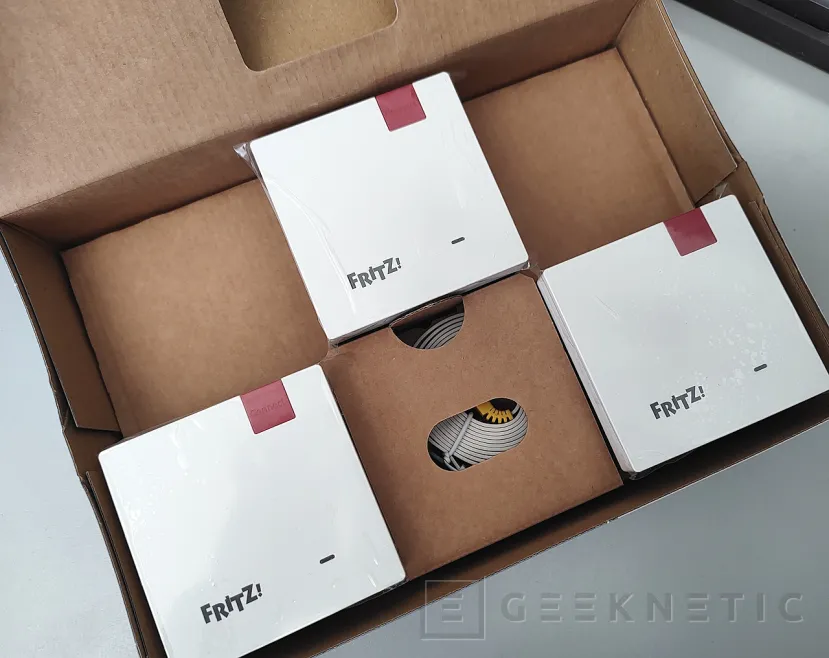
It must be remembered that Devolo, Lancom, TDT and FRITZ! They are founders of SAFENet, an alliance of European manufacturers that asks Brussels to treat the router as critical technology. This would have notable advantages. To begin with, it would help Europe gain digital sovereignty. It would also give more freedom to users. In addition, it would help community businesses commercially. After all, the business of European manufacturers depends largely on users being able to connect their equipment to the wall.
The solution is a transparent approval process
So, after everything analyzed, what would be the solution? The simplest thing would be to place the border between the user and the operator in the rosette. As we have seen, in Spain it would be enough to apply what other states already apply. There is no more.
Additionally, we could expect Europe to take action on the matter. For example, the Digital Networks Actwhich the Commission proposed in January 2026 and is still in the pipeline, could harmonize the criterion across the EU.
Obviously, the issue of fiber being shared is a real technical argument. Nobody in their right mind I would ask that any device be connected without control. Apparently, that is not the position of either the manufacturers or the users. The response to this risk is a transparent approval, with deadlines and open to manufacturers, not a list that no one can consult and that is reduced to the equipment distributed by the operator itself. While that does not exist, in Spain the border between your home and the fiber network is not marked by the wall, but by your operator’s router.
