
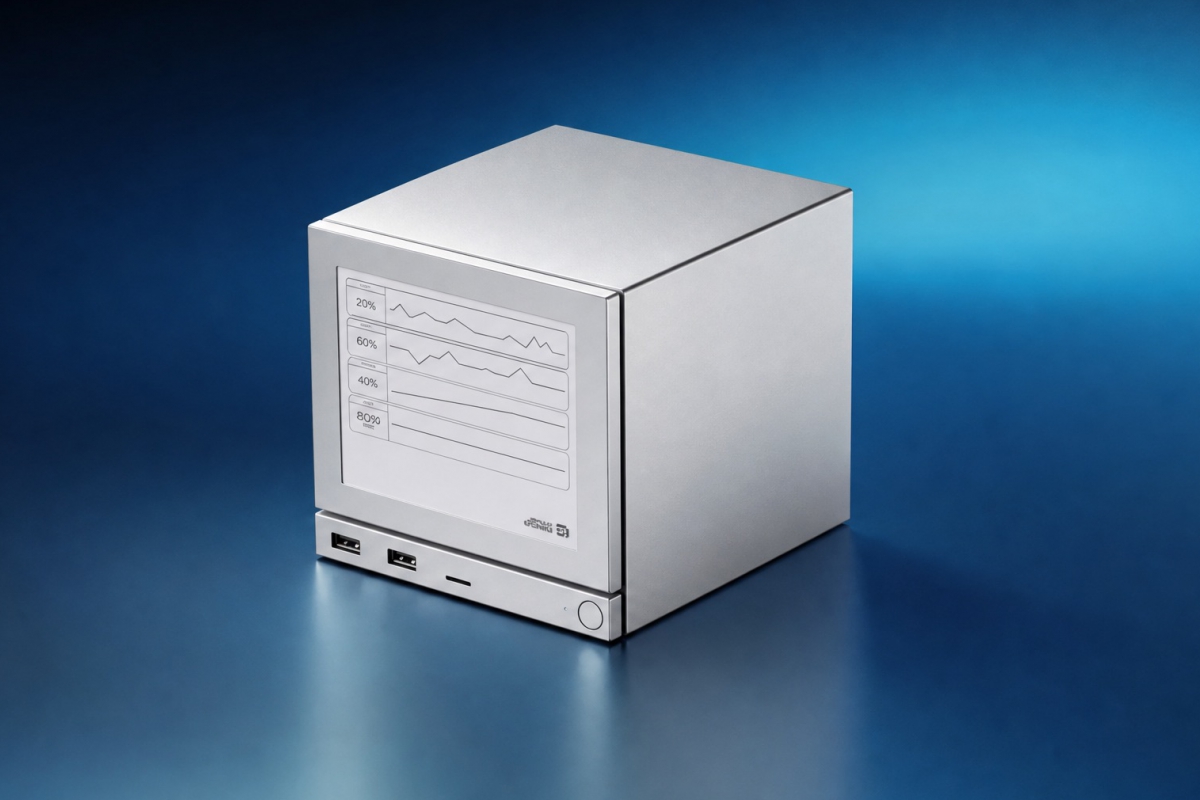
Inkterface, the project that is already in GitLab to fill the Steam Machine with data with an E Ink screen
When Valve showed the Steam Machine for the first time, one of the things that caught the most attention was not the internal power or the new controller, but a front cover with a black and white screen capable of displaying graphs, temperatures or static images. That remained as a demonstration: beautiful, curious, and without a date or declared intention of becoming a product that could be purchased..
Almost a year later, Valve has taken the next step, although not the one many expected. The company has uploaded its SteamOS repository to GitLab the complete files of the project known as Inkterface: assembly instructions, list of components, STEP and STL files for 3D printing and everything necessary so that anyone with a printer and some skill with electronics can build their own lid with an E Ink screen. What there is not, at the moment, is a link to buy it already assembled.
What exactly is Inkterface?
The standard Steam Machine has a magnetic front cover that can be removed without tools, designed precisely so that Valve and third parties can design their own versions. The Inkterface is the materialization of that idea taken to a much more elaborate level than the prototype shown at the time.
According to the published documentation, the project is built around a Adafruit 5.83-inch E Ink panelthe same electronic ink technology used by digital book readers, capable of maintaining an image on the screen without consuming almost any energy. Connectivity is managed by a plate based on a ESP32-S3 Feather with 2 MB PSRAMwhich is responsible for receiving the information via Bluetooth and sending it to the panel.
The list of required hardware also includes one LP803860 battery, four K&J Magnetics model S8443-OUT neodymium magnets, and thirteen M2.6 5 mm screws.. To this we must add the 3D printed parts: the front cover itself, a retainer for the battery, the left and right intermediate plates, and the base plate on which the entire assembly rests. Valve has included the corresponding CAD files within the repository, along with the rest of the links needed to complete the purchase of components.
A montage that is not for everyone
The process, as documented, is not plug and play. The user has to print plastic parts, assemble the electronics following the wiring diagram and flash the firmware on the ESP32 before the display works. It is a level of complexity closer to a maker project than to an accessory that is installed out of a box.
That fits with what Valve itself dropped when it showed off the prototype last year.: At no time was the lid with screen presented as a direct sales product, but rather as a demonstration that the interchangeable lid system allowed this type of advanced customization. Publishing the complete files now confirms that intention, but also makes it clear that, for now, building an Inkterface will require time, patience, and a 3D printer at hand.
What can be done with the screen once mounted
Once connected, the Inkterface’s E Ink screen can be used to display real-time hardware statisticssuch as temperatures or resource usage, as well as custom images or any other static content that the user wants to leave fixed on the cover. As it is electronic ink, the image remains visible without having to be constantly refreshed, which greatly reduces consumption compared to a conventional LCD screen.
This makes the front of the Steam Machine the most visible customization area on the machine, above the standard plastic lids or wood-finished variants that Valve offers as standard.
While Valve limits itself to offering the plans, at least one company has already gotten to work to bring the idea to the market. JSAUXknown for its accessories for portable and desktop consoles, has shown its own version of the panel designed to be mounted directly on the Steam Machine, although no confirmed release date or price for now.
It is worth keeping in mind that this is an independent development and not an official Valve cover. There is no public record that JSAUX has received authorization from the company to market the design, something that is usually common in this type of third-party accessories designed for hardware from another brand.
Why Valve prefers the DIY route
Valve’s decision to only publish the design files, instead of directly releasing an accessory for sale, fits with the general philosophy that the company has maintained with SteamOS and with much of its hardware: leaving the door open to the community so that it can develop solutions that Valve has no intention of manufacturing on a large scale.
For the average user, this means that Inkterface will remain, for now, a project reserved for those who have access to a 3D printer and minimal knowledge of electronics. For the rest, the most realistic option is to wait for companies like JSAUX to finish polishing their own commercial versions and put them on sale with guarantees, something that still has no confirmed date.
