
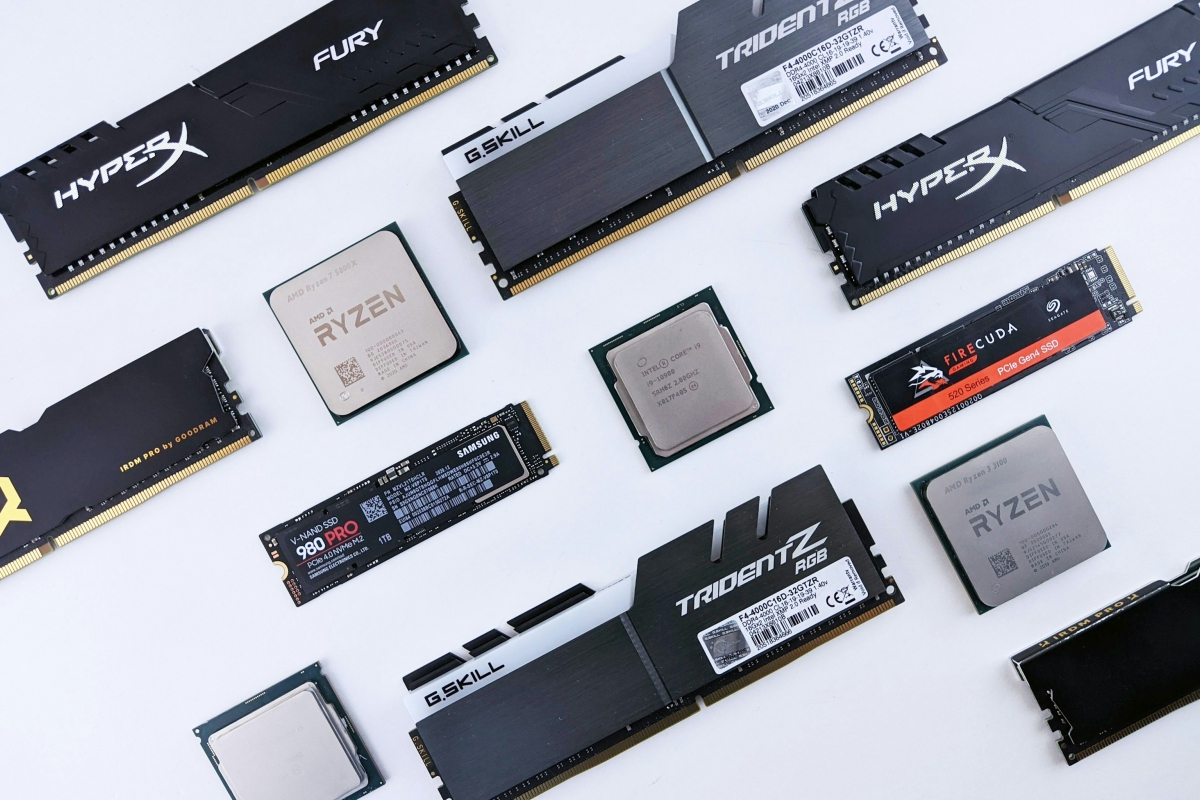
Memory prices rise again in July and DDR5 already costs on average 4.5 times more than a year ago
Memory-related hardware prices have regained momentum in July 2026 after several months of relative calm in some categories. The new index of 3D Centerer made from the best prices available in German retail, shows that desktop DDR5 rose 7.1% in just one month.
The study uses historical data from Geizhals and compares products defined by their technical characteristics, without being limited to specific brands. The usual starting point is July 2025, although for external drives and graphics cards September of that year is taken as it has marked its recent minimums. This methodology allows us to observe how the real minimum price of each category has evolved in the German market during the current memory crisis.
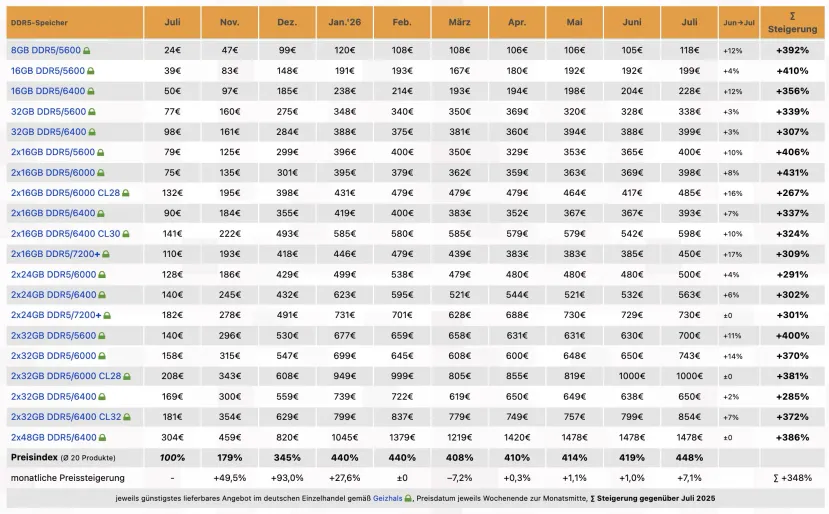
DDR5 is the most striking case. The average index for 20 products has gone from 100% in July 2025 to 448% in July 2026. In other words, DDR5 memory now costs on average about 4.5 times more that twelve months ago. A 32 GB DDR5-6000 kit has gone from 75 to 398 euros, while a 64 GB DDR5-6000 set has risen from 158 to 743 euros.
The rise is not concentrated in a single model. Of the 20 products analyzed, only two maintained the June price and all the others increased. Some kits advanced 10% to 17% in a month. The report interprets this movement as a new bullish phase and not as a simple punctual oscillationpossibly because stocks purchased at previous prices are running out.
Laptop memory also rebounds and hard drives accelerate
SODIMM modules for laptops followed a very similar evolution. Your index increased 7.6% between June and July and it already stands at 375% compared to last summer. The DDR5 references are the most affected: the 8 and 16 GB DDR5-4800 modules already cost more than five times what they cost in July 2025.
Desktop DDR3 and DDR4 remained practically stable, with an average increase of 0.7%. However, that calm comes after the index has tripled since the previous summer. DDR4 costs on average around 3.2 times more, although its lower starting price makes the increase less visible. Additionally, upgrading a DDR4 device is still cheaper than jumping to a DDR5 platform, which keeps demand high.
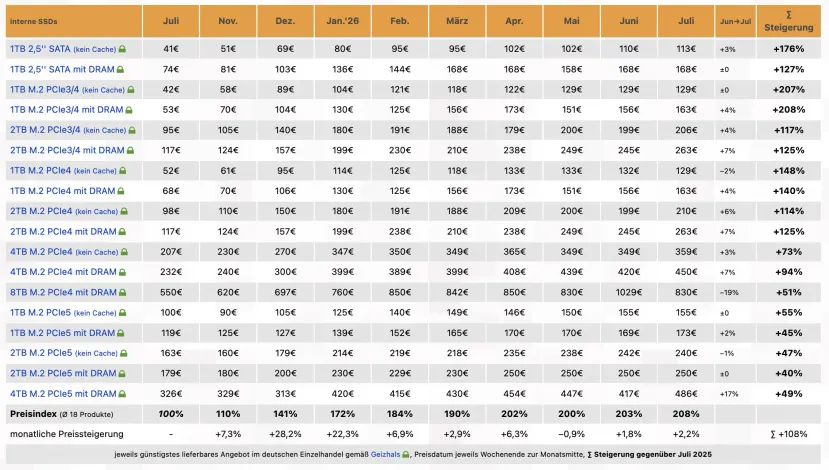
Internal SSD drives advanced more moderately. He monthly increase was 2.2% and the average index reached 208%, so its price has doubled in one year. Most units remained stable or rose slightly, although there were exceptions. A 4TB PCIe 4.0 SSD with DRAM became 17% more expensive in July, while PCIe 5.0 drives continue to show much more modest increases.
As for traditional hard drives, these present a more stable evolution. Internal units rose 6.5% in July and already cost on average 2.25 times more than a year ago. A 14 TB HDD went from 225 to 559 euros, while an 18 TB one reached 627 euros. The growth of data centers would be increasing the demand for mass storage at a lower cost per terabyte.
On external drives, the index rose another 11.2% after June’s 18% jump. The average is now 76% above September 2025, although some high-capacity models have shot up much higher. An 18 TB external drive went from 288 to 938 euros, with a cumulative increase of 226%.
Graphics cards contain the impact, but they are not left out either
Something interesting is that graphics cards are the category least affected by this crisis. Its average index has risen 16% since September 2025 and advanced 1.6% during July. The impact is minor because memory represents only a portion of the total cost of a GPU and because weak demand is leaving inventory in stores. Even so, several models again show small consecutive increases.
The GeForce RTX 5090 is the most obvious exception, with a minimum price that has gone from 2,319 to 3,973 euros, 71% more. In lower ranges, some cards even cost less than in September, such as the RTX 5060 or the RTX 5060 Ti 8 GB. This reflects a very unequal market depending on the model, availability and stock volume.
Although some forecasts point to improvements, especially for NAND during the second half of 2027, July retail data shows that relief has not yet arrived. The main fear is that many stores will continue to sell inventory acquired before the latest increases in industrial prices. When those stocks run out, the new costs could be passed on more strongly to the end consumer.
