
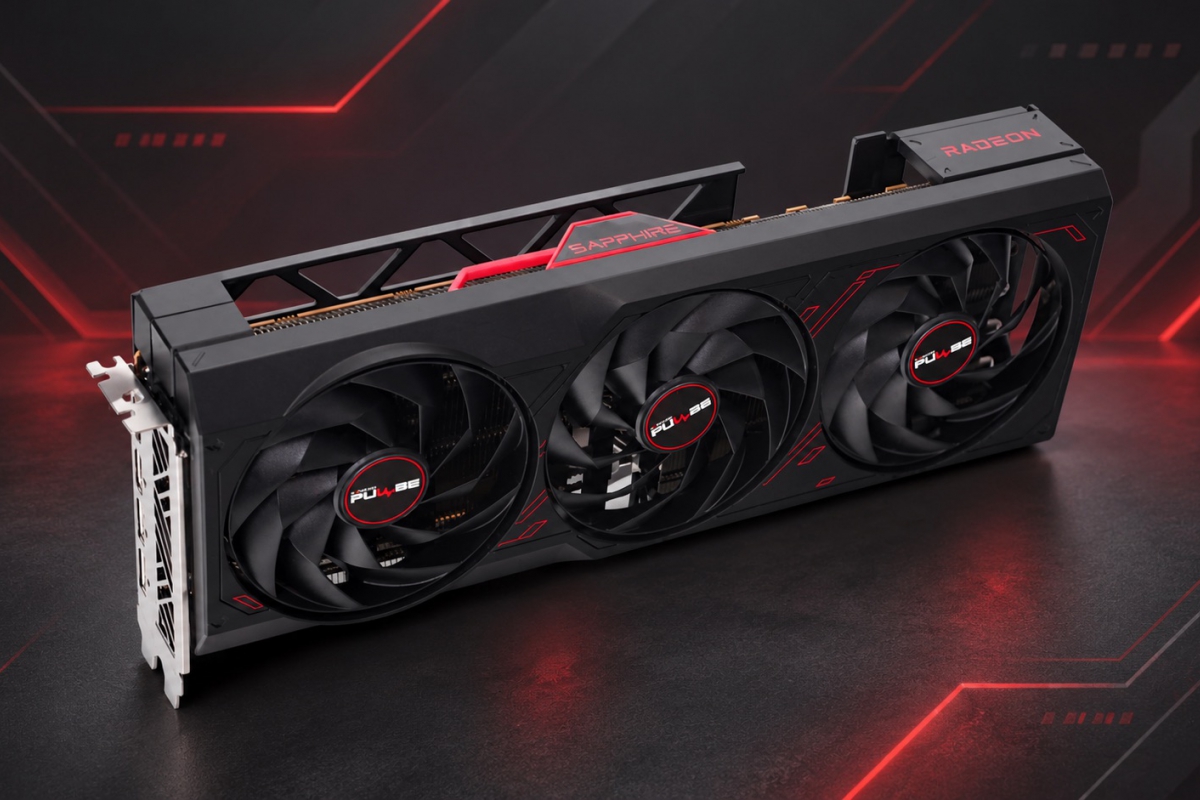
Sapphire publishes a security update for the Radeon RX 7000
Sapphire has published tools firmware update for eight models of its Radeon RX 7000. The company explains that the change responds to a security improvement identified together with AMD. The files are already listed on its official support page, separated by model, and are accompanied by an installation guide.
The models included are RX 7600, RX 7600 XT, RX 7650 GRE, RX 7700 XT, RX 7800. The list covers the entry-level RDNA 3 range up to the top Sapphire cards, but does not authorize the use of those downloads on Radeon made by other brands. Each assembler can distribute specific firmware for their own references.
Sapphire confirms the update, but does not describe the bug
In the support section, the manufacturer indicates that the new firmware addresses a security improvement detected in collaboration with AMD. It does not identify a specific vulnerability there, nor does it publish a CVE code, a severity score, or an explanation of the fixed mechanism. Nor does it claim that the problem has been exploited. These data cannot be deduced from the simple existence of an update.
The description matters because what security is can encompass problems of a very different nature. Without a detailed technical advisory, it would be incorrect to attribute a risk of remote access, data loss, or card tampering to the firmware. What is confirmed is the availability of the tool and the recommendation to install it on the affected models.
Sapphire also does not present this download as a new version of the graphics driver. The firmware resides on the card and the change is applied to that component. AMD Software: Adrenalin Edition is the package that is installed in the operating system to manage the GPU. It is important to distinguish both processes: updating Adrenalin is not necessarily equivalent to changing the firmware of the graphics card.
The official website offers a different package for each model name. In the same family there are close names, such as RX 7600 and RX 7600 XT, or RX 7900 XT and RX 7900 XTX. Selecting the correct download requires checking the exact card ID before opening the installer. The published list also does not allow us to conclude that all units of each model start from the same firmware version: the tool checks if an applicable update exists.
Two-pass installation for Radeon RX/PRO 7000
Sapphire’s guide asks have the AMD Adrenalin Edition driver previously installed and reserve between 15 and 20 minutes for the process. The updater runs with administrator permissions, detects the AMD GPUs present, and displays the update when appropriate. After applying it, it asks to restart the computer.
The particularity of the Radeon RX/PRO 7000 is that the tool works in two passes: one in normal mode and one in safe mode. This behavior is part of the described procedure and avoids interpreting the second execution as an error or as a different update. To follow it correctly, the reference should be the guide that Sapphire offers along with the downloads, not a general procedure for modifying the BIOS of a GPU.
When finished, the firmware version can be checked in AMD Adrenalin. This check is useful because a reboot, by itself, does not indicate which version is installed. If the tool reports that an update is not available, it should also not be forced with a file from another model.
As with any firmware change, Interrupting the operation may complicate card recovery. The official information consulted does not promise that a failure during the process is impossible. That is why it is advisable to complete the two planned passes and retain access to the installation guide until the final version is confirmed. There is also no reason to replace the Sapphire updater with third-party programs when the manufacturer provides a specific tool.
Scope of the list and outstanding questions
The news affects Radeon RX 7000 series Sapphire cardsnot to the Radeon RX 9000 simply because they share a manufacturer. In the official support consulted, no equivalent downloads appear for those RX 9000 within this notice. Owners of RDNA 3 cards from other builders will have to go to the corresponding support pages and check if they publish their own notice.
The manufacturer has not detailed whether it will publish a subsequent technical bulletin with the identification of the vulnerability or its exploitation conditions. Until then, attributing the update to a specific attack or establishing a severity would be speculative.
All eight tools are now available on Sapphire’s official firmware and security page. The pending data to more accurately assess the scope of the problem is the technical description of what they correct.
