
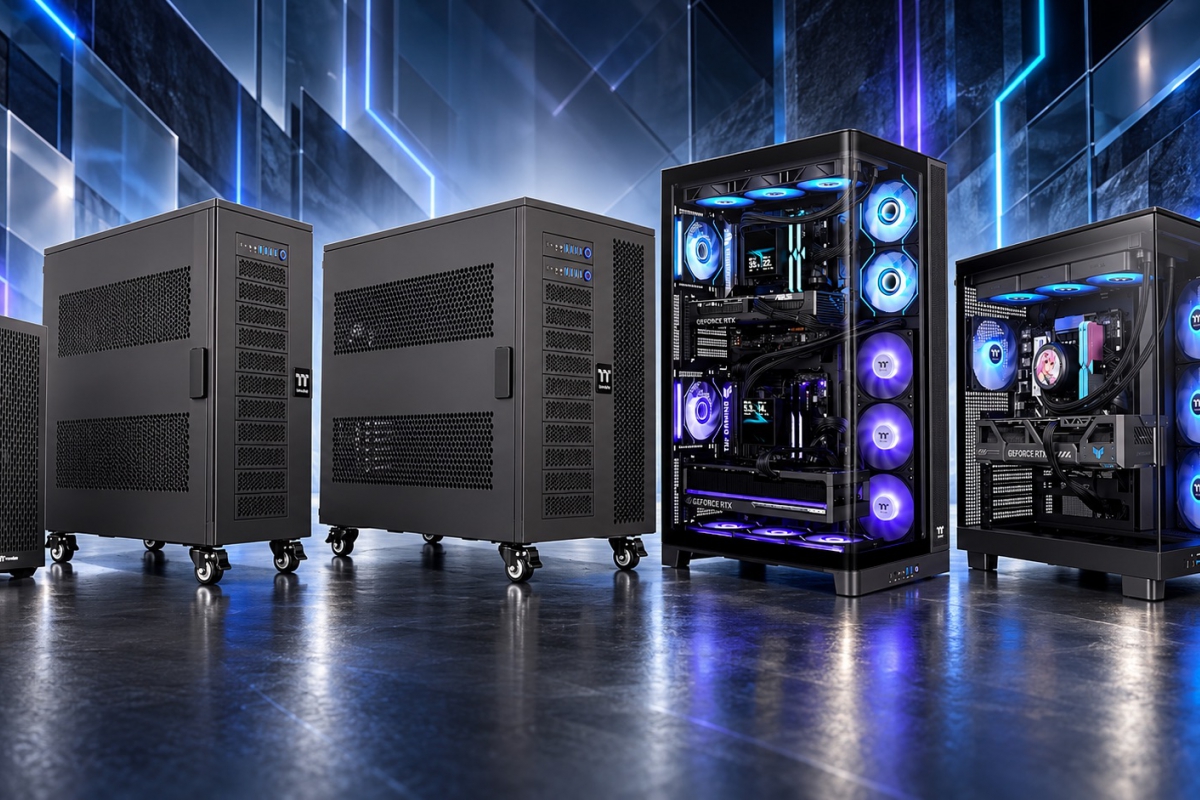
Thermaltake presents five PCs for AI and gaming: up to two systems and six GPUs in one tower
Thermaltake has introduced five complete computers ranging from local AI workstations to gaming and live streaming equipment. Three models, A1500 Dual, A750 and A550, are aimed at professional development and use. The other two, CAPO X Dual and View 380 XL, transfer part of that offer to gaming configurations.
The difference between them goes beyond choosing a more powerful graphics card. Two bring together independent computers within the same chassis; one concentrates four professional GPUs and the rest use a single platform. Thermaltake has detailed configurations and intended uses, although it has not provided a common price or an arrival date in Spain for the five.
A1500 Dual: two separate stations and six graphics cards
The A1500 Dual is the most ambitious model in the family. It houses two complete systems in a single tower, with independent motherboards, supplies, cooling and storage. One is dedicated to AI applications and the other to multimedia creation. This separation allows one of the computers to be updated or restarted without necessarily interrupting the work of the other.
The AI system mounts four NVIDIA RTX PRO 6000 Blackwell Server Editions with 96 GB of memory each. Are 384 GB of VRAM installed between the four cardsa figure that should not be confused with a single block of memory automatically available to any application. How much power a model can leverage depends on how the software distributes its data and calculations across GPUs.
Thermaltake proposes this part of the equipment for inference and adjustment of models in its own facilities. The company mentions models in the class of 70 billion parametersbut its execution will depend on the precision used, the context size, the GPU configuration and the other memory needs of the program. It has not published independent performance tests with specific loads.
The second computer incorporates two GeForce RTX 5090 of 32 GB each. It is aimed at 3D rendering, video editing and application testing. Each system has a 4TB NVMe PCIe 4.0 SSD. Sharing the chassis saves physical space, although it does not convert both computers into a single machine or directly add the memory of its six cards.
A750: four Radeons for a single professional system
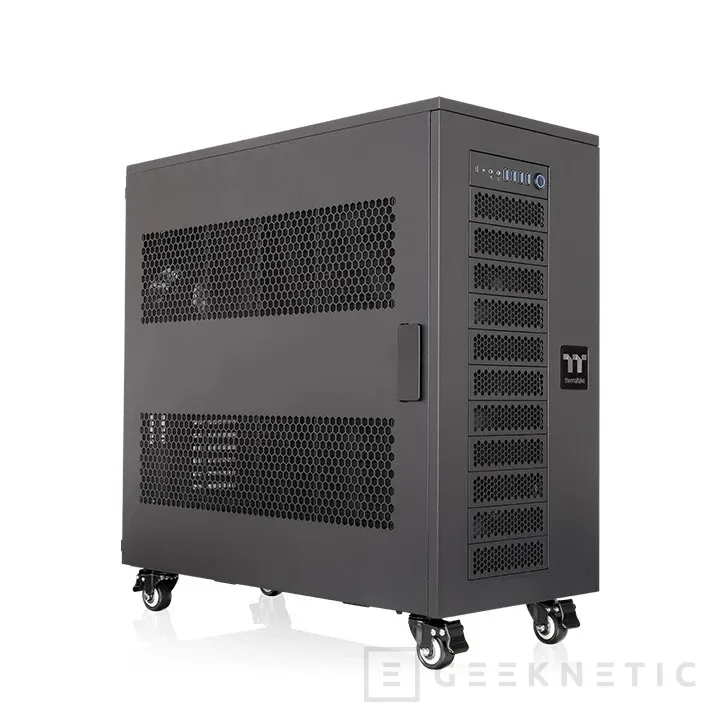
The A750 uses a different architecture. Here is a single workstation with four AMD Radeon AI PRO R9700 32 GB and 128 GB VRAM installed in total. The main memory is 128 GB DDR5 ECC, and the advertised storage consists of a 4 TB NVMe PCIe 4.0 drive.
ECC memory can detect and correct certain data errors, a feature relevant for long jobs. The brand offers processor configurations Intel Xeon or AMD Ryzen Threadripper PROwithout specifying in the announcement a single reference for all the teams. Therefore, the performance of the A750 will vary depending on the version finally supplied.
The manufacturer places it in AI development, multi-GPU inference, and research tasks. It also mentions models with between 30,000 and 70,000 million parameters, an orientation that requires nuances: the viable size depends on the quantization, the distribution between cards and the software environment. The addition of 128 GB of VRAM indicates the installed hardware, but by itself it does not certify that any model of that size will work.
A550: an RTX 5090 for individual development
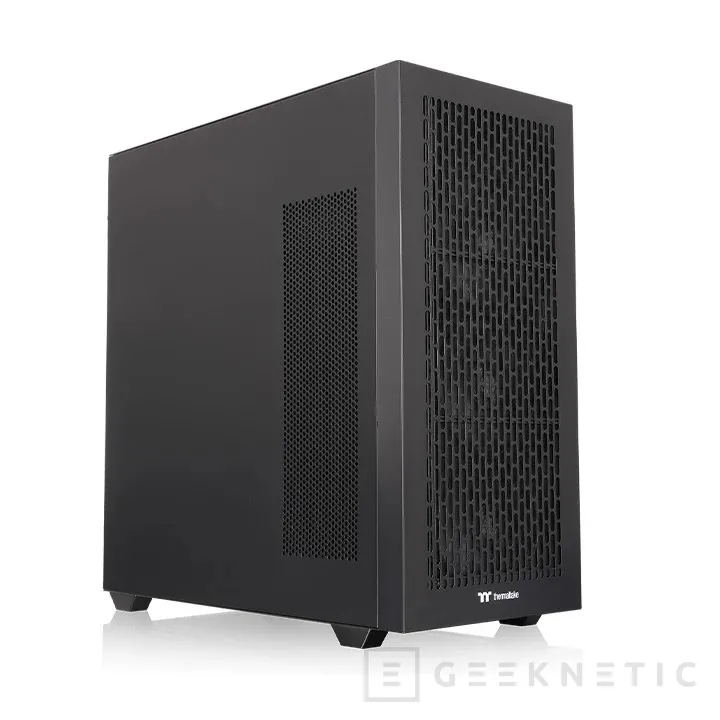
The A550 reduces the number of cards to one GeForce RTX 5090 32GB. He accompanies her with 128 GB of DDR5 memory and a 4 TB NVMe PCIe 4.0 SSD. Thermaltake contemplates different Intel Core or AMD Ryzen processor options, without associating a specific CPU with the entire range.
This setup is aimed at individual developers and studios who want to test models locally and keep authoring tools on the same computer. The manufacturer cites image generation, rendering and video editing among its possible uses. The presence of a single GPU avoids having to distribute a load between cards, but also sets the VRAM available directly on it to 32 GB.
Thermaltake talks about models in the class of 16,000 to 24,000 million parameters. That reference depends on the precision, quantization and resources consumed by each application. System RAM can help in some streams, although it is not equivalent to expanding the RTX 5090’s physical VRAM.
CAPO X Dual separates AI, gaming and streaming
The CAPO X Dual applies the concept of two independent PCs to a gaming computer. One half rides a AMD Ryzen 9 9950X, a GeForce RTX 5090 with 32 GB and 64 GB of DDR5. The other uses a Intel Core Ultra 9 285K, a 12 GB GeForce RTX 5070 and 32 GB of DDR5. Each system has a 2 TB NVMe PCIe 4.0 SSD.
The distribution allows you to dedicate one computer to run AI applications while the other is reserved for playing, editing or broadcasting video. It also supports separating the game from the broadcast. They are two complete platforms, so each task uses its own components and its own operating system. Thermaltake has not published consumption or noise measurements with both running at the same time.
View 380 XL: a conventional gaming PC with RTX 5080
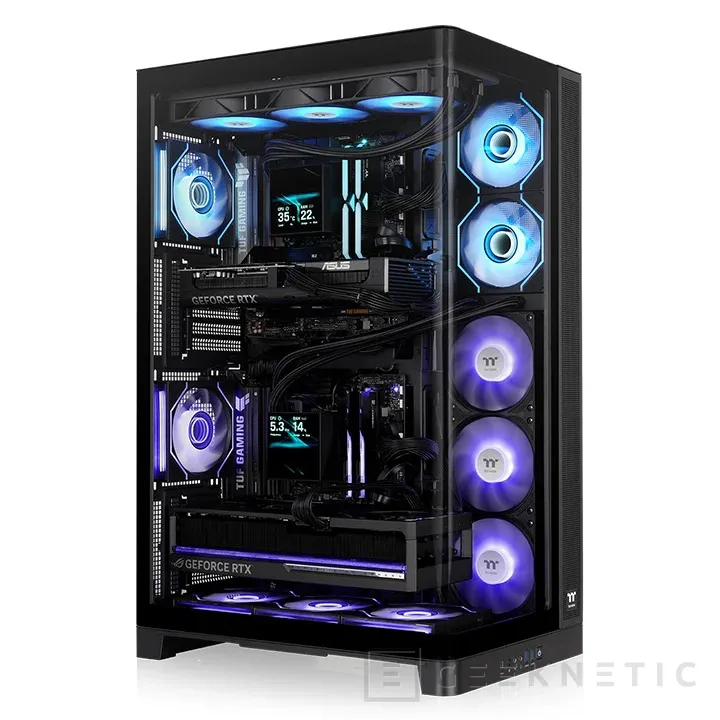
The fifth team dispenses with the design of two systems. The View 380 XL combines a AMD Ryzen 7 9700X with a 16GB GeForce RTX 5080, 32GB DDR5 memory, and a 1TB NVMe PCIe 4.0 SSD. It is the most direct proposal for those looking for a single gaming computer within this presentation.
Its chassis uses glass panels that allow the components to be seen. The name View 380 XL also identifies a case that Thermaltake sells separately, so the specifications of this assembled PC should not be attributed to all configurations that use that chassis. The company also does not provide gaming performance tests nor does it detail measured resolution or graphical settings here.
Thermaltake has described the five assemblies, but has not published in this announcement prices for the entire range, a sales calendar in Spain or closed files for each possible CPU variant. This data will be necessary to compare its cost with that of other workstations and pre-assembled PCs.
