
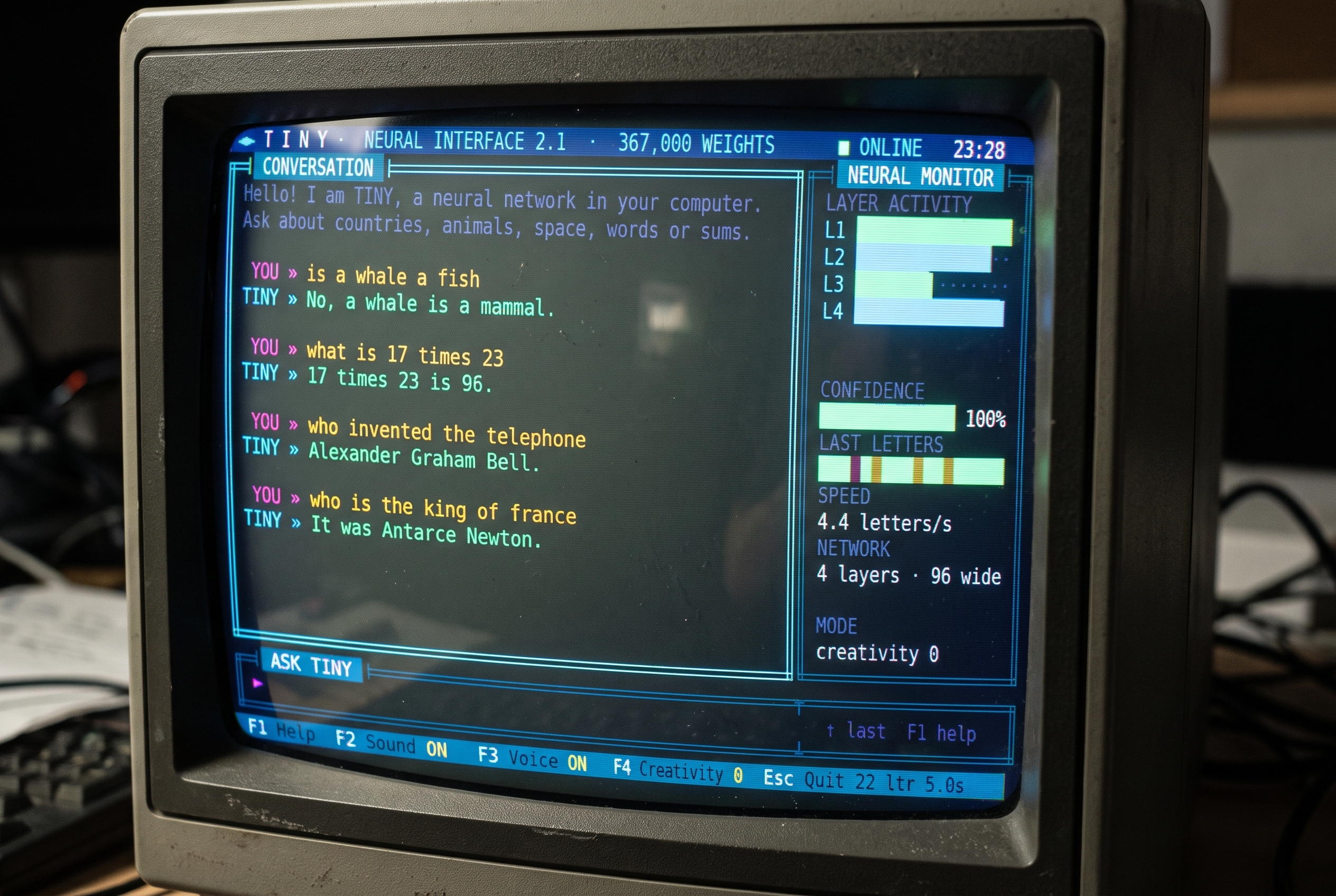
This AI model runs on a Pentium or 486DX with MS-DOS and occupies 380 KB
Transformers are the architecture behind current LLMs. Now, a developer has managed to bring them to a PC with MS-DOS, as if conversational AI as we know it now had been invented in the 90s. What we are talking about is TINY 2.1a small question-and-answer model written in Turbo C 2.0 that runs on a Pentium or 486DX and fits on a floppy disk.
The model has 367,000 parameters spread over 4 layers and read and write letter by letter. Its weights, that is, the values it learns during training, use 8 bits, so the set occupies 380 KB. To function, it needs about 540 KB free of conventional memory, which is what MS-DOS reserves for programs.
In addition, it includes a full-screen interface with a neon aesthetic, a monitor that shows the activity of the neural network in real time and a robotic voice that sounds through the PC’s internal speaker.
Trained with about 3,500 data
TINY 2.1 has been trained with about 3,500 pieces of data, each asked with many question variants. Of course, its documentation warns that, outside of this data, the model invents the answers with complete certainty. According to the project, the code was written by Fable 5.2 and the training was carried out by Opus 5.5.
To use it, simply copy TINY.EXE and TINY.BIN into the same folder and run the program. The project also includes the complete training kit, with the data, a generator that creates the question and answer pairs, and a PyTorch script that runs on a normal processor, without the need for graphics.
This way, anyone can add their own data and generate a new file for the program. The code is distributed under the MIT license, while three data files derived from public sets maintain their ODbL and CC BY-SA licenses.
