
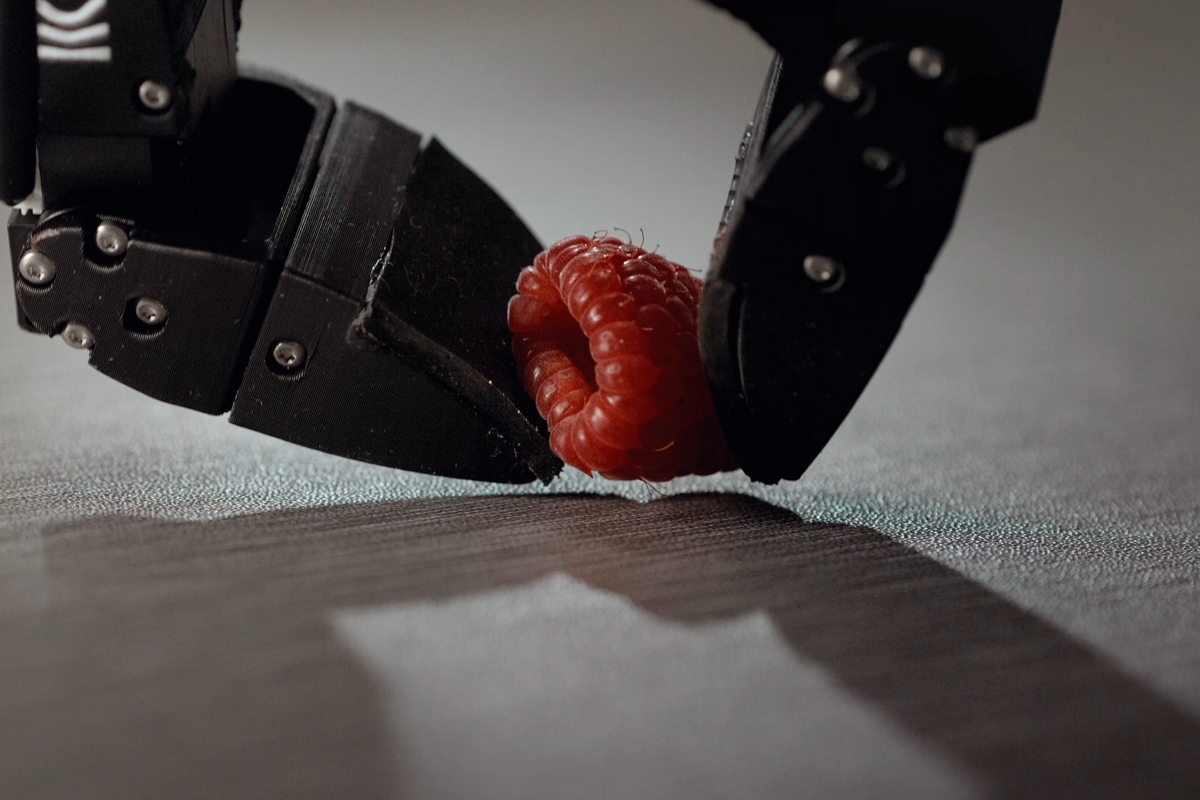
This is the Eka Robotics robot capable of picking up 1,500 different types of targets without breaking a single one
Advances in AI have allowed machines to simulate human reasoning and vision. However, the physical manipulation of everyday objects remains one of the biggest bottlenecks for modern robotics.
It is true that current language models are capable of planning complex tasks in a purely digital environment. Now, coordinating a mechanical arm to grab fragile, slippery or unexpectedly shaped parts without breaking any of them continues to pose a first-level technical challenge.
That is why the American company Eka Robotics has just closed a Series A financing round of 150 million dollarsreaching a valuation of 1.45 billion dollarsas published TechCrunch. The firm, founded by Pulkit Agrawal, a professor at the Massachusetts Institute of Technology (MIT), and Tuomas Haarnoja, a former Google DeepMind researcher, is backed by venture capital investment firms such as a16z and F-Prime.
From visual control to learning through force and touch
Much of current developments rely on vision-language-action (VLA) architectures, where cameras and visual algorithms direct each movement of the actuator. However, this company has a very different proposal.
In statements to TechCrunchAgrawal explained that “vision is not the primary way to solve this last millimeter problem,” as cameras indicate the approximate position of the object, but “the actual grasping and actual searching occurs through forces.”
So, what exactly does Eka Robotics propose? Well, the company has developed a clamp with advanced touch sensors whose manufacturing cost is below 1,000 dollarslinked to a vision-force-action (VFA) model. In fact, Tesla recently registered a patent that goes along the same lines.
Instead of relying on human operators logging thousands of hours guiding mechanical arms, Eka moves training to physical simulators. In this way, through reinforcement learning techniques at scale, they generate thousands of hours of synthetic experience in a few minutes. As Kris Hauser, a professor at the University of Illinois Urbana-Champaign, pointed out, this approach allows the robot to adapt to unknown objects without retraining and outperform previous human demonstrations.
1,500 different objectives classified in one hour
If we take it to a practical level, the records shared by the company place the speed of the system above human standards in repetitive tasks. The mechanical arm is capable of collecting and classifying some 1,500 objects up to 1 kg per hourachieving a success rate higher than 95%compared to the nearly 600 objects per hour that a person usually processes.
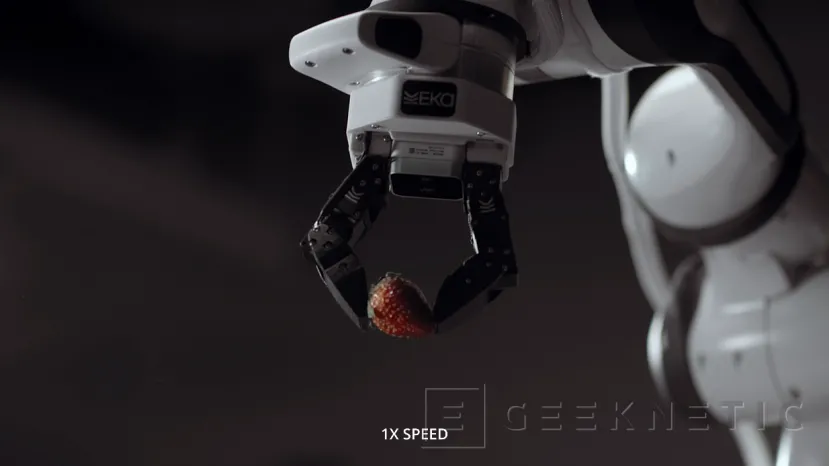
In addition, the immediate response of its pressure sensors allows it to brake in milliseconds to handle delicate products without deforming them. Regarding these capabilities, Raghu Raguram, general partner at a16z, stated that the technology already offers superhuman performance (literally, of course) in specific dexterous manipulation tasks.
However, the leap from the laboratory to industrial production still raises some doubts. Eka is currently collaborating on confidential pilot projects focused on cable placement and handling tasks, but the demands of manufacturing plants will require continuous operation without failures. In this sense, the company has indicated that its current gripper is certified for 5 million work cycles, with the aim of reaching the 20 million common in standardized industrial machinery.
