
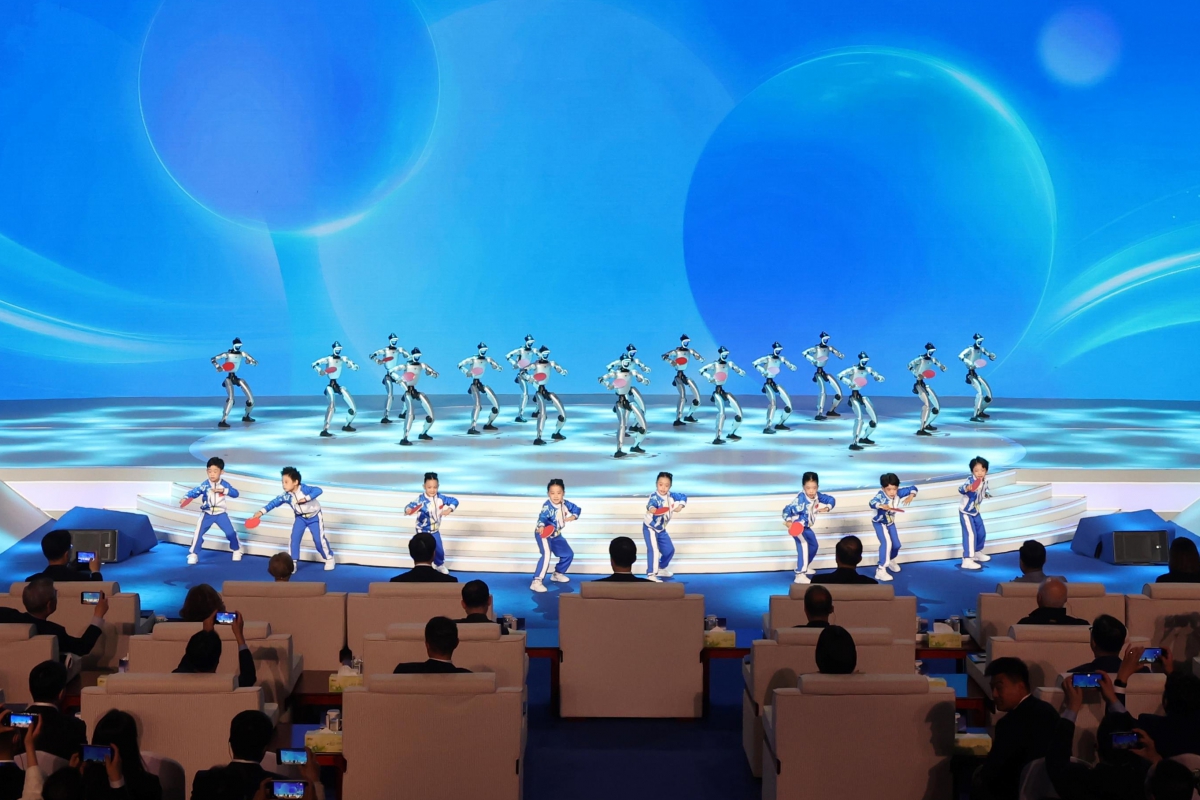
Unitree launches UniUni, its platform to choreograph and synchronize fleets of G1 and H2 humanoid robots
Creating an army of humanoid robots just got a little easier. It is because Unitree has launched UniUnia desktop platform designed to design, choreograph and synchronize the movements of your humanoid robots. It is compatible, among others, with the Unitree G1 and the Unitree H2. There is no mention, however, of his robot dog Go1.
Until now, this set of tools remained an internal development that the manufacturer used in large-format events, including the Chinese New Year television gala. From this moment on, however, it becomes available for free for both Windows and macOS.
The objective of the application is to avoid traditional code programming when coordinating several units at the same time. To achieve this, it combines a two-dimensional view, where the trajectories of each machine are traced using independent Bézier curves, with a three-dimensional space powered by Three.js and URDF files. This 3D viewer allows you to check the body posture and orientation of each robot in real time while the choreography is being designed.
This visual scheme is complemented by a interactive timeline (seen clearly in the image above and in the video) similar to what we find in video editors. In it, all you have to do is drag the movement sequences and associate them directly with the motors of the automatons. The system includes three modes of operation. They are rhythm-synchronized music accompaniment, a debug mode for checking step-by-step transitions, and a continuous loop playback mode.
A little LiDAR mapping spiced up with AI
When managing dozens of machines in the same facility, precision is important to avoid disaster. For this reason, UniUni incorporates a spatial mapping module based on point clouds captured by LiDAR sensors.
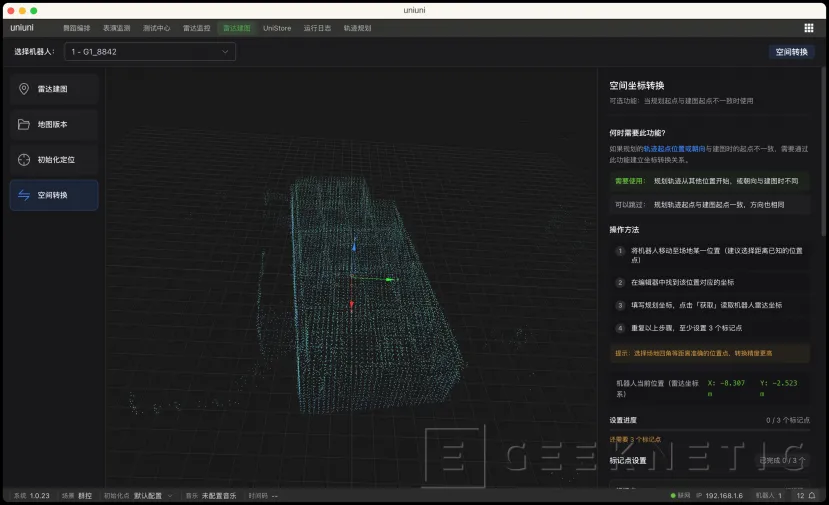
This technology offers three-dimensional localization with centimeter precision and performs automatic collision analysis before starting movement. In this way, if a matrix formation is planned with several robots in rows and columns, the program calculates the safety distances and approach routes on its own.
For its part, the creation of complex routines is also supported by an AI-powered assistant. Using natural language commands, the operator can request a specific formation and assign specific movements to a group of units. Simply ask, for example, that six robots form a two-by-three matrix and perform a coordinated dance. The model interprets the request, generates the waypoints and transfers the sequence to the timeline. From there, all that remains is to adjust the final details.
And how about a community movement store?
Perhaps the most surprising thing about the entire launch is the UniStore. Yes, you were right. This is a repository from which it is possible to download and install additional cinematic sequences, such as greetings, bows or complete dances created by the manufacturer or by other users in the community.
By the way, during execution, the tool also provides a telemetry panel that monitors the network status livethe internal temperature of the components and sensor alerts. In addition, it integrates immediate emergency stop mechanisms that can be activated both individually and for the entire group.
Unitree remembers that this millimeter synchronization is crucial, especially in public presentations, trade fairs and artistic montages where any mismatch of tenths of a second would break the staging. To accompany the launch, the brand has published a presentation video that is quite impressive as it shows dozens of humanoids moving in unison with complete fluidity. It is the one you can see in the tweet we attached above.
