
Any video is enough for Google’s AI to build the simulator in which to train a robot
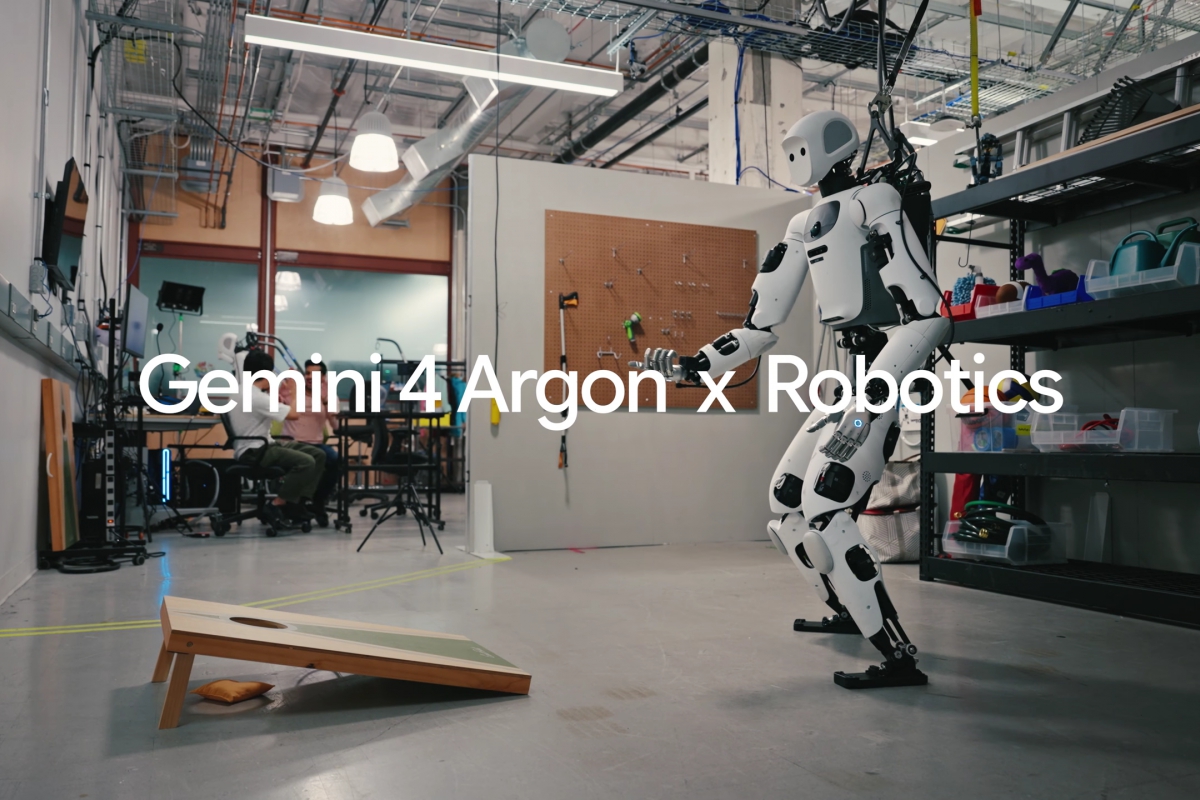
Teaching a new movement to a robot usually involves weeks of manual work to build the simulated environment in which to test it. Google claims to have reduced that process to a few hours with Gemini 4 Argon. How did they get it? The model was shown an unedited video of a person playing cornholethat game of throwing bags at an inclined board with a hole. From that input, the model took care of everything else.
According to the company, Argon mapped the spatial coordinates of the environment and calculated the full-body joint movements required by the launch. He then built the simulation code on his own to practice on. When that job transferred to humanoid robot Apolloby Apptronik, the robot scored seven consecutive shots in a real-world test.
Google calls that chain Video-to-Sim-to-Real and claims that it turns ordinary videos into a virtually unlimited training ground for robotics.
The real merit is not in the seven shots, but in who prepared the ground
What’s relevant about the experiment is that the skill was outside the distribution with which the model was trained, so Argon had to deduce the physics of the launch by observing a human instead of receiving a prepared demonstration.
As numerical support, the company uses the test bench ERQAwhich measures a model’s ability to understand and solve physical and spatial problems in three-dimensional environments. There Argon reaches a 87% relying solely on reasoning, a brand that, always according to Google, surpasses the rest of the frontier models.
This demonstration comes as another pillar of a launch that started at the beginning of October. Argon is the model with which Google seeks to close the gap against GPT-6 Astra and Claude Opus 5.5. It has an expanded generation window up to one million output tokens compared to the previous limit of 64,000 and outstanding results in very large contexts, where it signs 84.2% in GraphWalks.
Before opening it to the outside, the company had already put it to work on its own infrastructure, with agents who reorganized memory management on servers in production and freed up more than 300 TiB of RAM. Google has detailed the rest of its robotics experiments, including controlling a Boston Dynamics Spot quadruped and reconstructing digital twins from hand sketches, on its developer blog.
