
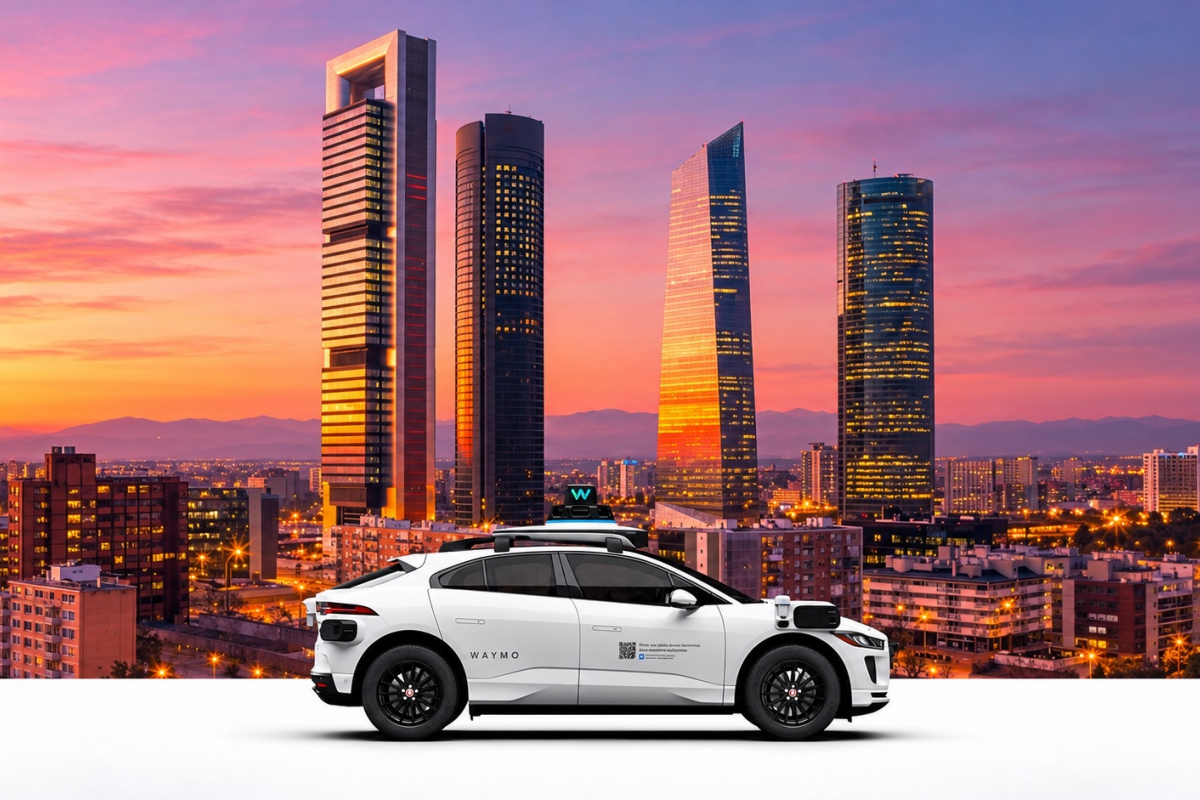
Waymo prepares its arrival in Madrid: its cars will circulate with a driver before offering autonomous trips
Waymo already has a schedule to start its activity in Spain. The Alphabet subsidiary has announced that will begin testing its vehicles in the Community of Madrid and that its objective is to transport the first users in 2027. The date is a forecast of the company, conditional on the progress of the tests and the permits necessary to operate.
The arrival of cars on the streets will not mean the immediate start of a driverless service. The first movements will be manual. Then there will be a validation stage in which the autonomous driving system will work with local specialists behind the wheel. Only after completing these phases does Waymo aim to circulate without a person in the driving position.
The first cars will be electric Jaguar I-PACE
The company will initially use the Jaguar I-PACEan electric vehicle equipped with the cameras, radars and lidar sensors used by its Waymo Driver system. Its announcement indicates that these cars would begin to be seen on the streets of the region in the following days. It has not communicated how many units it will bring to Spain or where it will install its operating bases.
Deployment begins with less visible work than passenger travel: know the roads and check how the vehicle responds to common local traffic situations. Manual circulation will allow you to travel through the planned areas before activating the autonomous functions for the next validation phase. During this stage there will also be a person prepared to intervene inside the car.
Waymo explains that its tests will take place both day and night. Your typical testing schedule may be 24 hours a day, seven days a week, to gather information on different traffic conditions. This activity should not be confused with the availability of a permanent public service: for now, the vehicles that appear on the streets will be carrying out preparation tasks.
Madrid, Alcobendas and Getafe are among the first test areas
Waymo expressly mentions Madrid capital, Alcobendas and Getafe between the municipalities in which it will begin to circulate. The list is not closed and the company plans to incorporate other areas later. Nor has it yet published a coverage map for future passengers. Just because a car travels through a location during trials does not mean that a trip will be able to be requested there when service begins.
In these areas you will have to interpret signs, respect priorities and react to pedestrians, cyclists and other vehicles. Waymo indicates that it will adapt its technology to Spanish standardsincluding the signage contemplated in the 1968 Vienna Convention, and to the particularities of the lanes and intersections in the region.
The company states that it will carry out the tests on public roads in accordance with the guidelines of the General Directorate of Traffic and the rest of the applicable regulations.
Waymo aims for 2027, but has not set the start of service
The announced objective is to receive the first passengers during 2027. Waymo has not specified the month, the initial service area, the rates or the procedure for requesting a car in Madrid. On its information page you can register to receive news, but this registration is not equivalent to a reservation nor does it confirm that the service will be available on a specific date.
The company notes that it needs to collaborate with authorities to obtain the required permits before offering fully autonomous trips. It is also looking for local partners and preparing the necessary operational infrastructure. These are different steps from technical tests: a vehicle can circulate to collect data and validate its operation without being authorized to pick up paying customers.
Waymo already provides commercial robotaxis services in the United States. According to data released by the company itself, it has completed more than 20 million trips and makes hundreds of thousands of commercial trips per week.
The company also cites more than 250 million miles driven fully autonomously and 95% fewer crashes with serious or fatal injuries than human drivers in the U.S. cities it uses for comparison. These are Waymo statistics for those markets; They are not results of the Madrid tests nor a guarantee that the difference will be repeated here.
