
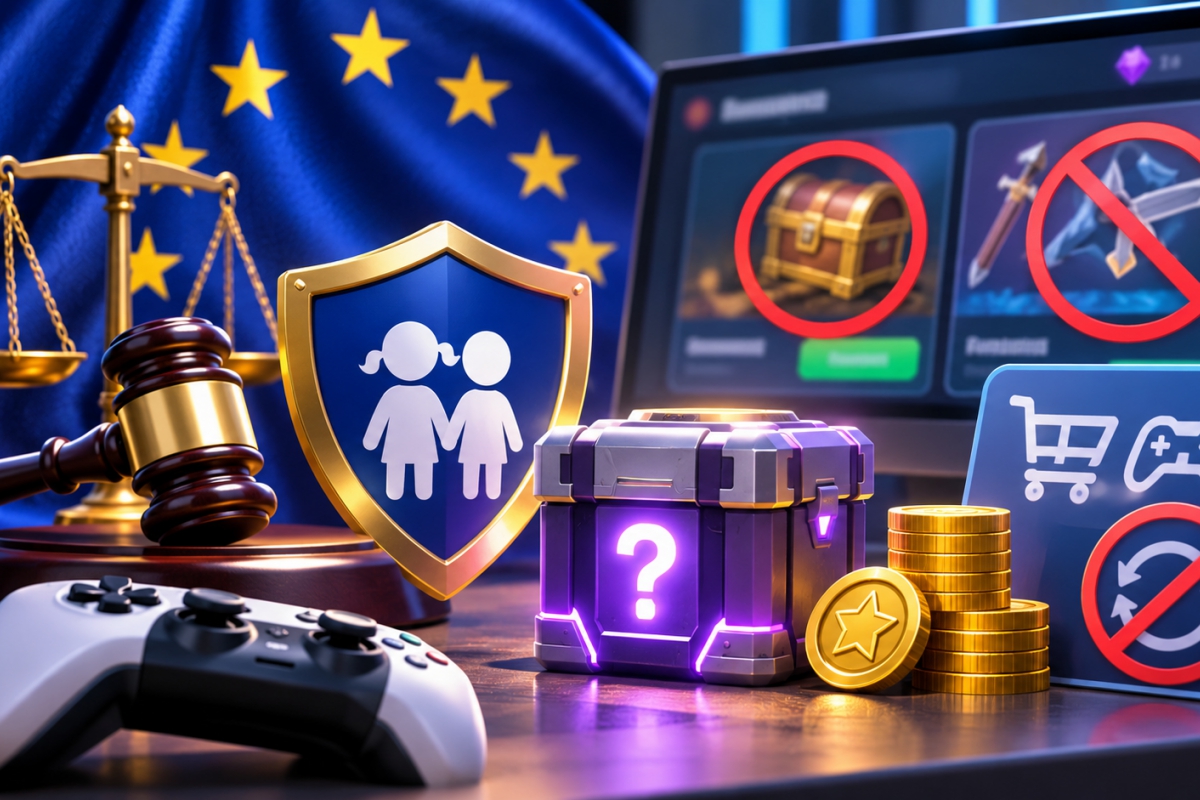
The EU prepares new rules against loot boxes, pay-to-win and abusive subscriptions
After the scandal of the social video network TikTok, the companies’ security measures seem scarce or insufficient. The European Commission is tightening measures regarding protection of minorsamong which includes the new proposal of Digital Equity Law. This is an important update for the protection of consumers who deserve similar protection online and offline.
The Digital Equity Law wants to ban loot boxes and pay-to-win mechanics
The proposal will go to debate in the European Parliament and the Council of the European Union which, if approved, will become a European Union Regulation directly applicable to member states. The measures once again attack video games and their use by minors, with controversial sales techniques such as pay-to-win or loot boxes. But this new proposed law also wants to combat the usual deceptive practices applied in the purchases of digital products to guarantee that all sellers have the same rules in the European Union.
Mainly, the ban on pay-to-win mechanicswhich force you to pay if you want to continue the game or level up. Also the loot boxes, called loot boxeswhich have a negative impact on minors by encouraging betting and lotteries. It also intends that transactions carried out with virtual currency clearly specify the real value in the local currency for this operation.
Other novelties proposed in the DFA prohibit the manipulations carried out by some sellers, simulating that the last units are left, to pressure people to buy the product who otherwise would not. The prices must be clear and transparentwhich includes purchases with virtual currencies that must express their real value. It also covers the dynamic pricing that are offered in sports competitions, which must include taxes and other charges to show the real final price, as well as the evolution of the price and the maximum achievable.
Consumers will be able to deactivate addictive features and know real prices
For consumers it will be an option disable certain addictive design features that encourage compulsive buying or excessive spending. This includes persistent app notifications, or gambling and lottery-like elements such as loot boxes and pay-to-win mechanics.
The influencers who advertise They should be clearer, and should transparently indicate when they are charging for the promotion of products or services. Additionally, brands will need to ensure that influencers comply with these rules. will also apply restrictions on advertising and personalized pricing aimed at minorsor what take direct advantage of sensitive data.
An option that many users will appreciate will be the proposal of facilitate the cancellation of subscriptions and digital contracts. It includes eliminating the automatic renewalsor convert free trials to a paid subscription without clear authorization to warn about it.
As for the purchasing assisted by AI agents on behalf of a consumer, customer service with clear rights will be required, preventing them from taking advantage of the situation and AI decision-making.
The European Commission seeks to strengthen consumer protection on the internet
For the moment this is a European Commission proposal to encourage online protection as good as if you were shopping in a physical store. A proposed law that aims to meet the demands of the European Commissioner for Justice, consumers must know what they are paying for and have the control to decide.
Thus, they have also cited a series of tools necessary to enforce these new requirements, with a centralized standard for consumer protection in the European Union. This will help the EU address problems directly, pursuing high-impact cases and protecting companies that carry out honest marketing from those that compete unfairly.
Fines of up to 6% of global turnover for companies that fail to comply with the rules
To this end, they have proposed granting the Commission direct powers to investigate cases on a large scale, with fines of up to 6% of annual and worldwide turnover of companies that fail to comply. Improve and accelerate coordination between national consumer authorities in cases that span different countries. They also require a legal representative for companies that do not belong to the EU and operate in our territory, to cooperate more closely with the authorities.
The only thing missing is approval in Parliament and Council so that European citizens can begin to enjoy the advantages offered by this new proposed law. Although there were already a regulation on Loot Boxes in Spaina centralized and broader management from Europe can mean greater pressure to eliminate this business that affects minors so much, and encourages other forms of excessive and hidden consumerism for this disadvantaged public in the face of these aggressive techniques.
