
The iPhone achieves its best third quarter in global share while Android falls to 74%, according to Counterpoint
Smartphone sales have been in decline throughout 2026 and the third quarter has been the worst of the three. According to the latest data from Counterpoint Researchthe fall reached 16% year-on-year between July and September, when in the second quarter it had been 11% and in the first, 4%.
The consulting firm attributes this disaster to the component crisis in which we are immersed. As a result, we have a much more expensive entry-level range and less competitive models, as well as a high-end range with fewer and fewer new features to justify the purchase.
In the distribution by operating systems, Android has been left with the 74% of global salesfive points less than a year ago and its lowest level in a third quarter. According to the consultancy, its presence in all price ranges has left it more exposed to the fall. High-end launches from OPPO, vivo and Xiaomi, along with Samsung’s latest foldables, have cushioned the blow.
The iPhone gains share without skyrocketing its sales
On the other side is iOS, which signs a 21% shareits best record in a third quarter. The key is that iPhone sales have only grown 2% year-on-year. In other words, Apple has kept pace in a market that has shrunk by 16%, and that’s enough for its share of the total to increase. Counterpoint attributes this to the success of the iPhone 18 Pro, which has surpassed the previous generation despite the price increases.
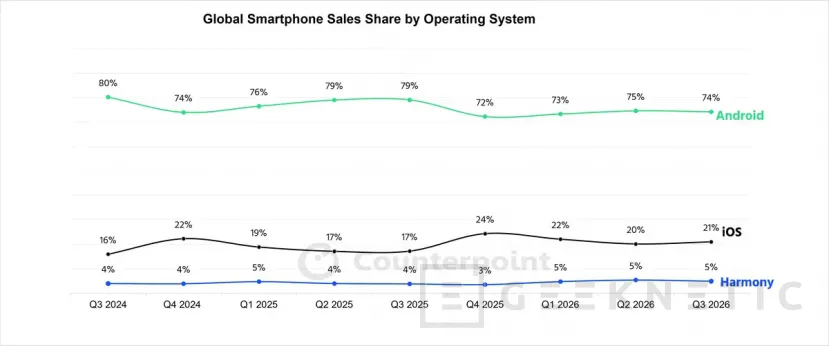
In the third quarter of 2024, Android had 80% of sales and iOS 16%, so the gap between the two has narrowed by eleven points since then. Furthermore, in the two years covered by the report, the fourth quarter has always been the best for iOS, with 22% in 2024 and 24% in 2025.
The United States, China and India are three very different markets
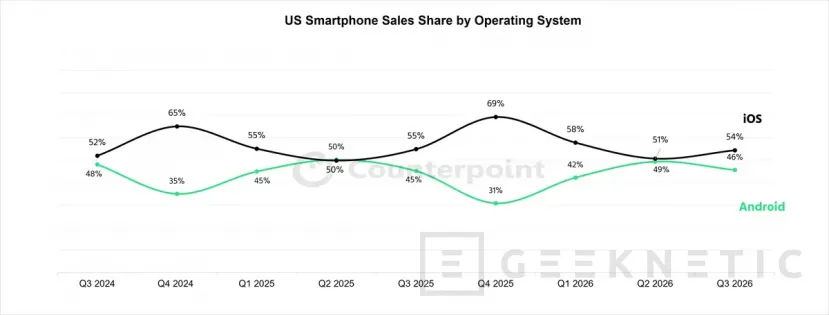
In the United States, iOS reaches 54% of sales compared to 46% for Android, and in none of the quarters analyzed has it fallen below 50%. In India, just the opposite happens, because Android controls 92% and the iPhone remains at 8%.
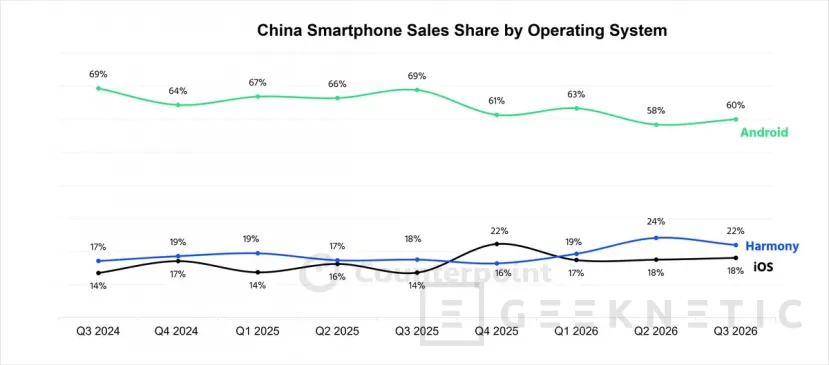
In China, where HarmonyOS comes into play, Huawei’s system takes 22% of sales, two points less than in the previous quarter, while Android rises from 58% to 60% and iOS repeats with 18%. Still, Huawei has grown 12% year-on-year in a market that has fallen 10%. On a global scale, HarmonyOS maintains a 5% share, although Counterpoint warns that the price increases that Huawei applied in September could slow that momentum.
Months ago we already explained to you that DRAM and Flash memory was going to hinder mobile and laptop sales during 2026. This year’s three quarterly reports make it clear that the trend is precisely that. Bad times for the sale of consumer hardware.
