
Qualcomm explains to us the leap that will change business networks
Qualcomm has launched different products at this Mobile World Congress 2026, among them are advanced network solutions with support for the new WiFi 8 technology, such as the Dragonwing Elite platforms for routers and professional network infrastructures, or the FastConnect 8800 modem for smartphones and mobile devices.
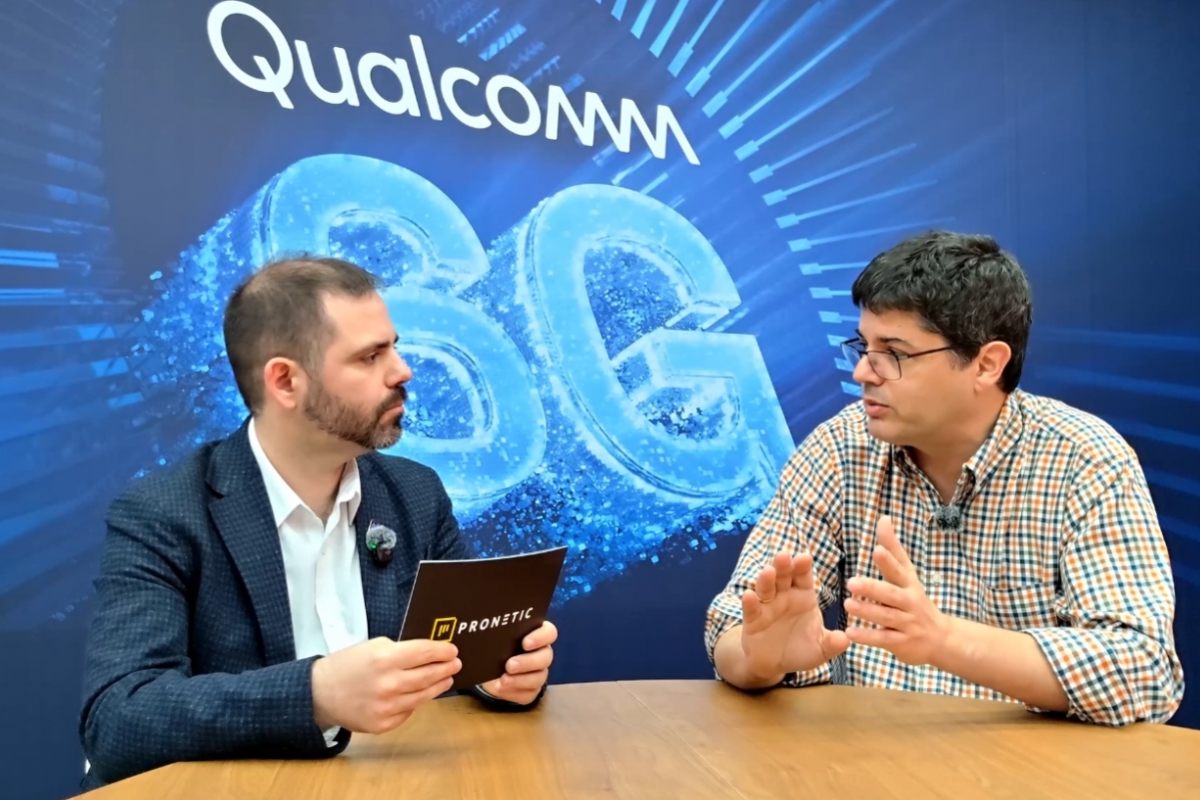
To learn more in detail about the new features offered by these products together with WiFi 8 technology, we have interviewed Chano Gómez, Product Director of Mobile Connectivity at Qualcomm.
In the interview, Chano explained to us the improvements offered by these new Qualcomm products and the WiFi 8 technology itself.
WiFi 8 will improve latency and connection stability, also allowing greater distances
For example, although the spectrum bands are maintained with respect to WiFi 7, with 2.4 GHz; 5 GHz and 6 GHz, as well as maximum speed peaks; with WiFi 8 different implementations improvements regarding the management of the wireless connection in situations of network congestion. To do this, WiFi 8 introduces features such as coordination between access points so as not to interfere with each other when there are clients connected in nearby areas. It will also detect when part of the spectrum is occupied to use the rest instead of blocking the entire spectrum as was previously the case.
The access points will be able to coordinate with each other to know what interference is generated, how many devices are connected and much more, so that the connection can be optimized by applying technologies such as beamforming, among many others.
Also connection on the move or “roaming” is improved. When devices such as mobile phones or laptops move along the different access points of the network, with WiFi 8 there will be no connection interruptions or speed jumps, being able to maintain Stable connections without interruptions.
WiFi 8 is also capable of maintain longer distances when connecting devices with access points, expanding useful coverage. This is possible thanks to the ELR (Extended Long Range) functionality, where devices can detect when they are at long distances from the router to use much more robust modulation and maintain the connection in situations where it would not be possible with WiFi 7.
The improvement in latency will also be very noticeable. At a business level, it will have application in connections sensitive to this, such as videoconferences or real-time voice in motion, with interested companies in sectors such as robotics, where the connection of this type of robots will benefit from a more stable connection without latency to be able to act in real time.
The Qualcomm FastConnect 8800 will allow smartphones with 4×4 antenna systems
In addition to the improvements of the WiFi 8 standard itself, Qualcomm has also implemented its own technologies to offer more advantages, for example, they already have 4×4 chips with four antennas with the FastConnect 8800the first available for mobile devices. This will increase coverage and connection speed.
These chips also integrate their own AI processing capacity, so that network management can be optimized with advanced AI systems running on the device itself.
The DragonWing Npro A8 Elite will be able to manage the network through local AI on its own NPU
Regarding the new Qualcomm Dragonwing Npro A8 Elite aimed at access points and professional network infrastructures, Chano assures that it will allow companies to significantly improve the latency and stability of their connections, thus reducing tickets and complaints about failures in calling applications, video conferencing and other uses. Along with this improvement, energy consumption and, therefore, the electricity bill will also be reduced.
This chip has a new AI Engine Gen 2 with the Hexagon NPU, so that AI systems can be run directly locally on the device, saving costs and latency by not having to send data and process it in the cloud.
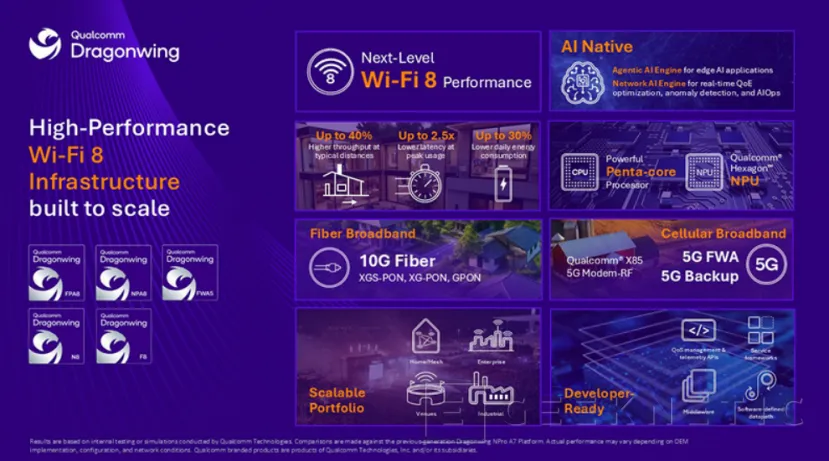
In addition, the operation of the WiFi network itself with devices with this chip (traffic management, selection of frequencies, resources, packet prioritization, etc.) can be done directly with local AI (Edge AI). This NPU also allows you to detect problems in the network through telemetry systems with all the data to which it has access.
