
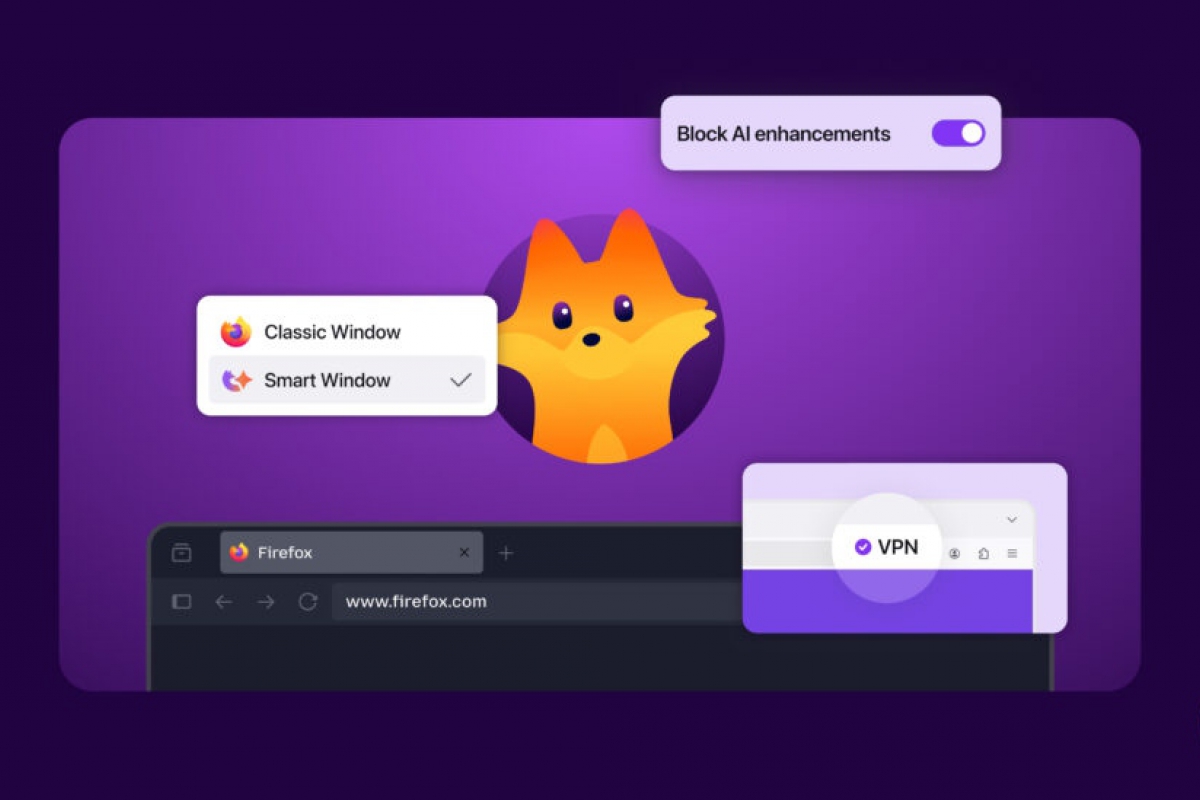
Firefox launches a free VPN built into “the world’s most trusted browser”
Mozilla has presented a very interesting package of new features for Firefox. The list includes a free built-in VPN in which, according to the company, it is “the most trusted browser in the world.” It has also added a split screen view, notes associated with tabs, improvements in settings and a visual facelift that we were already able to see thanks to a leak. Everything could arrive in the coming weeks, with Firefox 149 as the starting point scheduled for March 24.
The announcement fits with the roadmap that new Mozilla CEO Anthony Enzor-DeMeo laid out when he took over in December. The strategy involves turning Firefox into something more than a browser, diversifying income and making privacy the main differentiating argument compared to Chrome and Edge. The free VPN is the most visible bet in that direction.
The free VPN is the big news with an unanswered question
Firefox 149 will include a Integrated VPN at no additional cost which routes browser traffic through a proxy to hide the user’s IP address and location. It does not require installing anything extra. Users in the United States, France, Germany, and the United Kingdom will have a generous monthly limit of 50 GB to start. At the moment, none of this reaches Spain.
Obviously, Mozilla presents it as a reliable alternative to free third-party VPNs, which often monetize user data to sustain themselves. The argument is consistent with the company’s image. However, there is a reasonable question that any sensible user should ask themselves.
That Mozilla has better intentions than a random VPN is plausible. But what really determines the strength of that promise is whether there is an independent, external audit that verify that the proxy does not record or retain browsing data. At the moment, Mozilla has not detailed whether this process exists or is planned. It’s a nuance worth keeping a close eye on before assuming that privacy is guaranteed by default.
The browser VPN joins other recent security improvements, such as the implementation of the Sanitizer API, a new web security standard that blocks attacks before they reach the user and of which Firefox was the first browser to adopt.
Split view, notes and control over AI
Along with the VPN, Firefox 149 brings Split Viewa split view feature that allows you to display two web pages side by side within the same window, intended for comparing content or copying information without switching between tabs. It also comes Tab Noteswhich allows you to add notes directly to any open tab, available in Firefox Labs as an experimental feature.
Mozilla also expands Smart Window, formerly known as AI Window, an AI-powered contextual help panel that offers definitions, article summaries, and product comparisons without leaving the page. Its use is completely optional and requires explicit activation by the user, in line with the commitment Mozilla made in February to offer granular control over all AI features, including a global switch to disable them completely.
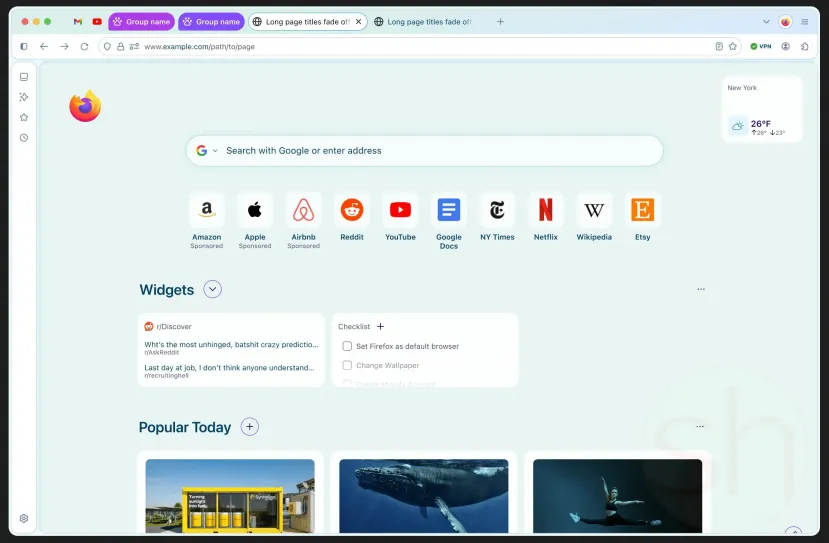
Regarding the visual aspect, Mozilla confirms that Firefox will receive a redesign that includes new themes, icons and refinements to toolbars, menus and home page. This coincides with the leak of the new look, known internally as Nova. With it would come rounded corners, subtle gradients on surfaces, vertical tabs integrated into the new visual language and the possible official recovery of compact mode. Indications are that Nova could land sooner than Mozilla suggests in its statements. The renewed settings section, with better navigation and integrated search, will arrive in a nightly version in April.
Finally, Mozilla also presents kita new browser mascot that will progressively appear in the interface as a visual companion. A minor detail, but it reinforces the idea that the renewal of Firefox in 2026 goes beyond specific functionalities and seeks to redefine the identity of the product as a whole.
