
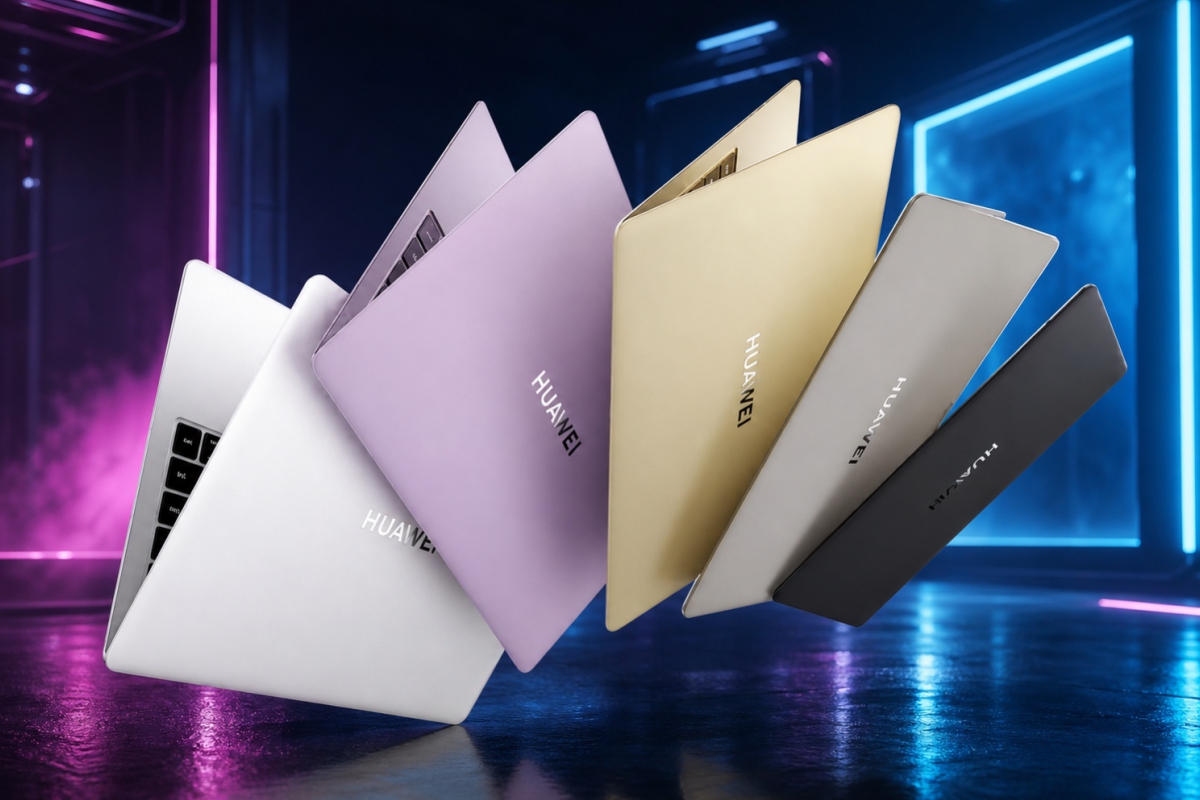
Huawei confirms that the MateBook Pro S will weigh 798 grams before its launch on August 5
Huawei has begun to show its new MateBook Pro S a few days before its full presentation in China, scheduled for August 5, and it has done so betting on a very direct argument: the weight. The company has shown the laptop on a traditional scale, one of those with saucers, marking 798 gramsa figure that places it among the lightest 14-inch laptops on the current market and that seeks to become the model’s cover letter before knowing the rest of its technical sheet.
The MateBook Pro S will arrive with HarmonyOS operating systemHuawei’s commitment to completely separate itself from Android and Google services on its most recent devices, and will set up a Kirin XE90 processor with ARM architecture.
This is a relevant movement because it confirms that Huawei continues to push its own silicon ecosystem also in the field of laptops, a segment where for years it has depended on Intel or AMD processors for its Windows models.
A three-chamber design that breaks with the usual
Beyond the weight, the other element that has attracted attention in the first images is the design of the back cover, which incorporates a three camera system. It is an unusual approach in a laptop, where the normal thing is to do without any rear camera or, at most, include a fingerprint reader or a logo. Huawei has not yet detailed what exactly this triple photographic system will be used for, although its presence in a device designed for mobility opens the door to functions related to document scanning, higher quality video calls or some type of visual recognition assisted by artificial intelligence.
The MateBook Pro S chassis points to lightweight materials combined with structural reinforcement that allows it to maintain rigidity despite the low total weight. Achieving 798 grams in a 14-inch laptop requires cutting thickness in the case and optimizing each internal componentfrom the battery to the motherboard, without sacrificing resistance to twisting or accidental knocks, something especially important in a device designed to be carried everywhere.
Kirin XE90: Huawei’s ARM bet for laptops
The Kirin XE90 processor represents the continuity of Huawei’s strategy to develop own silicon to reduce its dependence on external suppliers, a need that has been accentuated by the commercial restrictions that the company has had for some time in several international markets. Migrating to ARM architecture on a general-purpose laptop involves working a lot on software optimization, since HarmonyOS needs to adapt its applications and drivers to this type of processor, something different from what happens on a computer with traditional x86 architecture.
The advantage of ARM usually translates into better energy efficiency and lower heat generationtwo factors that fit well with a reduced weight objective such as that pursued by the MateBook Pro S. A more efficient processor allows the use of a smaller battery without sacrificing autonomy, and a chassis with fewer thermal dissipation needs can be further lightened by not requiring cooling systems as robust as those required by other laptops with higher consumption x86 processors.
What remains to be confirmed
Huawei has not revealed the rest of the specifications of the MateBook Pro S, including RAM, storage capacity, screen resolution or battery life. The official price has not been announced either.which is expected to be known during the August 5 launch event in China. Public sales, according to the information available so far, would begin shortly after that date, although there is no confirmation of international availability beyond the Chinese market.
This lack of data leaves relevant questions in the air to evaluate the laptop as a whole.such as the type of ports it will incorporate, if it maintains state-of-the-art WiFi connectivity or if it includes some type of backlit keyboard adapted to the mobility needs that the entire design of the device seeks to convey. It also remains to be seen if Huawei plans a variant with a higher-power processor for professional profiles, something common in the Pro ranges of other manufacturers.
The ultralight 14-inch laptop segment has been gaining relevance in the latest launches from several manufacturers, which compete to offer equipment capable of moving below the kilo barrier without giving up acceptable performance for office tasks and productivity. The MateBook Pro S, with its 798 grams, is in that field of direct competition against equivalent models from other Chinese brands and also against Western ultrabooks that rely on materials such as magnesium or carbon fiber to reduce weight.
No confirmed pricing or availability outside of China.any cost comparison against European competition remains pending until Huawei offers official figures. What is clear with this preview is that the company continues to bet on HarmonyOS and its own ARM silicon as pillars of its laptop strategy, in line with what it has already been doing in other segments of its device catalog.
