
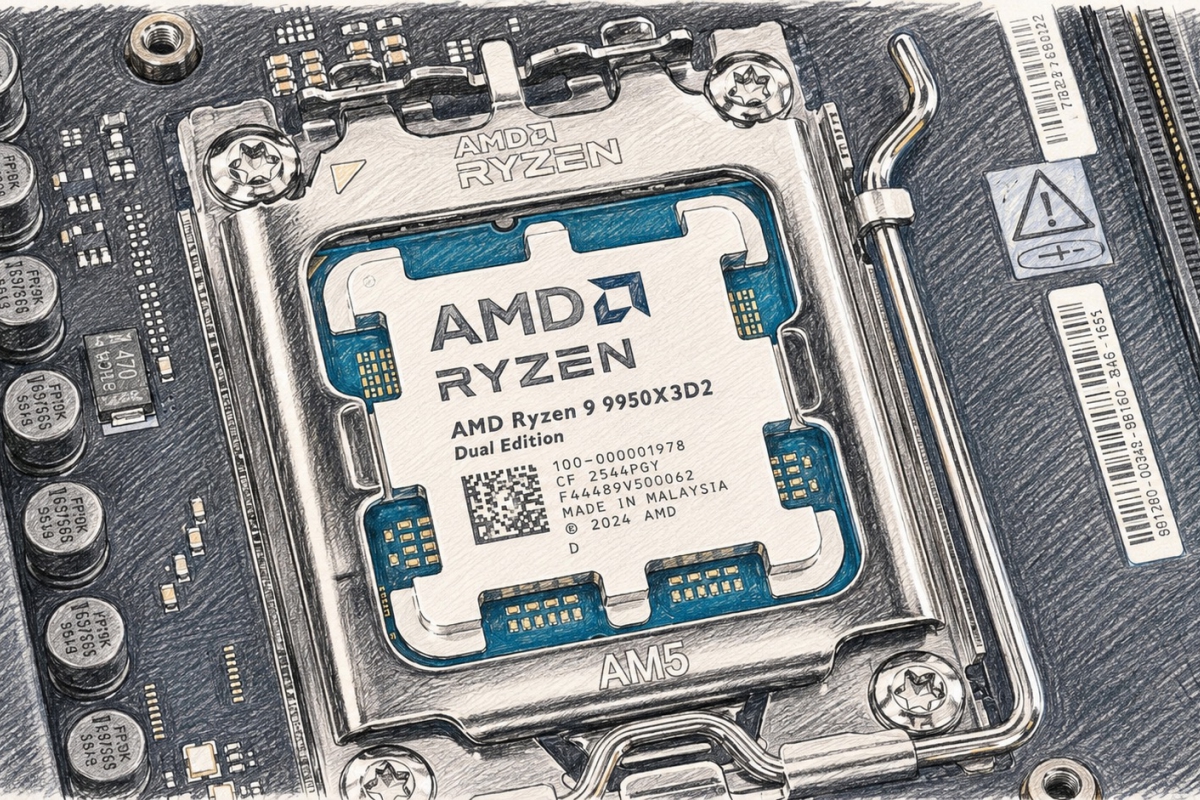
AMD removes TSME memory encryption from Ryzen consumer and reserves it for the PRO range
AMD has quietly removed a security feature that it had included in its processors for almost a decade. It is about TSME (Transparent Secure Memory Encryption)a technology responsible for encrypting the contents of system memory to protect it against possible physical attacks that could take advantage of unencrypted data stored in RAM. According to an investigation by Ars Technica, this feature has disappeared from mainstream consumer-oriented Ryzen processors without the company previously announcing it.
The discovery comes at a time when hardware security has become increasingly relevant, especially when it comes to protecting data stored in memory against attacks that require physical access to the computer. That a function of this type disappears from the consumer range without prior notice is striking.especially taking into account the long history that TSME has had within the AMD catalog.
A function present for a decade
AMD introduced TSME about ten years agoprogressively integrating it into practically its entire range of processors. Technology became present in both mainstream Ryzen and Ryzen Pro, Threadripper processors and EPYC server solutionswhich made it a security layer transversal to almost the entire company catalog.
The discovery of this withdrawal occurred almost by chance. A test carried out on a processor Ryzen 7 9700X, based on the “Zen 5” architecturerevealed the absence of support for TSME on that chip, something that caught the attention of several computer security professionals who had been assuming that the function was still present in the entire Ryzen range.
As a result of this discovery, several exchanges took place between AMD engineers and security specialists trying to clarify the situation. The Ars Technica investigation shows that, finally, the company confirmed that TSME becomes a security feature exclusive to PRO processorsas part of the so-called AMD PRO technologies.
Without prior notice and without detailed explanation
One of the most striking aspects of this case is the lack of communication on the part of AMD. The feature has been quietly removed, without an official announcement or note explaining the change to users or to motherboard and system manufacturers who until now could assume that their consumer Ryzen processors included this additional layer of memory encryption.
Finding out that a security feature has been deprecated only through independent testing and direct contact with company engineers is not the usual way these types of changes are typically communicated in the industry, especially when it comes to a feature related to data protection.
What exactly did TSME do?
To understand the real scope of this withdrawal, it is worth focusing on what TSME contributed to the operation of the system. The technology transparently encrypted the entire contents of RAMso that any data physically stored in the memory modules would be unreadable for anyone who managed to access them without going through the processor.
This type of protection makes sense against attacks that require physical manipulation of the hardware, such as the extraction of memory modules to analyze their contents with external tools, a more common scenario in environments where physical control over the equipment cannot be guaranteed one hundred percent.
Product differentiation between consumption and the PRO range
With this decision, AMD adds TSME to the list of exclusive features of the PRO series, thus reinforcing the differentiation between this range and conventional Ryzen processors. This strategy of reserving certain security or management capabilities for PRO models is not new in the semiconductor industry, where it is common for manufacturers to use these types of functions as an additional sales argument for corporate or professional customers willing to pay a premium for extra layers of security and management.
It should be noted that AMD never advertised TSME as a prominent feature of its consumer processors, so its presence until now could be considered more of an added advantage than an explicit sales pitch. Even so, its withdrawal implies a real loss of a layer of protection that was available until recent versions of the Ryzen range.
For those who especially value these types of additional security features, especially in professional or business environments where protection against physical attacks on memory may be of greater relevance, The investigation indicates that the option now involves opting for the Ryzen PRO series instead of conventional consumption models.
This movement is also part of a broader trend within the industry, where the line between what is offered in the consumer segment and what is reserved for professional ranges tends to be marked more clearly with each new generation of product, something that is already common in manufacturers such as Intel and that now AMD also seems to be adopting more explicitly with its catalog of processors.
