
Google releases Gemini 3.7 Flash three weeks after its predecessor and cuts API fees in half
If you have the feeling that AI models are happening at a dizzying pace, you are right. And it doesn’t just happen with frontier models, such as Claude Opus or OpenAI’s GPT. The most efficient models also follow one another within a few weeks. With this in mind, it is not surprising that Google has announced the official release of Gemini 3.7 Flash. It is a new model that is among the most powerful proposals and those that seek to respond at full speed. To give you an idea, it is at the level of Anthropic’s Sonnet 5. According to the company, it continues to focus on code development and the execution of autonomous agents, such as OpenClaw.
In reference to what we mentioned at the beginning, it is notable that this update arrives just three weeks after the deployment of version 3.6 Flash. It remains to be seen if this is a substantial improvement over its predecessor or a rushed launch. Obviously, for Google it makes sense. As the company indicates, the new version introduces improvements in development workflows along with a promotional price reduced to 50% compared to the initial cost of the previous generation.
Developer entry fees are set at $0.75 per million entry tokens and $3.75 per million exit tokens until the end of the year. If you want a company to work with it, the model is available today in the Gemini API through Google AI Studio, Android Studio and Google’s professional platforms.
The news and improvements of Gemini Flash 3.7
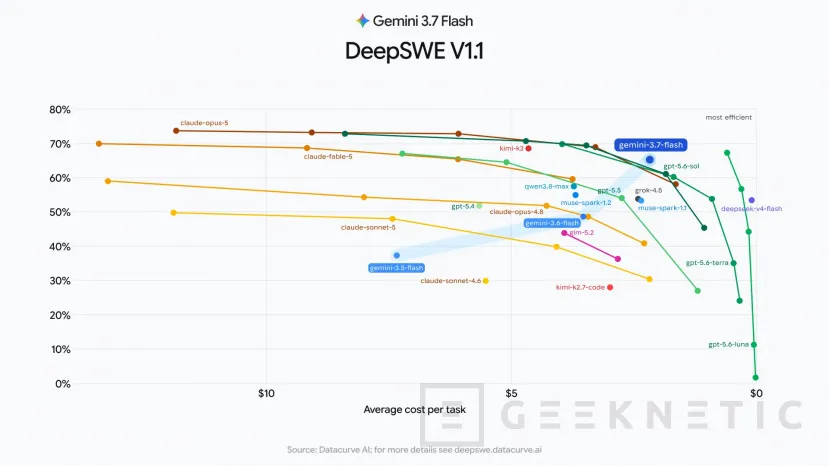
As is usual in these releases, all the prose is seasoned with benchmarks and technical data. On this occasion, the company highlights improvements in bug resolution and code debugging compared to the previous version. According to internal tests published by Google, Gemini 3.7 Flash achieves 43.6% accuracy in the FrontierCode 1.1 software test compared to 34.4% for version 3.6. In addition, performance in the DeepSWE benchmark rises to 65.3%surpassing the 49% recorded by its predecessor in generating code for production.
Tests have also been carried out in specific fields. For example, in the case of web interfaces, the model increases the ability to generate functional structures and complete applications. The important thing is that it is able to achieve this in a smaller number of requests, something that can reduce the final cost of development. For example, a button. In the WebDev Arena evaluation by Arena.ai, Gemini 3.7 Flash scores an Elo score of 1588 compared to 1538 points for the previous release. The system processes screenshots or design systems to replicate interfaces with greater conceptual fidelity.
Agents, agents and more agents
That 2026 is the year of the agents no longer doubts anyone. Google has worked to make the model have improved reasoning capabilities in specialized areas such as finance, law, and life sciences when processing dense documentation. In the GDP.pdf evaluation test, aimed at measuring the extraction of information in complex documents, the success rate goes from 22% to 34%. For its part, process automation metrics grow by 30.4% in the AutomationBench test compared to the 17% obtained by the previous model.
All of these improvements over the previous model allow Gemini 3.7 Flash to work on its own with greater precision. Google has also recalled that the update has been integrated directly into Gemini Spark, which is the personal agent available to subscribers of the Pro and Ultra plans.
Although this whole string of precision improvements is welcome, it is clear that we are still far from models capable of working completely without human supervision. The frontier models, which are the most reliable, are tremendously expensive. And models like the Gemini 3.7 Flash, much cheaper, although they continue to improve, have work to do to achieve acceptable reliability.
