
Samsung’s Wide View technology improves the brightness of the foldable panel around the fold
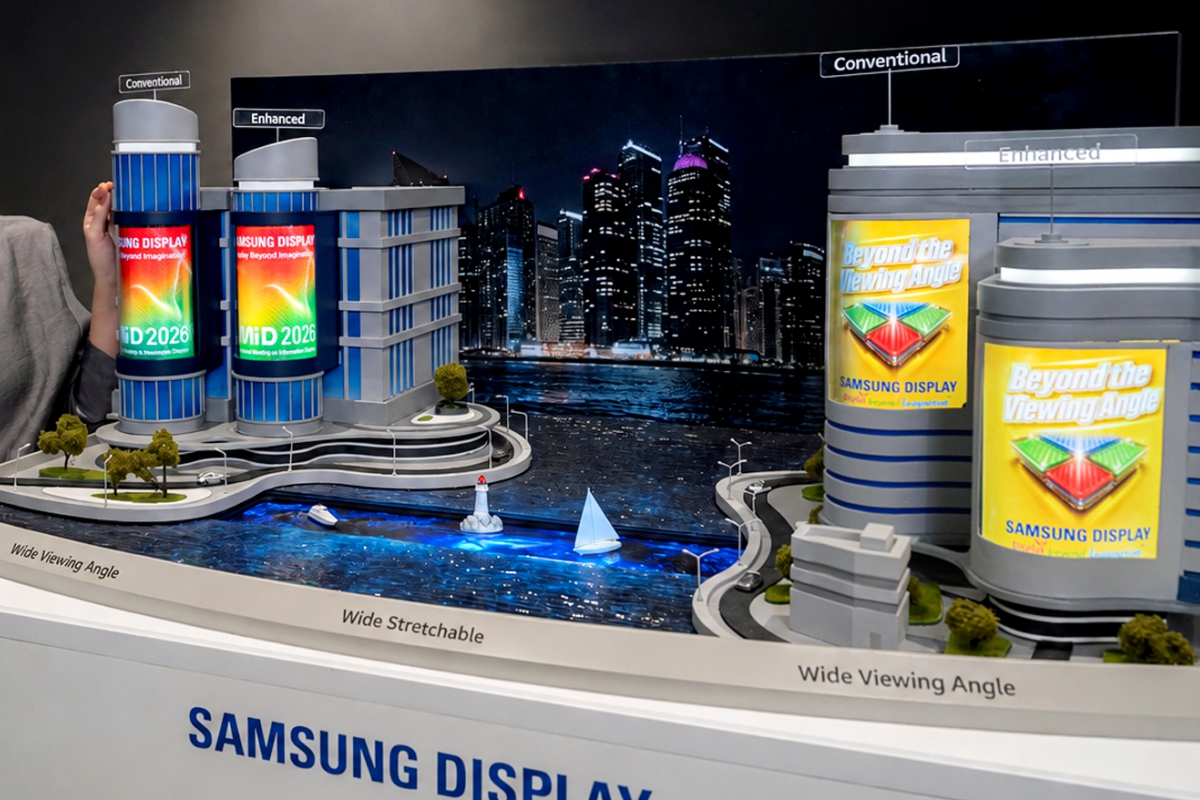
During IMID 2026, Samsung showed off a 7.6-inch foldable OLED display called Wide View. The demonstration was part of the South Korean company’s exhibit and focused on a specific problem with flexible panels: the loss of gloss that can be seen when looking at the curved areas near the fold.
The company brought the prototype to the fair as sample of its display technologywithout associating it with a commercial telephone. Nor did it communicate a production date, interested manufacturers or devices that will use it. Therefore, what was seen in Busan allows us to know a possible evolution of folding screens, but it still does not anticipate the launch of a new Galaxy.
The curved area may lose much of its shine
Samsung Display explains that in current folding panels the curved parts on either side of the central fold can appear around 40% of the brightness seen from the front. The difference is visible by the angle adopted by the pixels in that area and constitutes a structural limitation shared by flexible screens.
The Wide View panel addresses that behavior through changes to the materials and structure of the light-emitting organic layer. According to the company, this modification maintains a bright and uniform image also in bent or curved sections, preventing those areas from darkening when the user observes the screen from a frontal position.
The demonstration focused on luminous uniformity. Samsung Display did not announce improvements to the physical visibility of the fold mark, the strength of the panel or the hinge mechanism, components that also depend on the final design of each device. It is advisable to separate the two aspects: an area may retain its brightness better and still show a gap under certain lighting conditions.
A technology designed for various flexible formats
Although the exposed prototype had the size of a folding mobile phone, the company proposes the use of Wide View in more categories. The same technology could be applied to sliding, roll-up panels and screens with curved edgeswhere the image is also viewed from different angles or crosses surfaces that are no longer completely flat.
The practical objective is to reduce luminosity changes between the center and flexed areas. In a finished device, that greater continuity would allow colors, light backgrounds, and other graphic elements to maintain a more homogeneous appearance across the fold. The company, however, did not release additional benchmark measurements, consumption data, or information on the maximum brightness of the 7.6-inch panel.
IMID also served as a showcase for a 20-inch extendable screen
Within the same space, Samsung Display showed a screen Wide Stretchable of 20 inches created by joining two extendable panels. Its surface area is more than double that of the company’s previous product, while a high-precision design and module lamination process reduces the visible separation between the two pieces.
This second concept was aimed at different applicationsincluding vehicle dashboards, signage and screens for humanoid robots. Along with it, other OLED developments for laptops and monitors were exhibited. The 7.6-inch Wide View screen was thus integrated into the set of demonstrations that could be seen during the fair.
Samsung Display closed IMID 2026 without specifying when Wide View will reach mass production. Until there is a product that integrates it, the improvement remains a technology publicly demonstrated in Busan, with its possible commercial application still to be defined.
