
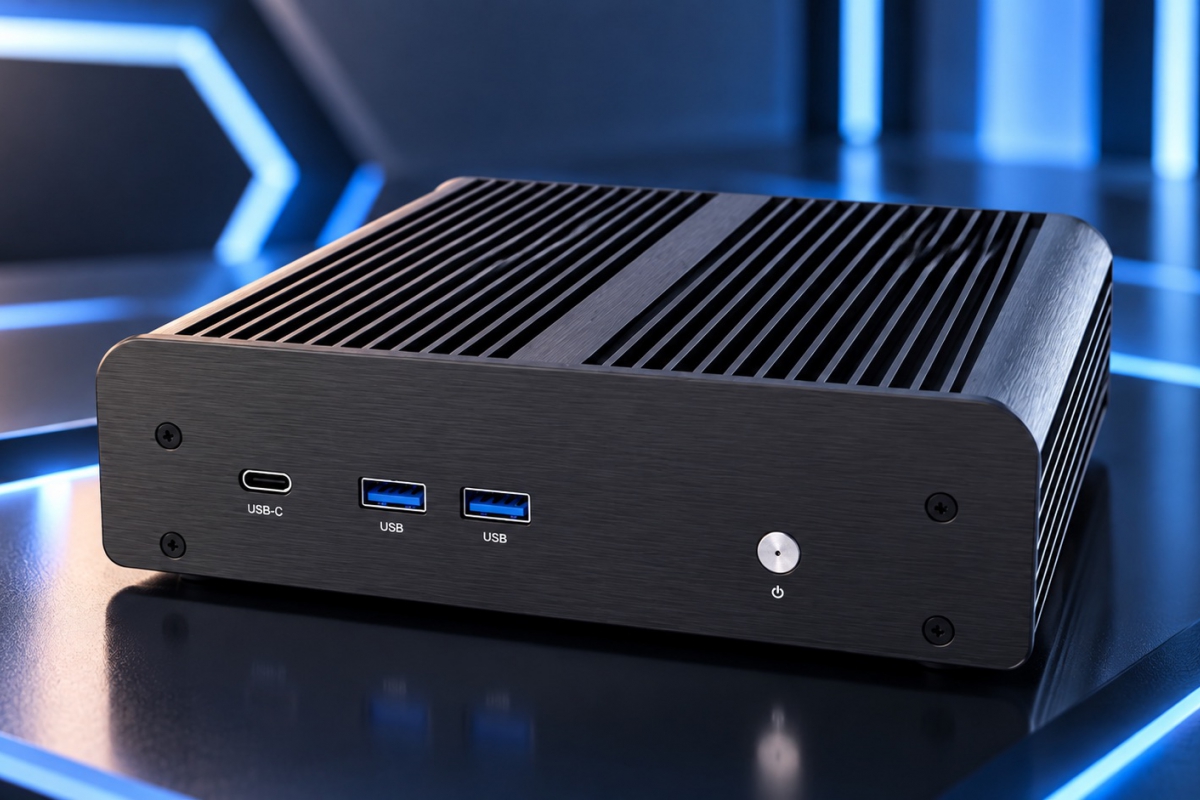
Akasa turns the ASUS NUC 16 Pro into a fanless mini PC with its Newton N16
Akasa has presented the Newton N16an aluminum casing that allows turn the ASUS NUC 16 Pro into a cooled mini PC completely passively. The chassis replaces the standard thermal system with modules that conduct heat from the processor and the two M.2 units to the casing itself. The result works without fans or other moving parts, although it requires limiting the processor to a maximum of 28 W.
The proposal is designed for installations where the noise or wear of a fan is problematic. The Newton N16 is still listed as an upcoming launch: the manufacturer has published its specifications and compatibility, but has not communicated the price or the date of arrival in stores.
The entire case acts as a heatsink
The body and its panels are made of aluminum with black anodized finish. The fins distributed on the outside increase the surface area available to expel heat into the environment. Inside, Akasa includes a aluminum module for cputhermal compound and two independent modules with pads for M.2 SSDs. In this way, the cooling system covers the three components that can concentrate the most temperature in this format.
The Newton N16 measures 188.6 x 204 x 53.6 mm and occupies 2.1 liters. It grows compared to the original NUC 16 Pro case, whose dimensions are 144 x 117 x 42 mm, because it requires more metal and a much larger outer surface to dissipate without forced ventilation. It only supports M.2 storage, in line with the two slots offered by the ASUS equipment board.
VESA mounting allows you to fix the computer behind a monitor. Akasa will sell a separate wall mount, identified as A-NUC109-KT01and a front A-NUC109-FP02 intended for installations in 10-inch racks. These options fit workstations, digital signage, and small deployments with multiple teams.
The 28 W limit forces you to adjust the BIOS
The most important change compared to the stock NUC 16 Pro affects power. ASUS offers this platform with Intel Core Ultra Series 3 processors configured for 45 or 65 W, while Akasa’s passive system is approved up to 28 W. The manufacturer warns that it may be necessary to modify the power limit from the BIOS and provides specific guidance for doing so.
The case accepts NUC 16 Pro boards with Core Ultra X9, Core Ultra A configuration limited to 28W will have less headroom to maintain high frequencies under prolonged loads than the original dual-fan chassis. The reduction is the direct commitment to achieve silent operation without mechanical ventilation.
The NUC maintains its NPU and the Intel Arc or Intel Graphics of each processor. ASUS advertises up to 180 combined TOPS on the top configurations. Akasa does not publish tests on actual performance with the 28W limitso that figure does not necessarily represent its sustained performance.
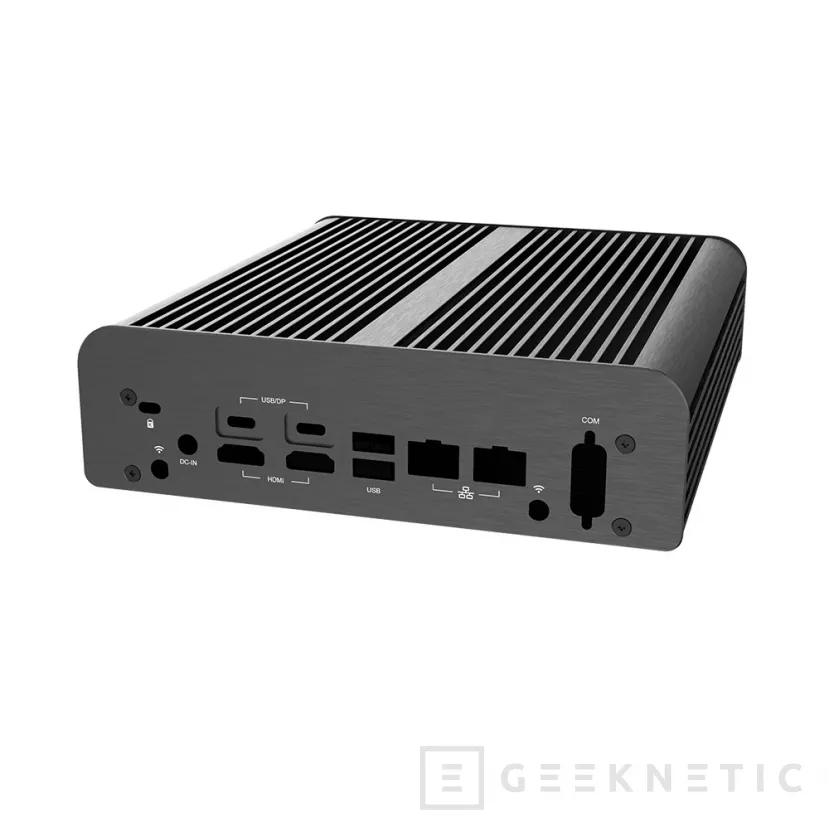
Two versions for HDMI and DisplayPort outputs
Akasa prepares two references because ASUS sells boards with different rear distribution. The A-NUC109-M1B corresponds to models with two HDMIwhile the A-NUC109-M2B is designed for the variant with two DisplayPort. The brand recommends checking the board before purchasing, since the video openings are different and the two cases are not interchangeable at that point.
Both retain the original NUC connectors. On the front, a 10 Gbps USB-C, two 10 Gbps USB-A, the power button and its status indicator are accessible. The back has openings for two more USB-C, two USB-A, two Ethernet connections, power input, serial port and the two video outputs corresponding to each version. It also includes two holes for antennas and a Kensington slot.
Akasa indicates its AK-PD120-04M 120 W and 19 V external source as an option. The documentation supplied includes the thermal material, the dissipation modules and installation manuals in several languages, including Spanish.
The Newton N16 turns a compact, high-performance platform into a equipment aimed at moderate loads, continuous operation and environments in which it is important to reduce mechanical maintenance. The absence of fans prevents their noise and eliminates this possible point of failure, but the heat will still depend on the ambient temperature, the placement of the chassis and the correct setting of the energy limit.
Akasa still classifies the two versions as upcoming products. Until I publish the price, date and possible regional compatibility lists, the codes A-NUC109-M1B and A-NUC109-M2B, the maximum support of 28 W and the VESA, wall and 10-inch rack mounting options are confirmed.
