
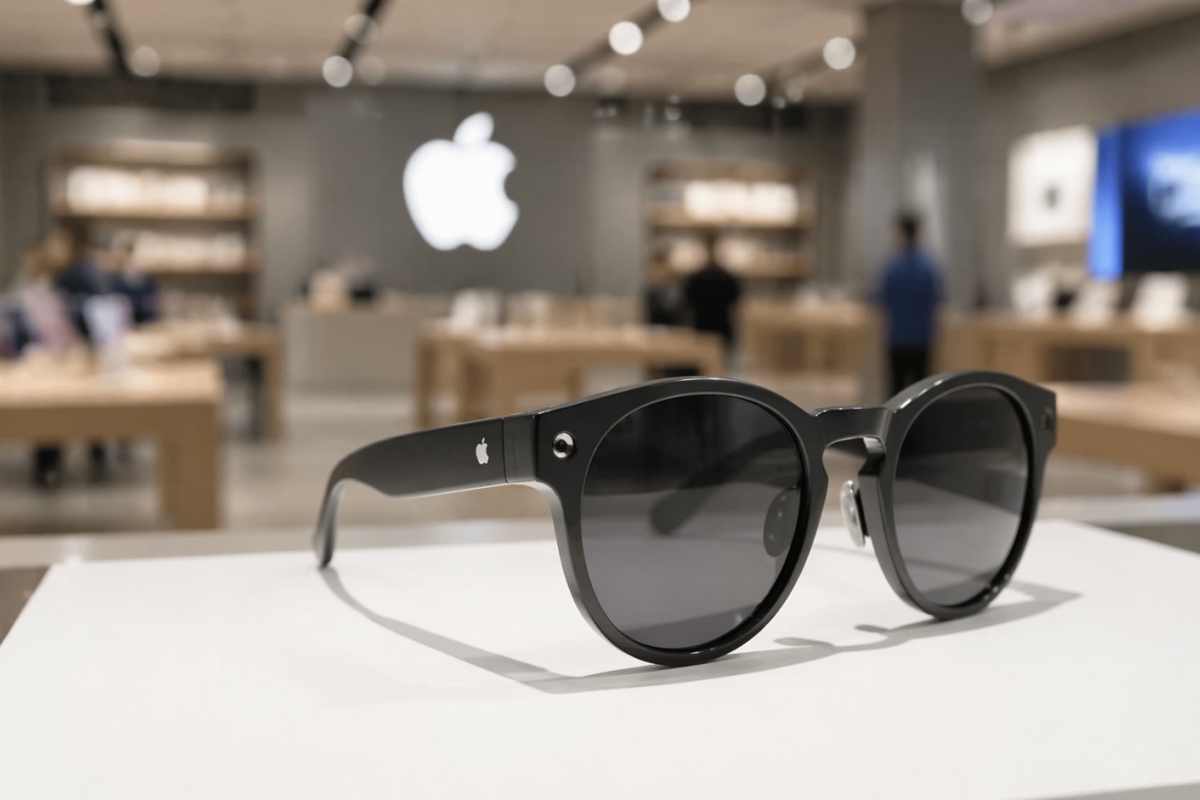
Apple plans for its smart glasses to arrive with several styles and a very different camera
Apple continues to outline its first smart glasses without screena product that, as explained by Mark Gurman in Bloomberghas become one of the company’s big bets to open a new category of hardware more for everyday use than Vision Pro and much closer to the commercial success of products like the Ray-Ban Meta. The novelty now is not only in the calendar, which once again points to a presentation at the end of 2026 or beginning of 2027 with a launch that same year, but in how Apple wants to differentiate this device in design, materials and fit within the iPhone ecosystem.
According to Gurman, the company is testing at least four frame styleswith rectangular and oval variants, as well as multiple finishes. The idea fits with something that Apple has been pursuing for some time: that the product is not perceived as a rare gadget, but as recognizable and desirable glasses in their own right. This is also where the use of acetate comes in as a high-end material, more luxurious and resistant than the usual plastic in many frames on the market.
The other distinctive detail that Bloomberg mentions is that of the camera. Apple would be exploring a system with vertical oval modules and lights arounda different solution to Meta’s visual language. It is a minor change on paper, but important if Cupertino wants to build its own identity in a product that will inevitably be compared to the Ray-Ban Meta from day one.
Apple moves away from Vision Air to find a more salable wearable
The roadmap that Gurman describes fits quite well with what we have already been seeing. In October we already told how Apple had frozen Vision Air to prioritize smart glasses closer to the general public. The logic of that movement remains intact. And the mixed reality market does not enjoy massive sales, while lightweight glasses, without a screen and focused on the camera, audio, notifications and voice assistant have many more options to enter the daily life of the average user.
Gurman also reinforces a key idea. These glasses will be part of a broader strategy of wearables with artificial intelligencealong with new AirPods and other devices with cameras and artificial vision. The goal wouldn’t be to create a full augmented reality experience, but rather to use cameras, context, and Apple Intelligence to power a much more useful Siri. That opens the door to features like smarter Maps directions, visual reminders, quick photo and video capture, or true hands-free interaction.
There is also an important nuance regarding previous information. In October there was talk of glasses without AR as an obvious lack and of a more complete second generation, as we explained previously. What Gurman now suggests is that Apple seems to accept this initial limitation without complexes and turn it into part of the strategy. Before you chase a perfect AR glasses, you want to sell a useful pair of glasses.
More than arriving first, Apple wants to arrive with a more polished proposal
That’s probably the most interesting angle in this whole story. Apple is late to this category, just as it was late to others, but it doesn’t seem to worry too much. According to Bloomberg, the company believes it can compete thanks to integration with the iPhone, its own chips, its network of stores and a more premium finish than that of its rivals. In other words, he doesn’t want to invent the category, but rather appropriate it with the same old manual.
Of course there are risks here. The main one is Siri. If the glasses depend largely on a truly capable version of the assistant, Apple needs iOS 27 and Apple Intelligence to be much more mature than they have been until now. The second risk is that the market has not yet demonstrated that glasses with a camera and voice are a mass product. Meta has paved the way, yes, but it is not clear that this is enough to guarantee a new Apple Watch.
In view of all this, Apple seems to have accepted that the first step will not be full augmented reality, but rather a simpler and easier to sell wearable. First, smart glasses without a screen. Later, if the technology supports, the real AR will arrive. And, in parallel, the iPhone range enlivened by the new Fold that would arrive in September.
