
ChatGPT Ads arrives in Spain next week: this is OpenAI’s largest advertising expansion so far
OpenAI has officially confirmed that ChatGPT Ads coming to 31 European markets next weekincluding Spain, Germany, France, Italy, Sweden, Norway, Denmark, Netherlands and Austria. The announcement does not set a specific day beyond “next week”, although everything points to Monday, August 24 as the start date.
This is the largest advertising expansion that OpenAI has carried out to date, surpassing in market volume the eight expansions that the company has added since it began testing ads in the United States six months ago.
Who will see ads and who will not
Ads will only be shown to users of the free and Go plans. Plus, Pro and Enterprise subscriptions will continue without advertising, as confirmed by OpenAI itself. This distinction makes the absence of advertisements an increasingly clear differentiator between the most basic and higher payment levels, something that has already been noted since the pilot test began in the United States.
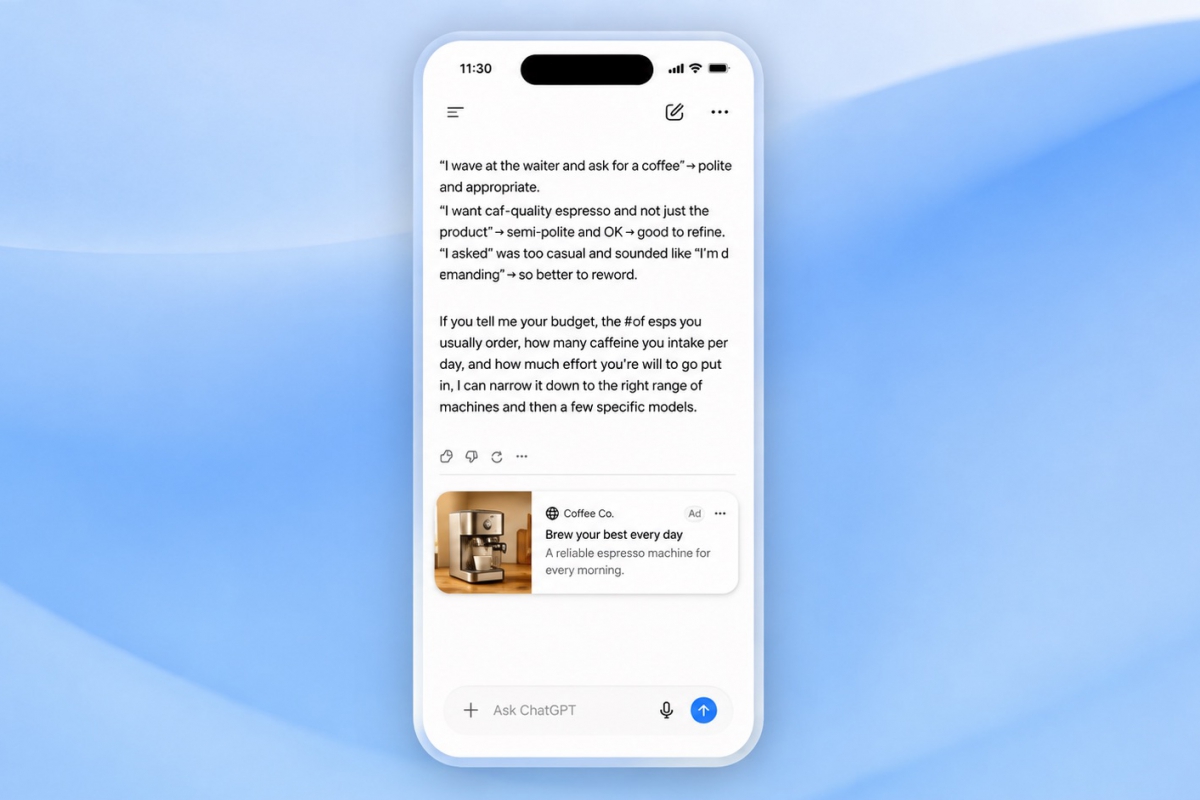
Ads will be shown after chatbot responsesin blocks clearly differentiated from the content generated by the model, and will only be activated when the system detects that the context of the conversation is commercially relevant. OpenAI insists that advertising cannot influence what ChatGPT responds under any circumstances, and that user conversations are kept private from advertisers: the company ensures that it does not sell anyone’s data to third parties.
Initial access limited to agencies and commercial teams
At first, European advertisers will only be able to access ChatGPT Ads through OpenAI’s Ads Solutions teamas well as authorized agencies and technology partners. Self-service access through Ads Manager, the tool that allows any company to manage its own campaigns without intermediaries, will arrive later this summer.
Users, for their part, will maintain control over the advertising personalization they receive.and those who prefer not to see ads at all still have the option to upgrade to one of the ad-free paid plans.
This split between managed access and self-service is common at the start of any new advertising platform: it allows OpenAI to better control the quality and relevance of the first ads that European users will see, before opening the door for any company, without intermediaries, to launch their own campaigns autonomously.
A platform that has been building for six months
OpenAI began testing ads on ChatGPT in February, with a pilot limited to the United States. Since then, the company has added eight additional markets before making this leap to Europe, the largest to date in number of countries incorporated at once.
In parallel, OpenAI has continued to build the technical infrastructure of its advertising platform. Conversion optimization has been added to the initial bidding model for impressions (CPM) and clicks (CPC), designed so that advertisers can orient their campaigns directly towards business results instead of just visibility. Geotargeting and custom audiences have also been added, along with more comprehensive measurement tools: OpenAI’s own pixel, a conversion API, and several integrations with third-party measurement platforms.
According to the company, tens of thousands of advertisers have already used ChatGPT Ads since its launch in the United Statesa figure that gives an idea of the pace of adoption in just half a year of the program’s existence. OpenAI has indicated that it plans to continue expanding advertising formats, optimization tools and measurement solutions as the program advances into new markets, making it clear that this European expansion is an intermediate phase within a development that continues.
A decision that responds to the ChatGPT scale
The arrival of ads to conversations with AI chatbots is a movement that has been seen coming for a long time, and It was especially important for OpenAI in order for its revenue to grow significantly.. The subscriptions make money, but they are just a fraction of what the company is investing in training and serving its AI models, a gap that has been mentioned repeatedly over the last year.
The decision also brings ChatGPT closer to the terrain where Google already competes. Gemini overviews have long coexisted with advertising results within searches, a mechanism that ChatGPT is now beginning to replicate in the European market, although with a different approach: instead of ads integrated into the response, OpenAI has chosen to keep them separate and clearly labeled as such.
With next week’s date already on the table, attention now shifts to how European users will react, a public that has generally been more sensitive to privacy and data protection issues than the American public.
