
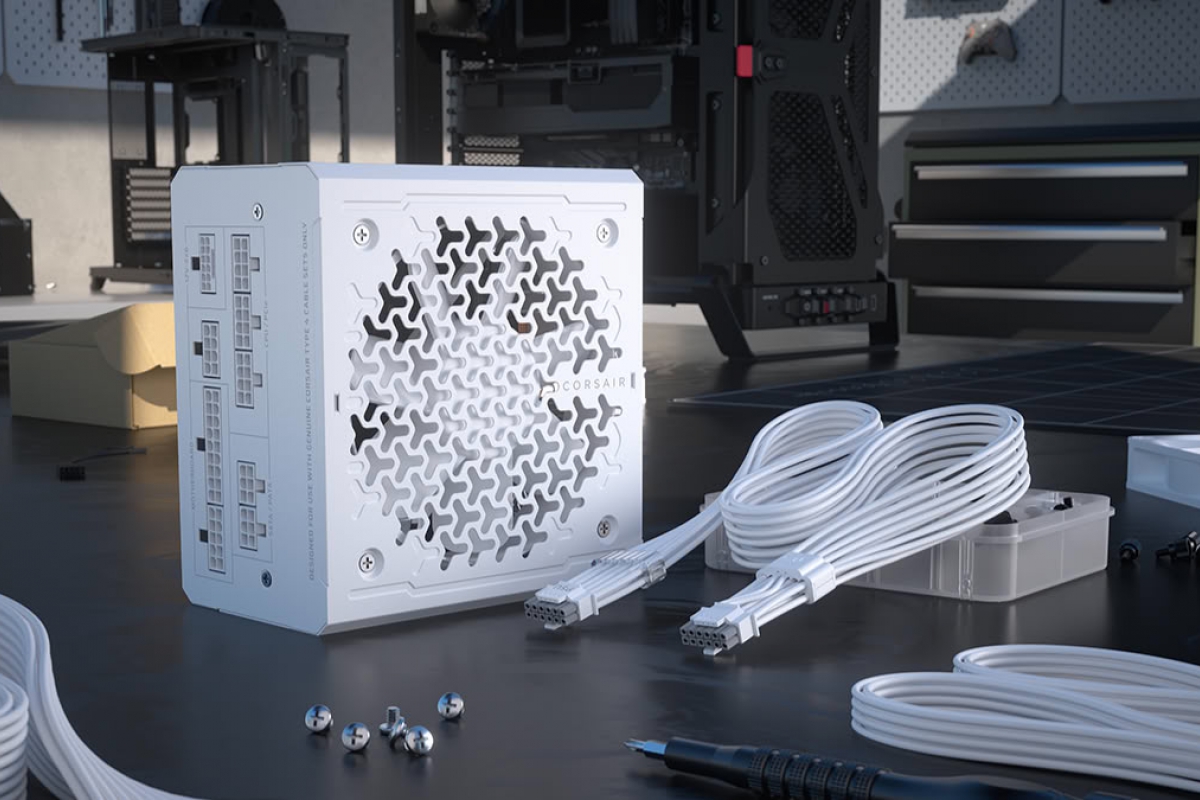
Corsair upgrades its RM850e and RM1000e to Platinum with 65°C cable protection
Corsair has confirmed the immediate availability of its RM850e and RM1000e power supplies together with the 600W ThermalProtect PCIe 5.1 cable with 12V-2×6 connectora combo that had already been anticipated at Computex and that now reaches stores with Cybenetics Platinum certification and a confirmed price in Europe.
The ThermalProtect cable incorporates an over-temperature protection system (OTP) integrated directly into the cable comb, 30 millimeters from the graphics card connector. If the temperature at that point exceeds 65° C, the system wakes up and turns off the GPU to prevent damagesomething specifically designed to reduce the risk of connector melting that has affected some recent generation graphics cards.
Platinum certification, up to 91% efficiency
With this launch, The RMe series leaves behind the Cybenetics Gold certification it had until now to upgrade to Cybenetics Platinumwith an efficiency of up to 91%. The RMe is, according to Corsair itself, its most popular range of sources thanks to the balance between power, functions and price, so this increase in certification affects a considerable sales volume within the brand’s catalog.
Both models maintain the ATX 3.1 certification and PCIe 5.1 complianceplus 105°C capacitors to improve long-term durability. The design is completely modular, so it is only necessary to connect the cables that are actually going to be used, and these arrive with a flat and embossed finish designed to facilitate cable management inside the box.
ThermalProtect’s 12V-2×6 cable features dual-tone connectors on each enda detail designed to be able to check at a glance that both the source side and the graphics card side are correctly fitted, without depending solely on the tactile click of the connector to confirm it.
In terms of cooling, the RM850e and RM1000e maintain a Custom fan curve next to Zero RPM modewhich completely stops the fan when the system load is low or moderate. Corsair indicates that both models have a length of only 140 millimeters, which makes it easy to install in practically any box on the market, including those with the most compact format.
Protection integrated into the cable, independent of the GPU
What differentiates ThermalProtect from other security systems for the 12V-2×6 connector is that monitoring occurs directly on the cableand does not depend on the internal sensors of the graphics card or any third-party software that the user has to install and configure. This distinguishes it from the PinProtect protection that Corsair introduced in its new RM1200e, which instead monitors pin-to-pin current in real time from the source hardware itself.
The RM850e combo with ThermalProtect cable has a price of 139.90 euros in Europewhile the RM1000e version it remains at 174.90 euros.
Both sources are available now through Corsair’s global network of authorized distributors and retailers.as well as in the brand’s own online store. The combo is offered in two finishes, black and white, to adapt to different mounting types.
Corsair backs both the RM850e and RM1000e with a seven year warrantythe same figure that already accompanied the RMe series before this update, along with access to the brand’s global customer service and technical support network.
This pricing and availability confirmation comes several months after Corsair teased the RM850e/RM1000e combo with ThermalProtect as part of a broader refresh of its power supply range, which also included the new RM1200e with PinProtect protection and the high-end AX1600i SHIFT and HX1000i SHIFT CRYSTAL models. While those two more ambitious references are aimed at very high-end or exhibition mounts, the RM850e/RM1000e combination with ThermalProtect aims directly at the majority of users who are looking for a reliable source with extra protection in the connector without paying the extra cost of the top-of-the-range options.
For anyone considering upgrading their power supply for a high-consumption graphics card, this combination adds an additional layer of security at the exact point where most blown connector issues have been concentrated in recent years.
