
https://www.geeknetic.es/Noticia/37582/BIOSTAR-estrena-memoria-DDR5-UDIMM-de-16-GB-en-4800-y-5600-MT-per-second-para-actualaciones-sin-complicaciones.html
There’s a kind of slowness that isn’t noticeable until you get used to it. You open the browser with a thousand tabs, start a video call, put on music and, in the meantime, try to edit a photo. The PC does not hang, but begins to respond with a delay of a second. This microdelay is the typical clue that memory is running shortor that the computer already lives in another generation of RAM.
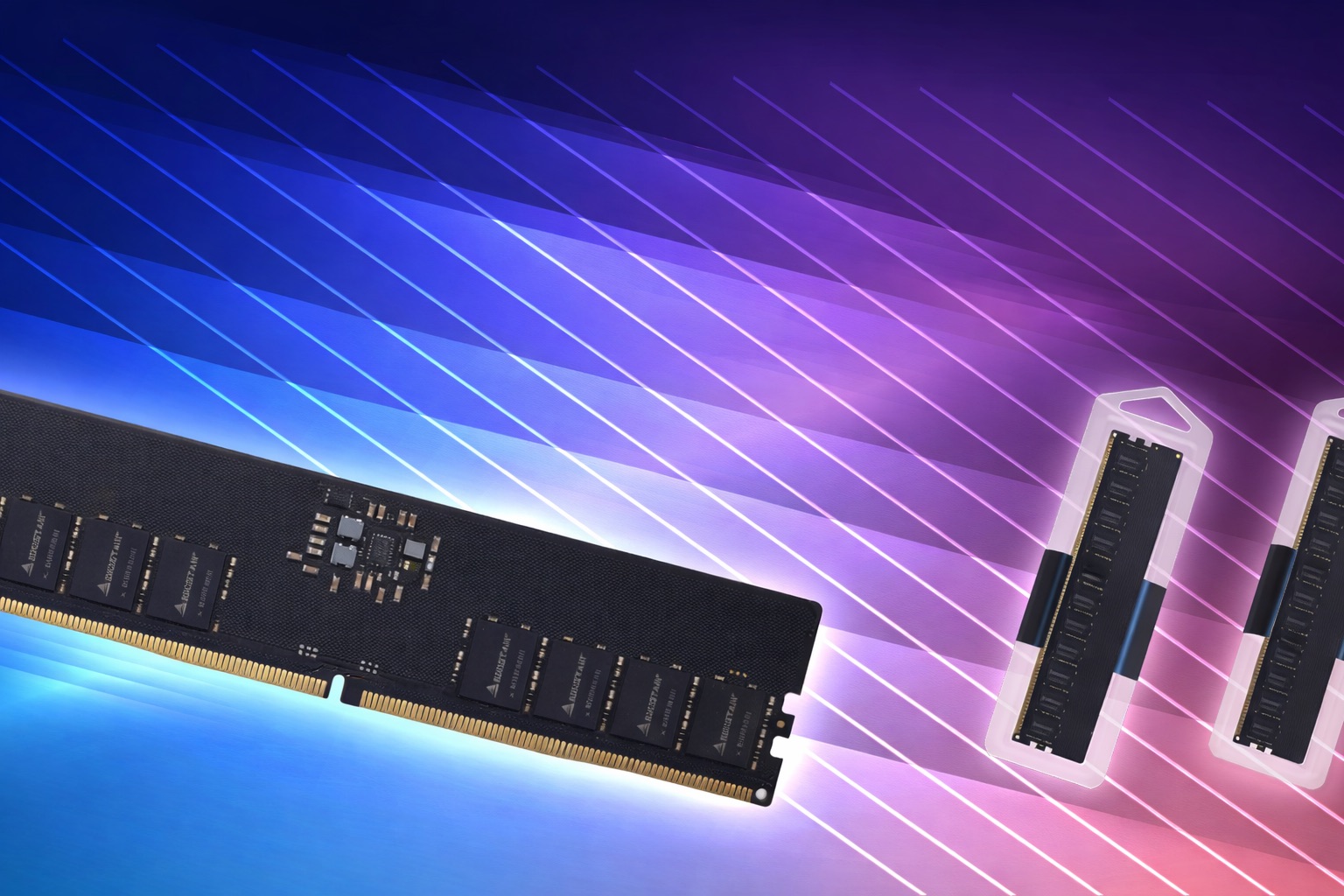
BIOSTAR has just announced new DDR5 modules in UDIMM format and with 16 GB per moduleavailable in two speeds: 4800 and 5600 MT per second. The idea is very direct: offer a desktop expansion option that prioritizes compatibility and stable operation, without going into the league of aggressive overclocking or RGB aesthetics as the main argument.
What comes to the market: two modules, a very standard technical sheet
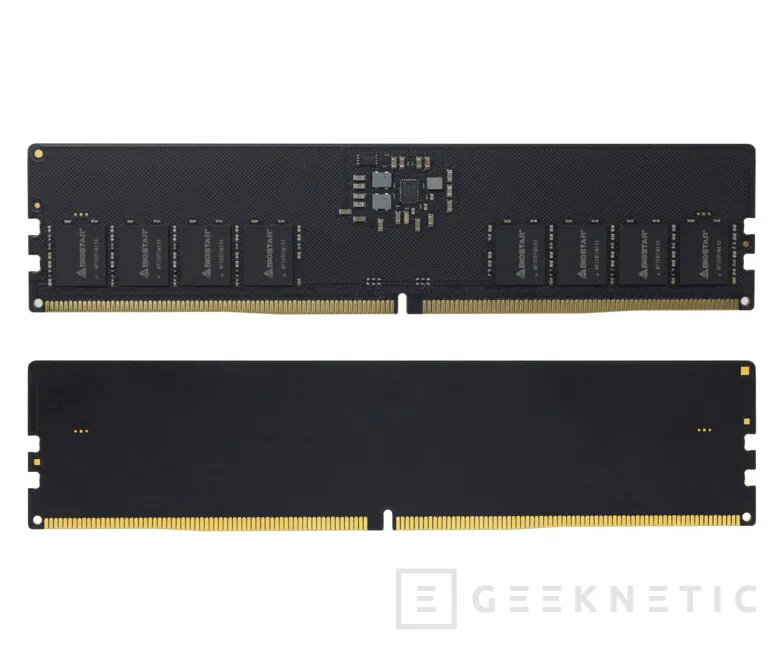
The ad focuses on two 16GB variants. The The first stays at 4800 MHz and the second goes up to 5600 MHz. In both cases, BIOSTAR highlights a voltage of 1.1 V, a power management circuit in the module itself, the PMIC, with JEDEC certification, ECC on-die support and declared compatibility with Intel and AMD platforms.
UDIMM detail is also important: We’re talking about the typical home PC memory format, the one you mount on a consumer motherboard without getting into proprietary modules or server-oriented solutions.
Why 4800 and 5600 are two very practical points in DDR5
DDR5 started with 4800 as one of its base speeds and, with the maturity of platforms and chipsets, 5600 has become a very common step in current equipment. The standard contemplates these rates and higher ones, but for the average user these two values are the ones that usually best match the reality of compatibility and price.
If we put an easy number on the table, the theoretical bandwidth per channel of 64-bit would be 38.4 GB per second on DDR5 4800 vs 44.8 GB per second on DDR5 5600. It is not a promise of automatic improvement in all programs, but it does help to understand why faster memory can hold up better when the system is doing several things at the same time.
PMIC and 1.1 V: the electrical part that is almost never explained well
DDR5 brings a change of focus on power: part of the voltage regulation is moved to the module itself using a PMIC. This has practical implications for efficiency and stability when working at higher frequencies. That’s why BIOSTAR insists on two ideas: 1.1 V as nominal voltage and a PMIC aligned with JEDEC.
At the user level, the message is simple: memory should behave as a plug-and-play component, especially if the goal is to expand a computer without touching advanced parameters in the BIOS.
On die ECC: it is not server ECC, but it provides extra robustness
Another concept that can be misleading is on-die ECC.. In DDR5, this error correction occurs within the memory chip and is intended to improve reliability in normal use. It is not the same as traditional ECC server memory, which requires specific support and adds parity bits at the module level, but it is part of the DDR5 package of stability-oriented improvements.
Who a 16 GB module fits today
A 16 GB module is a wild card. With two modules you reach 32 GB, which is already a very reasonable figure for playing games, working with many open apps, editing photos or moving medium-sized projects. It also serves to expand a computer that already had 16 GB and is beginning to suffer with intense multitasking.
The choice between 4800 and 5600 is usually more sensible than it seems: 4800 is the safe step for expansions and usually has the best balance between price and compatibility; 5600 is the sweet spot if your motherboard and processor support it without issues and you want extra headroom under heavy loads.
What is missing to complete the news: latencies and real price
As with many RAM launches, two key pieces of information remain to be landed: the exact latencies and the final price in stores, in addition to the actual stock. Speed in MT per second is only part of performance, and latencies complete the picture. Even so, BIOSTAR’s move fits with the market moment: DDR5 is already the natural lane for many platforms, and simple, stable modules with standard specifications are needed so that expanding a desktop becomes a formality again.
