
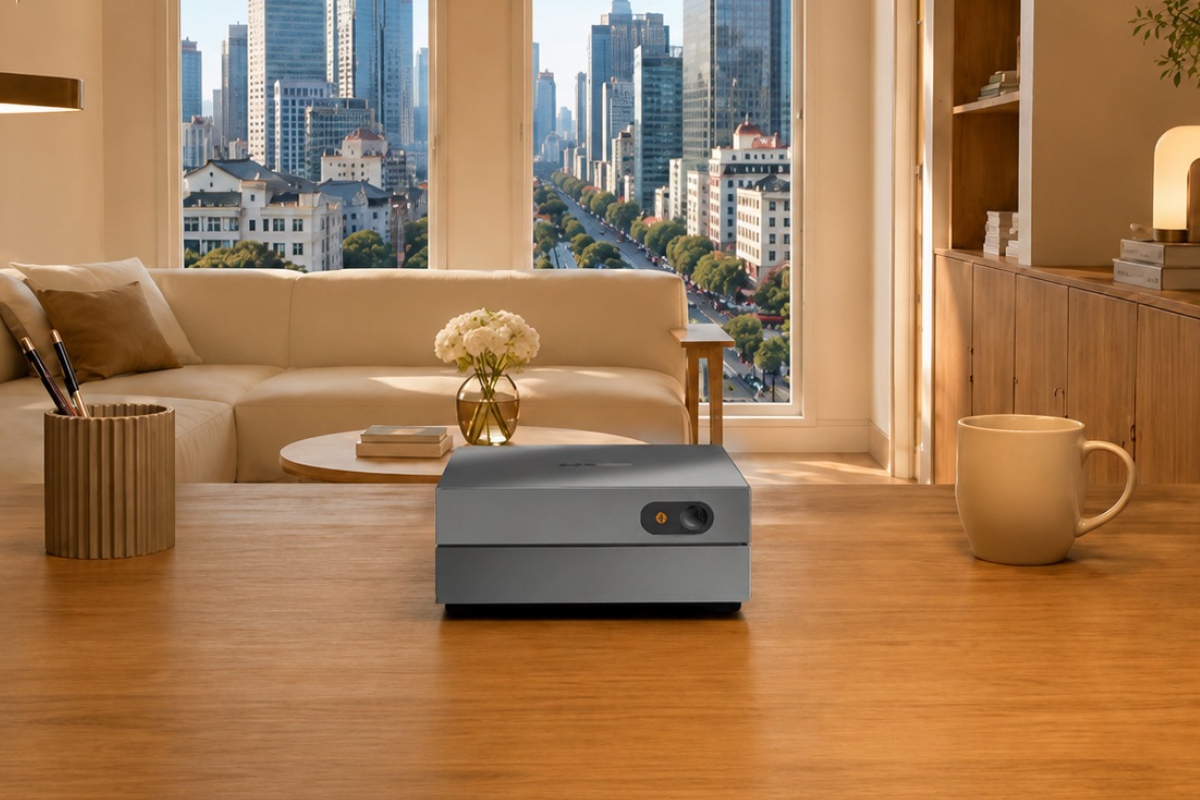
Lenovo skips Intel and AMD in its new AI Host Mini, equipped with a Chinese SoC
Lenovo has presented a new mini PC oriented to local artificial intelligence tasks that draws attention for an unusual decision: instead of turning to Intel or AMD for the processor, the Chinese manufacturer has opted for a Cixin P1 SoC, developed in China. The device, named AI Host Minijoins the growing offer of compact equipment designed to execute AI functions without depending on the cloud.
The commitment to a nationally manufactured chip is not accidental. In a context where several Chinese manufacturers seek to reduce their dependence on American suppliers for certain product segments, seeing a commercial mini PC built around a local SoC is significant, especially when it is a brand with Lenovo’s international projection.
Specs: Modest but sufficient AI power
According to data published by Lenovo, the AI Host Mini offers a total AI computing capacity of 45 TOPS. The equipment comes equipped with 8GB LPDDR5-6000 memory and a 256GB SSDa configuration that makes it clear that we are dealing with an input device within the local AI segment, not a workstation-level system.
These figures place the AI Host Mini as a proposal designed for light inference and home or office automation tasksrather than for model training or intensive workloads. The amount of memory, relatively adjusted for current local AI standards, reinforces the idea of an access product, aimed at those who want to start experimenting with AI functions without assuming the cost of more powerful equipment.
A tiny chassis
Beyond computing power, the AI Host Mini’s other big claim is its size. The chassis measures 100 × 100 × 48.65 mm and weighs just 0.373 kgdimensions that Lenovo takes advantage of to also sell it as a “0.48 liter mini host.” It is a volume small enough to be placed on a desk or shelf without taking up much space, in line with other ultra-compact mini PCs that have been gaining ground in recent times.
This focus on size is not just an aesthetic issue. For a device intended as a “host” of AI functions that can remain on continuously in the background, minimizing the physical footprint facilitates its integration into any environment, from a home to a small office, without the need to reserve a specific space for it as would occur with a conventional desktop tower.
Tianxi Claw platform instead of Windows
One of the most particular aspects of this release is the system on which it works. The AI Host Mini does not arrive with Windows or a standard Linux distribution, but with the Lenovo Tianxi Claw platforma proprietary environment designed specifically for this type of AI-oriented devices.
According to the company, equipment configuration is done scanning a QR code from your mobilea process that replaces traditional software installation and simplifies startup for users less familiar with manually configuring a system. Once configured, the Deployment of artificial intelligence functions is managed through its own system that Lenovo calls Skillsa kind of catalog of capabilities that can be activated according to the needs of each user.
This approach moves the AI Host Mini away from the traditional definition of a general-purpose mini PC. It is not intended to replace a conventional desktop computer in everyday tasks such as browsing, working with office automation or editing documents, but rather works more like what could be described as an agentic PC– A device built around specific hardware to run AI agents and functions autonomously.
A different approach within the mini PC segment with AI
The market for mini PCs aimed at artificial intelligence has grown rapidly in recent months, with manufacturers betting on increasingly powerful chips in smaller formats. However, most of these proposals are still built on Intel or AMD processors, which is why Lenovo’s choice of a Cixin P1 SoC stands out within that panorama.
Although the features of the AI Host Mini do not compete with those of a high-end AI-oriented device, it does offer something different– An operating system and configuration flow designed from the ground up for AI tasks, rather than adapting a general system for this purpose. This differentiation, together with the extremely compact size of the chassis, makes the AI Host Mini a unique product in a market that, until now, had been almost completely dominated by configurations based on conventional x86 platforms.
Lenovo has not yet detailed price or availability outside of China for this device, although its presentation suggests that the company will continue to explore this line of products focused on local AI, where the small size and ease of configuration seem to weigh as much as raw computing power when defining the proposal.
