
Mozilla shows the new Firefox and prepares a broader redesign that also leaves clues about mobile improvements
Mozilla has officially presented the evolution of Firefox’s design with an announcement that confirms what has been anticipated for weeks. The company explains that it is working on a renewal of the browser’s interface and design system under the internal name of Project Novaa project that will roll out later this year and that seeks to make Firefox feel cleaner, warmer, faster and more adaptable without breaking with its historical identity.
Mozilla’s publication makes it clear that it is not a new browser, but rather a deep review of its visual and functional base. Mozilla defines the change as a renewal, not a replacement, and focuses on privacy, speed, visual consistency and personalization. In fact, some of these lines had already been seen when the first signs of Nova were leaked, the most ambitious redesign of Firefox in years.
One of the pillars of the redesign is privacy. Mozilla explains that its new interface will make tools such as private browsing or the free VPN integrated into Firefox more visible, in addition to redesigning the settings area to make data decisions easier to understand. The company also confirms that there will be controls to completely disable AI functions and clearer language on everything related to data protection and processing.
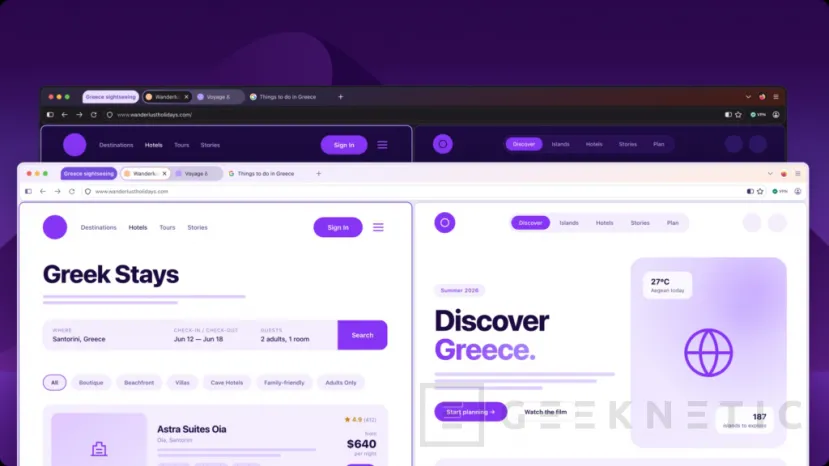
Mozilla accompanies the news by addressing another topic just as important as the UI, namely, that of performance. According to the company, over the last year Firefox has improved loading times of the main content of pages by 9%. At the same time, the new design aims to accelerate usage flows with more visible access to tab groups, split view and vertical tabs. As if that were not enough, compact mode returnsa function that many users had been asking for for some time and that Mozilla acknowledges having recovered after hearing that feedback.
Firefox changes on desktop, but mobile screenshots point to something more important than it seems
In the visual field, Mozilla talks about eyelashes with softer shapes, subtle gradients, more rounded components, new icons and a palette inspired by warm and smoky purple tones. The goal, as he explains, is for Firefox to look current without falling into a generic design. The intention is to continue looking like Firefoxbut with a more uniform interface between menus, panels, settings and browser controls.
The announcement focuses mainly on the desktop, although one of the most interesting details is in the mobile screenshots shared by the company itself. There you can see a much more careful interface and, above all, the tab groups icon appears in the overview. That suggests that Mozilla could finally be getting closer to a more robust experience of syncing and continuity between devices, an area where Chrome and Edge have long offered much more mature integration.
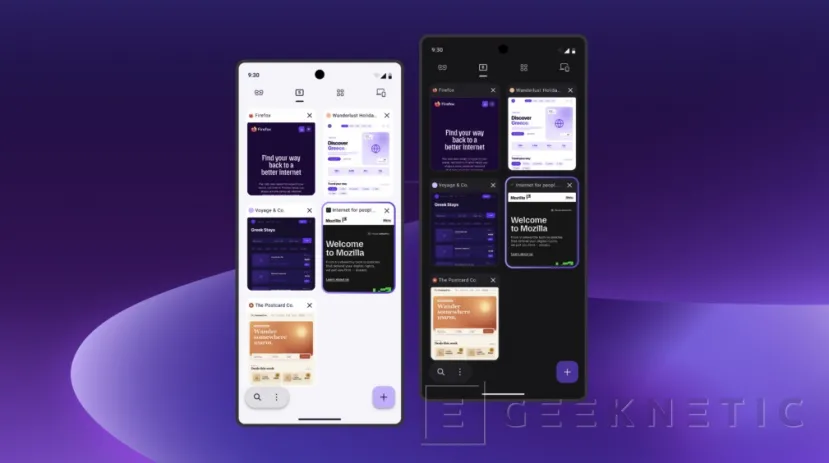
It is not a minor detail, because Firefox has for years had a certain feeling of being behind in some everyday functions, despite maintaining a differential proposal in privacy and control. In this context, visual renewal matters, but Convenient synchronization between mobile and desktop matters even more. If Mozilla manages to combine both things, the change would have much more weight than a simple facelift.
Project Nova fits with a broader transformation phase within Mozilla
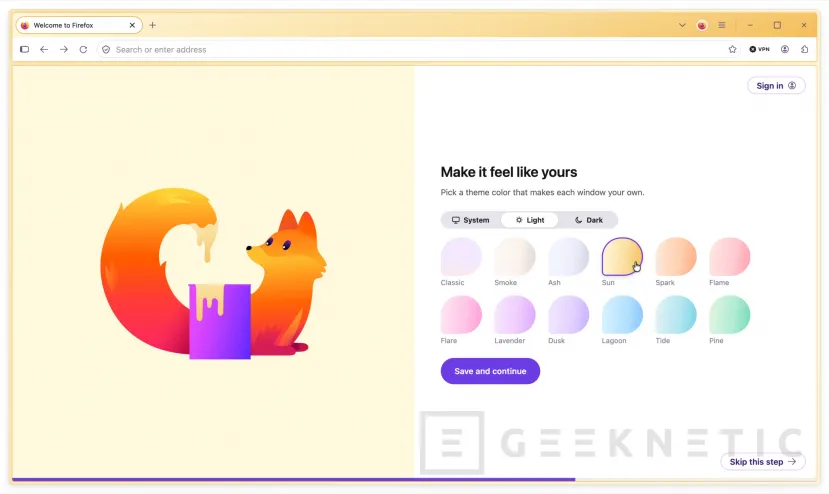
Firefox isn’t doing too well. The arrival of Anthony Enzor-DeMeo as the new CEO already anticipated a phase of change with the intention of bringing Firefox to a broader ecosystem and not limiting it only to the role of a traditional browser. Project Nova fits that idea quite well, because it not only updates the look, but attempts to build a more scalable foundation for future features and for a more consistent experience across devices.
Mozilla also insists that Firefox is still being built publicly and asks the community to continue providing feedback as the new design system takes shape. That’s one of the keys to this ad. The company seems to be clear about where it wants to go, but it is still in a phase of progressive deployment. AND I should probably speed up a little morebecause many of these functions arrive late compared to options as refined and established as Chrome.
