
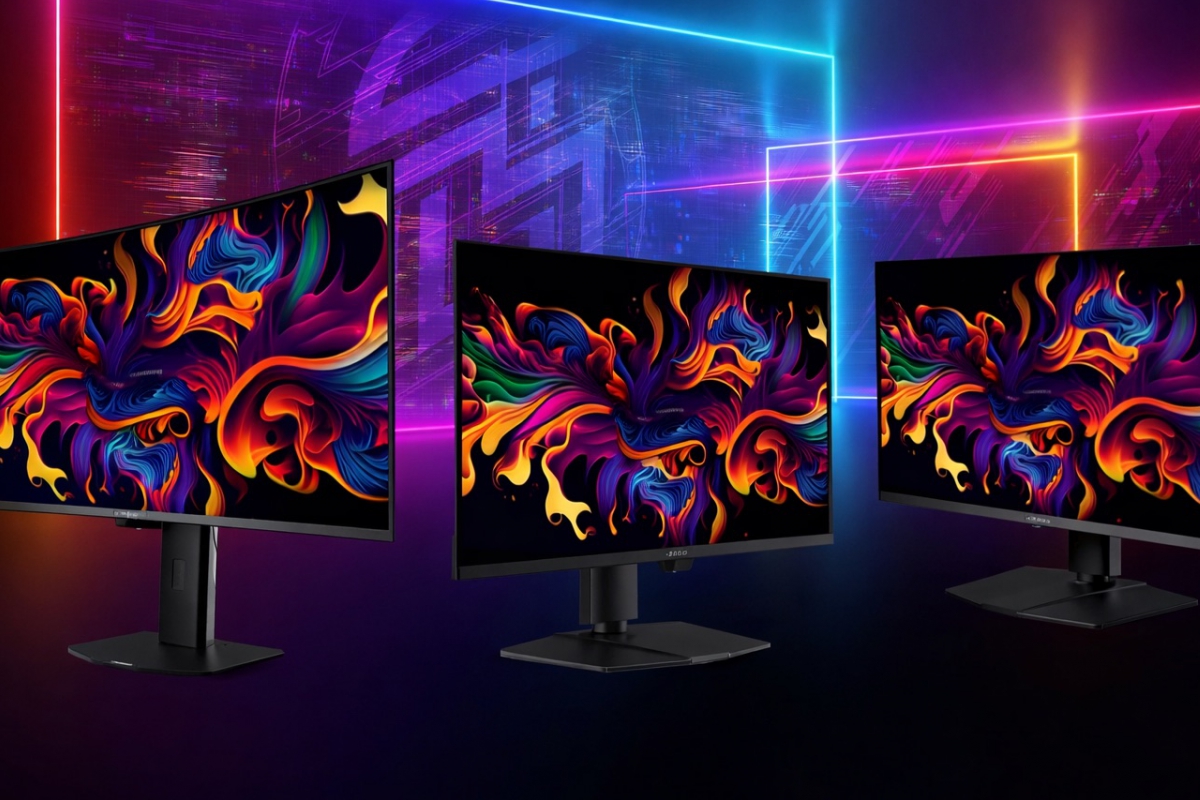
MSI reinforces its 2026 QD-OLED monitors with Penta Tandem technology
The OLED monitor market has gone from curiosity to serious scrutiny. On the desktop, perfect blacks are not enough: there are long sessions, fixed interfaces and many hours of continuous use. In that context, MSI has decided that 2026 will be its year to raise the bar in QD-OLED, iintegrating what is called Penta Tandem in its line of monitors.
What’s behind Penta Tandem in a QD-OLED panel
The concept points to a layered OLED architecturewith a five-layer tandem design designed to improve the luminous efficiency and useful life of the panel. The brand’s materials mention the use of a five-layer design along with new generation materials, with an efficiency jump of around 30% compared to previous solutions.
Translated into actual use, more efficiency means that the panel can achieve a concrete luminance level with less effort. And that is usually relevant for two reasons: less heat buildup and less degradation with the passage of time. In monitors, where the screen lives on for more hours than a TV, this balance is especially important.
The focus of 2026 on MSI’s QD OLED range
MSI does not present Penta Tandem as a whim for a single model. His message is that the technology is integrated through its 2026 QD OLED cataloga move that suggests widespread adoption and not just in the most expensive range.
At the same time, details of launches oriented to media formats have been appearing. 32 inches with 4K resolution and 240 Hza combination that seeks to compete in the most demanding segment of gaming and creation. It is not about improving a panel to shine in HDR, but rather about maintaining high performance in long sessions.
In OLED there is always a recurring fear: retention and burning by static elements. On the desktop it is a plausible scenario, not an urban legend, because we live with bars, icons and repeated windows. The most sensible approach to reducing that risk combines two avenues: material and efficiency improvements, and intelligent panel management.
That’s where Penta Tandem’s argument makes sense.. If the screen gains efficiency, it can better distribute the work necessary to produce light. In practical terms, at the same brightness, the panel looks less forced; and if it is not so forced, it ages more evenly. MSI talks about efficiency and longevity as objectiveswithout selling it as a miracle solution, but aligned with what the market has been asking for since OLED began to appear on the desktop.
It’s also key to distinguish between flashy peaks and sustained brightness. On monitors, true HDR relies heavily on stable luminance in mixed scenes, not just a brief spike in a small window. If the panel withstands these scenarios better without aggressive cuts, the daily experience improves.
QD-OLED and why this jump affects color and HDR
QD-OLED combines OLED emission with a quantum dot layer for color reproduction. This usually translates into very vivid colors, a wide color volume and the contrast typical of OLED. If the new tandem design manages to increase the useful brightness margin, the direct beneficiary is HDR, because there is more space for highlights without the need to limit so much due to consumption or temperature.
In gaming, MSI is pushing with 4K proposals at 240 Hz in 32 inches, a specification that, by itself, already implies panel and electronic requirement. In this area, improving efficiency is not a detail: it helps maintain performance and consistency without penalizing as much in long sessions.
What changes for those who buy a monitor in 2026
The final verdict will come with units in hand and measurements: window brightness, ABL behavior, stability in HDR, uniformity after many hours. But the movement already leaves a clear reading.
The first is competitive. If MSI extends this architecture in its range, it pressures rivals to accelerate their own evolution. The second is maturity: Desktop OLED needs to be less finicky and less niche, and efficiency leaps are one of the pieces that make that transition possible.
The third is practical: For those who work with fixed interfaces, OLED always tempted by contrast and clarity, but was held back by fear of intensive use. If 2026 brings more efficient panels and, on paper, more prepared to endure long days, the entry barrier will lower.
MSI thus places the focus on what really decides an OLED monitor on a desktop: not only how it looks on the first day, but how it maintains itself after hundreds of hours of work, games and windows stuck.
