
NVIDIA and LG to build AI factory for robotics, autonomous driving and data center infrastructure
Jensen Huang has already said that robots are the present and the future. Now, NVIDIA and LG Group have announced the construction of a AI factory with which they seek to accelerate several lines of business linked to physical artificial intelligence, mobility and infrastructure for data centers. As explained by both companies, this platform will serve as a basis for training, simulating, validating and deploying AI applications in areas such as robotics, autonomous driving, cloud services with GPUs and data center technologies.
The initiative combines NVIDIA’s end-to-end platform for AI factories with the presence of LG in consumer electronics, robotics, mobility, smart spaces and infrastructure. The goal is to connect model development, data generation for physical artificial intelligence, robot simulation and training, edge deployment, and factory-scale digital twins in the same workflow.
In the industrial field, the companies have explained that the combination of LG’s production data and experience in global manufacturing with NVIDIA’s infrastructure will allow progress towards a autonomous manufacturing ecosystem. The idea is to link in real time, through data and artificial intelligence, the entire chain that goes from the purchase of raw materials to production, logistics and delivery to the customer.
Robotics, synthetic data and industrial automation
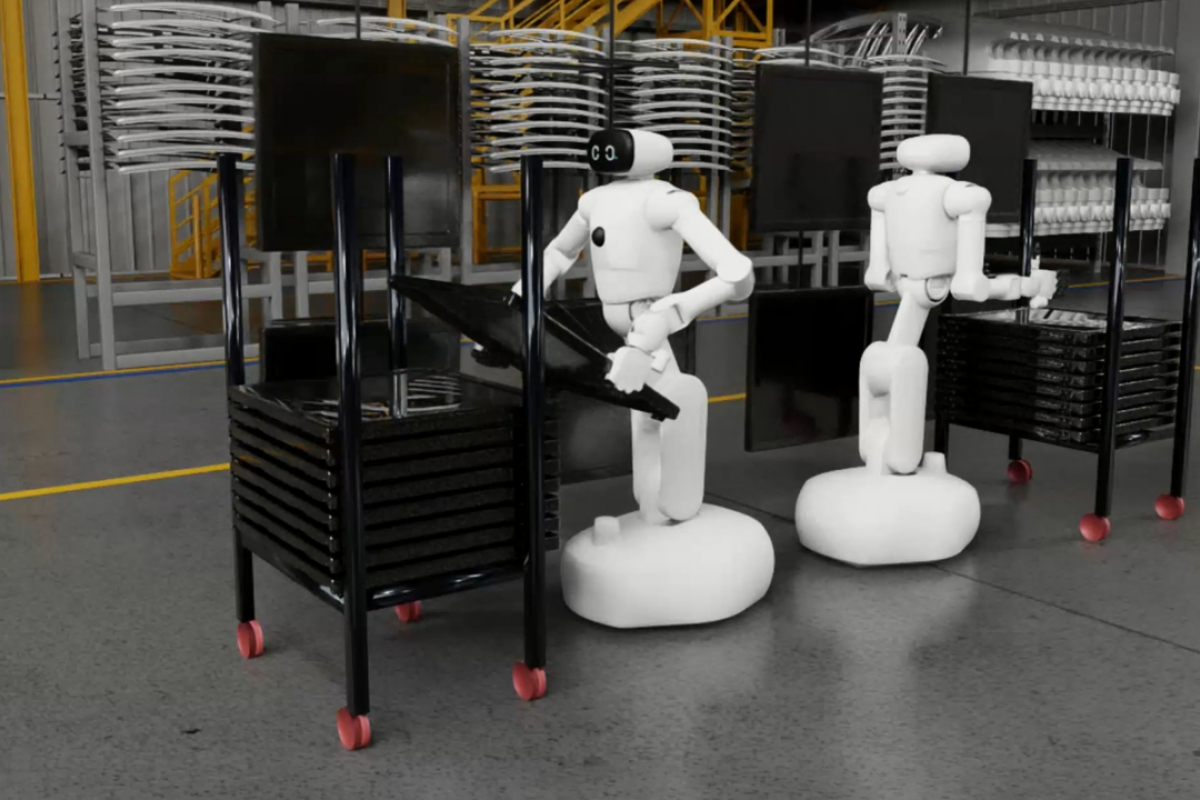
Within the agreement, LG will use NVIDIA Isaac Sim and Isaac Lab in the development of domestic robots such as CLoiD, in order to simulate, train and validate these systems in physically precise virtual environments before their deployment. The company is also studying the use of NVIDIA Isaac GR00T for home robots and modular platforms, in addition to working with NVIDIA on reference robots within that ecosystem.
LG Electronics has also indicated that it is developing a data factory for physical artificial intelligence aimed at providing training data for industrial robotics and AI projects, both in Korea and other markets. To do this, it will use NVIDIA Cosmos models to generate and expand synthetic data.
Other subsidiaries of the group will also participate in the project. LG Innotek plans to contribute robotics components and sensorization solutions Optimized for NVIDIA development environments and GPU architecture. For its part, LG CNS will integrate NVIDIA technologies such as Isaac, Cosmos and Isaac GR00T into its PhysicalWorks platform to facilitate the adoption of AI robots in logistics and manufacturing.
EXAONE data centers, mobility and development
The collaboration also covers the construction of infrastructure aligned with NVIDIA DSXincluding liquid cooling solutions, coolant distribution units, cold plates and prefabricated modular design to deploy high-performance, scalable supercomputing. Within this framework, LG Uplus plans to build AI factories and a large data center prepared for the latest NVIDIA GPUs, while LG Energy Solution will work on 800-volt direct current energy solutions for data centers.
In mobility, LG Electronics will continue to collaborate with NVIDIA to align your in-vehicle ADAS and AI systems with the NVIDIA DRIVE platform. Work will include sensors, compute and software architecture based on NVIDIA DRIVE Hyperion and NVIDIA DRIVE AGX, with a focus on autonomous driving, software-defined vehicles, AI-powered cockpits and edge processing.
Additionally, NVIDIA and LG AI Research collaborate on the development of EXAONE, one of Korea’s sovereign models. LG AI Research has used Blackwell GPUs, the NeMo framework, Nemotron datasets and TensorRT-LLM to support the development and deployment of the model. LG Group is studying expanding the use of EXAONE and agentic technologies within its businesses through platforms such as ChatEXAONE, its corporate chatbot based on this model.
