
NVIDIA Expands Partnership with Doosan to Power Robotics, Energy and Data Center Infrastructure for AI
NVIDIA has announced an expansion of its collaboration with Doosan Group to explore new opportunities in physical artificial intelligence, robotics and AI factory infrastructure. The agreement covers several divisions of the South Korean conglomerate, including Doosan Robotics, Doosan Bobcat, Doosan Enerbility and Doosan Corporation Electro-Materials BG, with the aim of combining NVIDIA’s accelerated computing platform with industrial capabilities linked to automation, power generation and advanced materials.
The news also comes shortly after NVIDIA presented a similar alliance with LG Group, also aimed at building infrastructure and workflows for physical AI. In this case, the focus changes from a more transversal approach in electronics, mobility and cloud to one heavily supported by industrial machinery, electrical power and components for data center systems. That is, NVIDIA continues to weave agreements in South Korea to cover different pieces of the future value chain of AI factories.
As both companies have explained, the collaboration will study how technologies such as NVIDIA DSX, NVIDIA MGX, and the NVIDIA Physical AI Stack They can be applied to various areas of the group. Doosan has businesses ranging from collaborative robots to large power generation systems and printed circuit board materials, putting it at various levels of the infrastructure needed for next-generation data centers.
Industrial robotics, autonomous machinery and new platforms
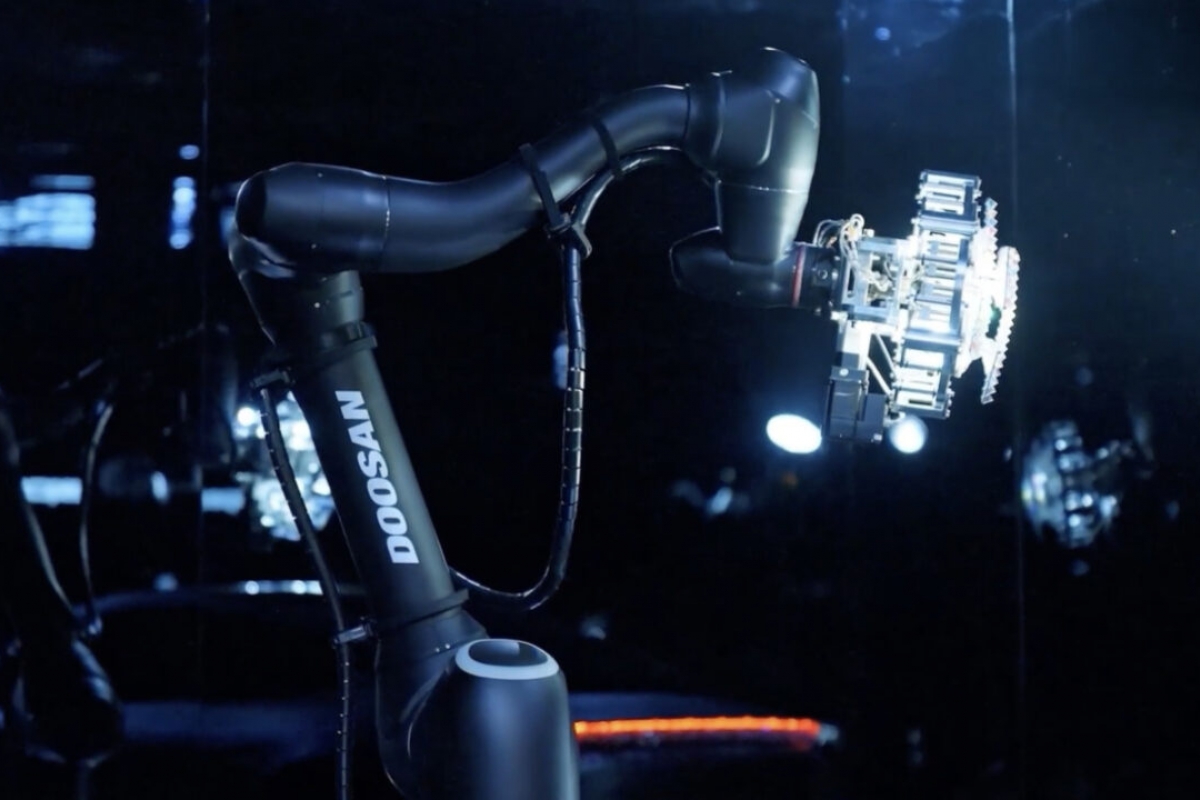
In the field of robotics, Doosan Robotics will integrate NVIDIA Isaac Sim, Isaac Lab, Cosmos, Newton and Jetson Thor in the development of its Agentic Robot OS, an artificial intelligence-based platform that connects perception, reasoning, simulation, learning and local inference. The company points out that this integration will allow its industrial robots to better adapt to complex and variable environments, with workflows that connect simulation and real deployment.
The two companies also contemplate the development of high industrial value use casesincluding tasks such as depalletizing and sanding, as well as new robot formats such as double-arm or humanoid platforms. Doosan presents this move as part of a broader evolution, with which it seeks to go from a provider of robotic arms to a company of complete robotic solutions with an AI-first approach.
The alliance also includes Doosan Bobcat, which will study the integration of NVIDIA physical AI technologies in equipment for construction, agriculture, landscaping and material handling. The work aims to develop specialized world models that allow these machines to better interpret the environment, reason in the face of changes in the situation, and operate with greater autonomy. Both companies also want to contribute to a more standardized ecosystem for compact autonomous machinery.
Energy for AI factories and materials for servers
Another of the key pieces of the agreement is Doosan Enerbility, which will explore ways to support the NVIDIA’s AI factories and the DSX platform through its portfolio of large-scale energy solutions. The company mentions gas turbines, steam turbines and small modular reactors, along with Doosan Fuel Cell hydrogen fuel cell systems. Future collaboration could cover power supply design for AI deployments, optimization of generation equipment, and assessment of low-carbon sources.
In parallel, Doosan Corporation Electro-Materials BG will participate through advanced PCB materialsspecifically copper clad laminate or CCL, a base component for printed circuit boards used in networking equipment, AI accelerators, and server motherboards. The company frames this activity within the NVIDIA MGX ecosystem, a modular reference architecture with which different manufacturers can build accelerated systems and racks for AI factories.
In this way, NVIDIA adds Doosan as another relevant industrial partner in its strategy to take artificial intelligence beyond model training. The collaboration covers everything from robots and machinery to energy and materials, that is, several of the elements that may be decisive in the deployment of large-scale AI infrastructures in the coming years.
