
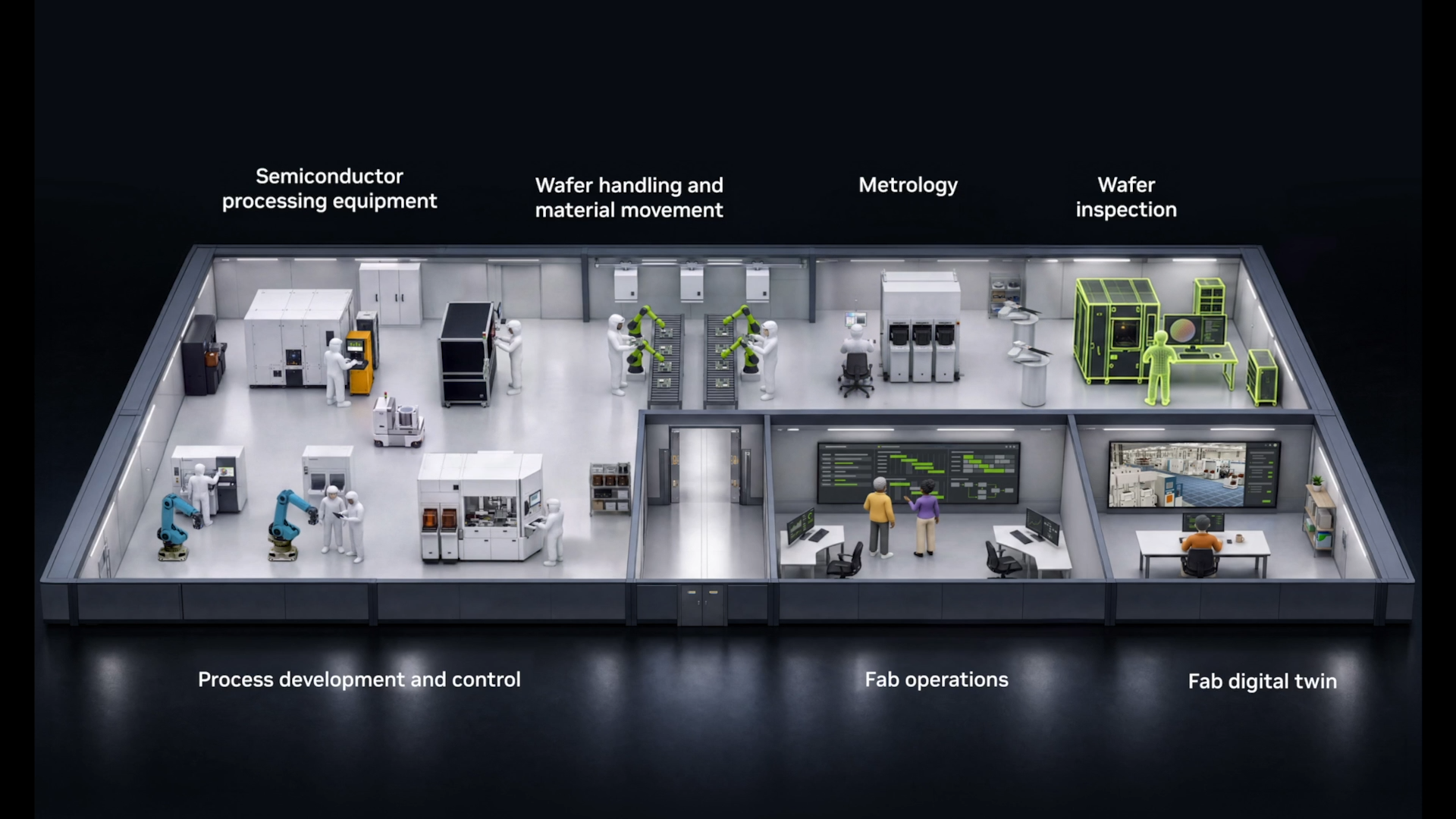
NVIDIA shows how Lam Research, Applied Materials and Siemens use their AI to accelerate chip manufacturing
Lam Research has shown that it can predict in milliseconds how plasma, the electrically charged gas used to etch circuits on silicon wafers, behaves versus the days required for a full simulation of that process. This is just one of the examples that NVIDIA gives to explain what is called an AI-defined factory. What exactly does it refer to?
Simply put, it is a semiconductor plant where accelerated simulation, physics-trained models, AI agents, and digital twins help engineers make decisions before doing physical testing.
And, as the company explains, each experiment on a production line is slow and expensive. As if that were not enough, some analyses, such as finding out the origin of a defect or how a material will react to a new process step, can take several days.
In the case of Lam Research, the tool used is PhysicsNeMoan NVIDIA framework for creating AI models that learn from physical laws and therefore do not need to solve all the equations every time a parameter is changed.
Simulations up to 35 times faster
The rest of the cases focus on accelerating simulations that already existed. For example, COMSOL is specialized in multiphysics software. This is how you model how heat, electricity and mechanical stresses interact. Now accelerate your semiconductor manufacturing simulations by up to ten times with NVIDIA’s cuDSS library.
Applied Materials sees a similar improvement in its Ginestra platform over CPU alone, while its ACE+ platform, combined with PhysicsNeMo, runs the topography simulations up to 35 times faster.
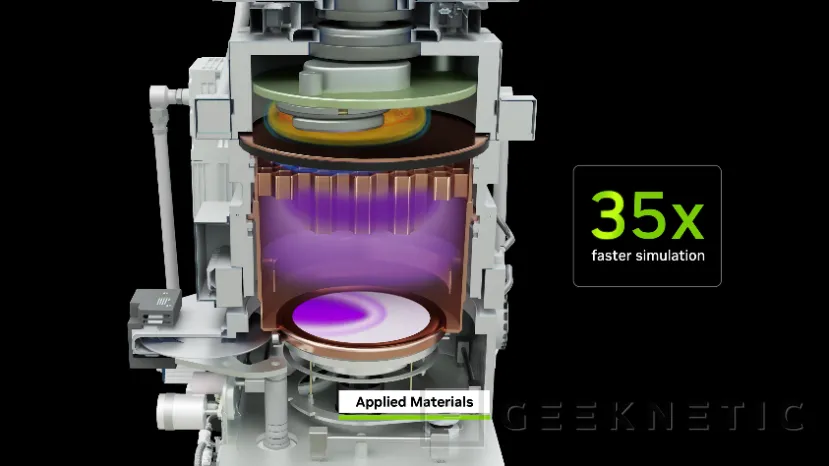
For its part, Siemens is integrating cuLitho into its Caliber lithography software, with speedups of up to 17x in some core workloads. Computational lithography calculates how circuit patterns are printed onto silicon. In this sense, NVIDIA assures that, at production scale, these calculations are too heavy to be completed with CPU alone.
NVIDIA also talks about AI agents and digital copies of factories
AI agents are also present in all this AI deployment. One company that makes chip testing equipment uses NVIDIA NeMo Switchyard agents to automate a specific step, namely choosing which AI model to apply to each task on the test floor. According to NVIDIA, it was a manual and sequential process that could take hours and is now resolved in minutes.
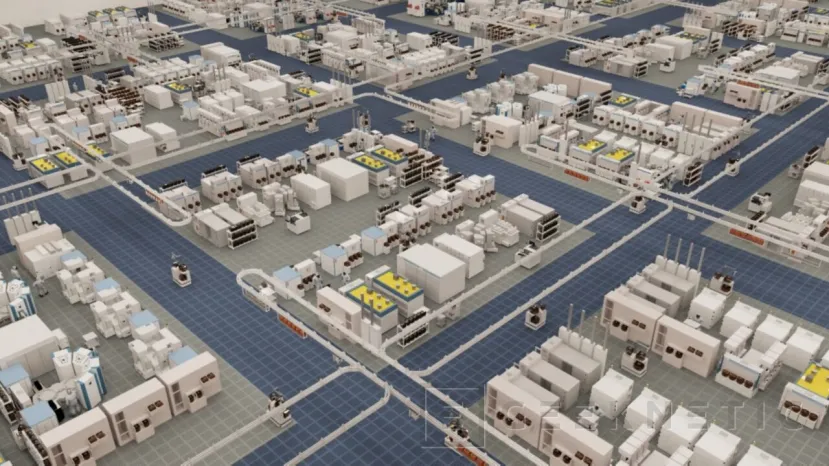
Again, Applied Materials builds with NVIDIA Omniverse libraries digital twins of complete factories, which are virtual replicas like the ones you see in the image above. With them, you can simulate the movement of materials, detect bottlenecks and evaluate different distributions and operating strategies before applying them in the real plant.
