
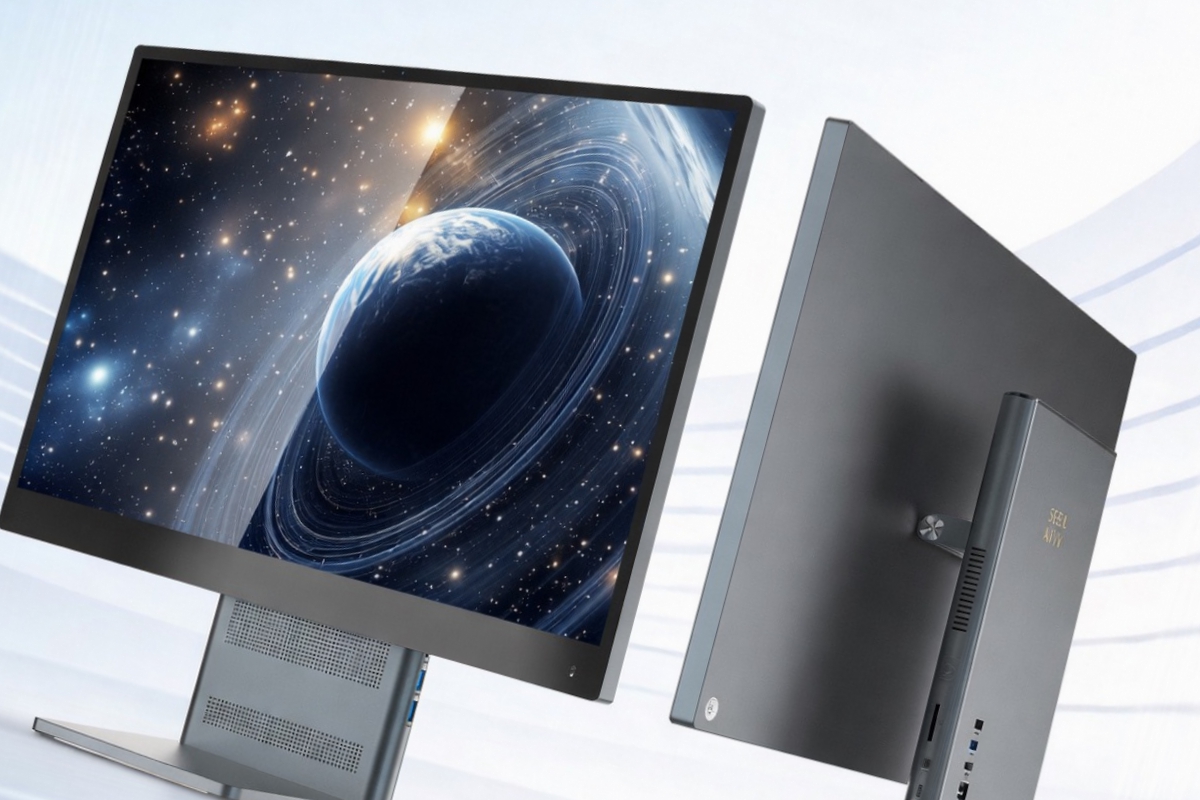
SEAVIV AidaONE R27, an all-in-one with Ryzen AI Max+ 395 that puts the PC on the stand
There are computers that try to attract attention for their power and others for their design. He AidaONE R27 wants to do both at the same time: on the outside it looks like a thin monitor, but on the inside carries one of AMD’s most ambitious chips for compact equipment. The idea is unusual in an all-in-one: separate the screen from the part that generates heat.
SEAVIV has presented the AidaONE R27, a 27-inch all-in-one with 4K panel which is based on the Ryzen AI Max+ 395. Its proposal does not revolve only around the processor, but also around a curious physical architecture: most of the hardware does not go behind the screen, it goes inside the base or base.
A design that changes the classic all-in-one recipe
In most all-in-ones, the screen acts as the lid of a large laptop: panel in front, plates and cooling just behind. Here SEAVIV has chosen a different approach. The body of the panel boasts a thickness of 15 mm, with a glass front and an anodized aluminum back.
The trick is in the support. By moving the CPU, memory, storage and cooling to the base, the display module can be thinner and is isolated from the heat generated by the processor and integrated graphics. In addition, the base allows you to adjust the inclination from minus 5 degrees to plus 21 degrees.
Ryzen AI Max+ 395: big laptop muscle in a compact format
The heart of the team is the AMD Ryzen AI Max+ 395an APU designed to push hard in creation, serious multitasking and workloads with local AI. AMD lists it with 16 cores and 32 threads, with a boost of up to 5.1 GHz and 64 MB of L3 cache.
In graphics, the set is supported by the Integrated Radeon 8060San iGPU that seeks very high performance to be integrated, especially if it is combined with fast memory.
SEAVIV accompanies that chip with 128 GB of LPDDR5X at 8000 MTs and with a 2 TB M.2 2280 PCIe 4.0 SSD. To expand, there is a second M.2 2280 slot.
Refrigeration and energy: serious equipment figures
The change in architecture is especially noticeable in the cooling. The company talks about a system with double fans and three heatpipes, designed to sustain up to 120 W of system power. Power is provided by a 240 W external adapter.
The reading is clear: SEAVIV intends for this all-in-one not to remain a pretty piece of office equipment, but rather a station capable of withstanding long tasks without collapsing due to temperature.
4K screen and extras designed for teleworking
The AidaONE R27 mounts a 27-inch IPS panel with 3,840 by 2,160 pixel resolution60 Hz refresh rate, 360 nits brightness and 100 percent coverage of the sRGB space. It is not a gaming monitor, but it is a very logical format for light editing, productivity and general creative use.
SEAVIV includes a 5 MP webcam based on the OmniVision OS05A10 sensorwith a field of view of 86.7 degrees, and is accompanied by two microphones with digital noise reduction. The integrated audio remains in two 3 W speakers, suitable for video calls.
Connectivity: ports so as not to depend on hubs
In wireless, the equipment mounts a AMD RZ616 module, based on MediaTek MT7922, with WiFi 6 and Bluetooth 5.2. In cable, it incorporates dual Ethernet 2.5 GbEa detail more typical of compact stations than of a domestic all-in-one.
As for ports, USB4 type C with DisplayPort and Power Delivery output, several USB 3.2 Gen 2 type A, a USB 2.0, HDMI 2.0, 3.5 mm jack, 3-in-1 SD reader and Kensington slot are mentioned. Altogether, it is designed to connect fast external storage, an extra monitor and peripherals without going crazy.
Price and availability: a clearly premium positioning
The AidaONE R27 is listed in China for 21,999 yuan, an approximate conversion that is around 2,685 euros. With that figure, the objective is clear: clean desktop, 4K screen and a chip capable of moving creation and local AI with big memory. The combination of 128 GB and double 2.5 GbE also sounds like a workflow with NAS, video libraries and heavy projects without depending so much on the cloud.
It remains to be seen its availability outside of China and, above all, how it performs in real tests: sustained performance, noise under load and panel calibration. But as a concept, the AidaONE R27 points to a clear trend: the all-in-one makes sense again when it offers integration and power without compromising design.
