
Snapdragon Reality Elite: 60% more graphics power and 20% extra battery in the new mixed reality brain
The Evolution of Virtual Reality towards Mixed Reality
Virtual reality glasses technology is changing to become more integrated into everyday life. Although the most representative characteristic of the Traditional VR has been to completely isolate ourselves in digital worlds, current market trends seem to be moving more towards mixed reality. In this philosophy, virtual elements overlap and interact realistically with the physical environment that surrounds us, rather than introducing us to a virtual world isolated from the environment. At the same time, augmented reality also continues to advance to miniaturize components and create much lighter glasses for everyday use.
The uses of this type of system cover both consumer level and professional and business environments. Games, multimedia entertainment, or assistance systems for education, healthcare environments, technical training, etc.
Qualcomm is one of the brands that has made the strongest commitment to this sector, with a base that already exceeds 60 million virtual and mixed reality devices on the market. His previous chip, the Snapdragon XR2 Gen2, It gave life to virtual reality glasses, with mixed functions, such as the Quest 3, and now, with the launch of its successor, we can see the evolution towards more integrated environments where the virtual joins the basic reality, and not as an extra function.
The new Snapdragon Reality Elitein addition to brand new nomenclature, also comes with a development from scratch to encompass autonomous Virtual and Mixed Reality viewers with greater performance, efficiency and a clear focus on advanced capabilities for local AI processing.

New Snapdragon Reality Elite with up to 60% more graphics performance and 30% CPU
The new Qualcomm Snapdragon Reality Elite announced today for high-end Mixed Reality systems, comes with significant improvements in both CPU and GPU performance when compared to the data of its most immediate predecessor, the Snapdragon XR2+ Gen 2.
On the part of the main processor, the CPU improves its gross performance by 30%, reducing energy consumption by 45% under the same workloads when compared to the previous generation. Don’t forget that many VR/XR glasses use their own battery, and efficiency is key.
c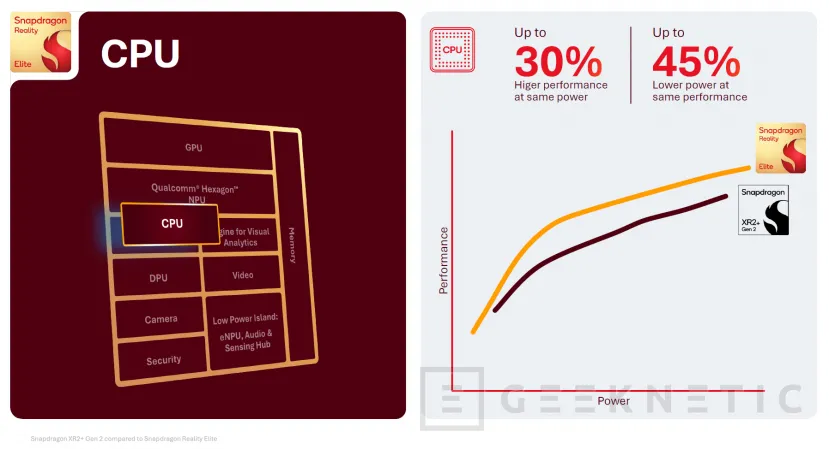
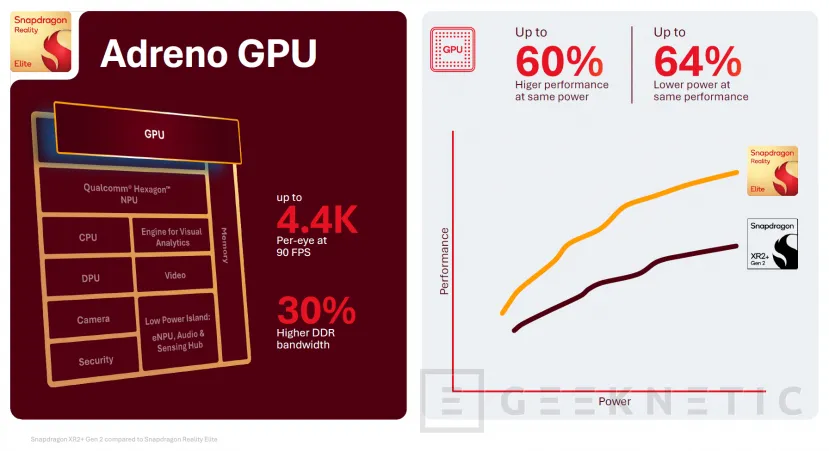
The Adreno GPU has been updated to offer up to 60% more graphics performance while consuming the same energyor a consumption saving of 64% if the same level of performance as the previous model is maintained. This increase in power is what makes it possible to handle high resolutions of up to 4.4K per eye with a refresh rate of 90 FPS, gaining sharpness and color fidelity.
In addition, the GPU adds hardware support for technologies such as Ray Tracing or Mesh Shading.
AI also reaches virtual reality: The Hexagon NPU performs 160% more
The artificial intelligence It is being integrated into every current technological product, whether it makes sense or not. In the case of virtual reality and mixed reality systems, having advanced AI capabilities for positioning, environment and object recognition, etc., is very necessary; That is why the NPU has a fundamental weight in this Snapdragon Reality Elite processor to be able to perform AI processing tasks locally without depending on external servers that add latency. After all, having high latency in a VR system is something that can ruin the experience and even cause dizziness.
He Snapdragon Reality Elite includes a NPU Hexagon new generation that It reaches 48 TOPS of power dedicated exclusively to AI tasks.
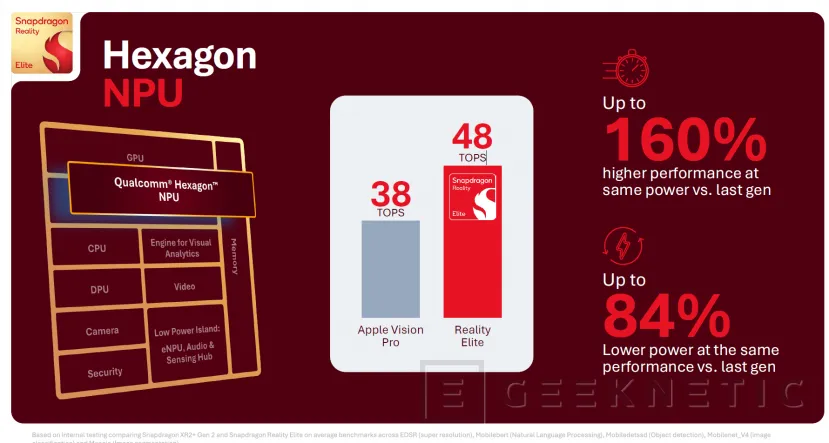
The company boasts of this performance compared to the competition, since models such as the Apple Vision Pro remain at only 38 TOPS of AI processing. Compared to the previous Snapdragon XR2 model, this means multiplying the AI performance by more than two while maintaining the same consumption, specifically, we are talking about a 160% performance improvement over the Snapdragon XR2+ Gen 2
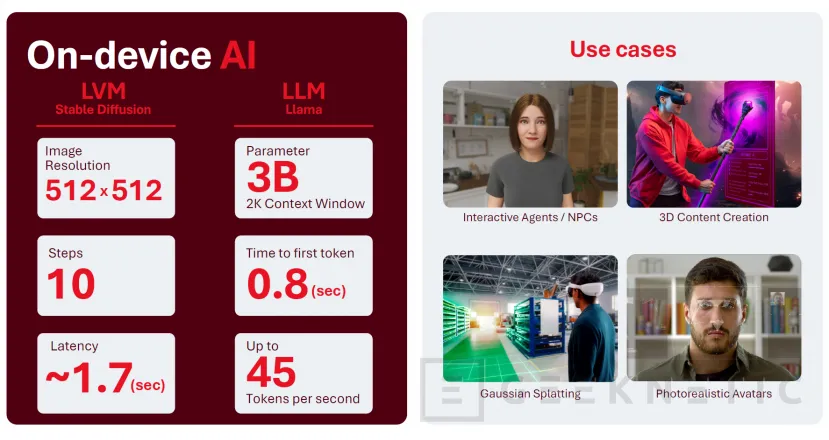
Thanks to this hardware, the device can internally run vision models (LVM) and language models (LLM) of up to 3 billion parameters (3B). Internal performance testing shows that it is capable of moving the Llama model at a speed of 45 tokens per second, with a latency of just 0.8 seconds to drop the first token.
If we go to the generation of images with Stable Diffusion at 512×512 resolution, the response time is about 1.7 seconds.
All this with greater efficiency, since at the same performance, it offers an 84% reduction in consumption than the last generation.
EVA visual analytics accelerator frees CPU and GPU from environment and motion detection
Another key point in the architecture of this Snapdragon is the inclusion of an independent physical block or module called EVA (Engine for Visual Analytics, or “Engine for Visual Analysis”). It is a dedicated hardware accelerator that will be dedicated exclusively to the mapping system, depth, environment detection, etc. thus freeing the CPU and GPU from this task.
This EVA module exclusively manages the detection of environmental features, sensitivity to motion and depth, 3D point clouds and geometric reconstruction in real time. Qualcomm promises a 10% reduction in latency by making the CPU and GPU not involved in functions such as hand detection or head movements.
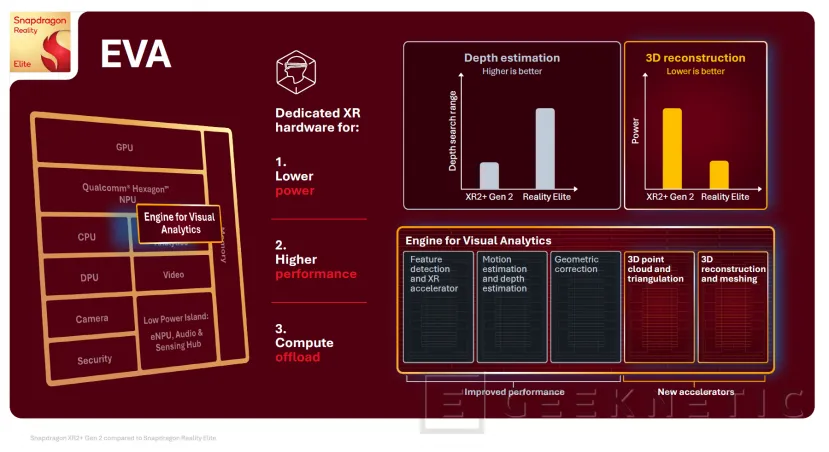
This improvement also influences augmented or mixed reality systems where video of the environment needs to be transmitted in real time. In these cases, power consumption is reduced by up to 33% while the quality of the background image is improved.
Lower temperature and up to 20% more autonomy
Despite the increase in performance in all sections, the Snapdragon Reality Elite also improves the overall efficiency of the chip, which represents a direct improvement in the temperatures and battery life of the glasses that use this chip.
According to Qualcomm, the Snapdragon Reality Elite is capable of running up to 12 degrees Celsius cooler under heavy loads compared to the XR2+ Gen 2.
This drop in temperature will allow manufacturers to dispense with heavy dissipation systems and will facilitate the design of much thinner, more compact and lighter glasses for use during long sessions with greater comfort. In fact, we recently analyzed the ASUS ROG XREAL R1, and one of its main handicaps was, precisely, the high temperatures it reached in the frontal area. Being able to have advanced systems that do not heat up is an interesting advantage.
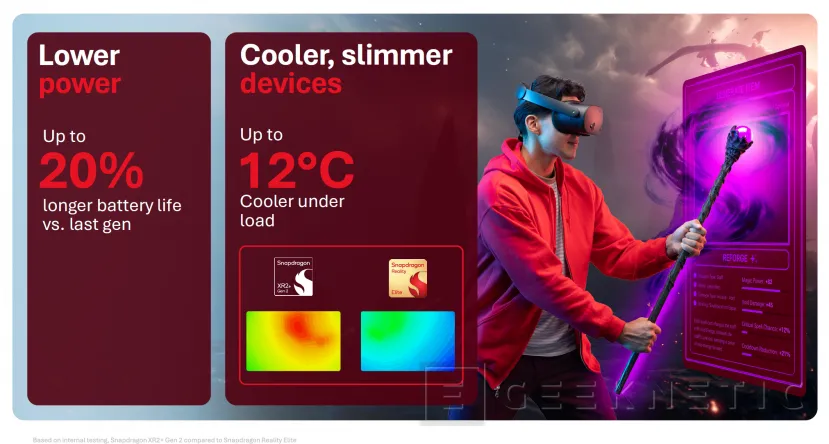
The Snapdragon Reality Elite promises 20% more autonomy
In terms of energy management, the chip achieves greater efficiency, increasing the battery life of glasses that integrate it up to 20% more.
From XR glasses to smart rings in Qualcomm’s personal AI ecosystem
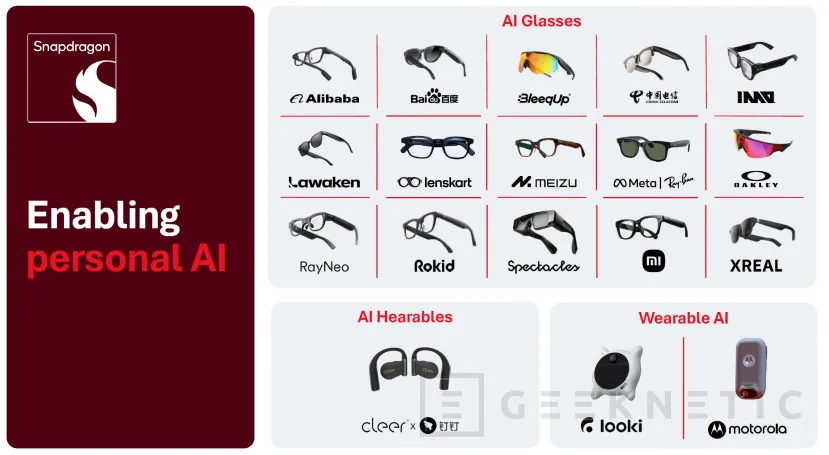
One of the glasses that will integrate the platform Snapdragon Reality Elite will be the new XREAL Auraa model that can be tested at the AWE 2026 fair that is taking place these days. It will also come to new models of mixed and augmented reality glasses in different formats.
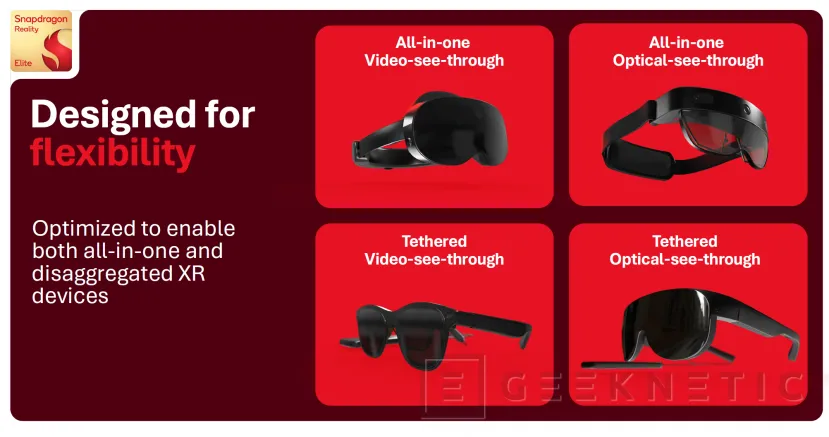
The Snapdragon Reality Elite is therefore positioned as the high-performance platform for high-end virtual reality and mixed reality glasses. It will share space with the Snapdragon XR2+ Gen2, Snapdragon XR2+ Gen 1 and Snapdragon
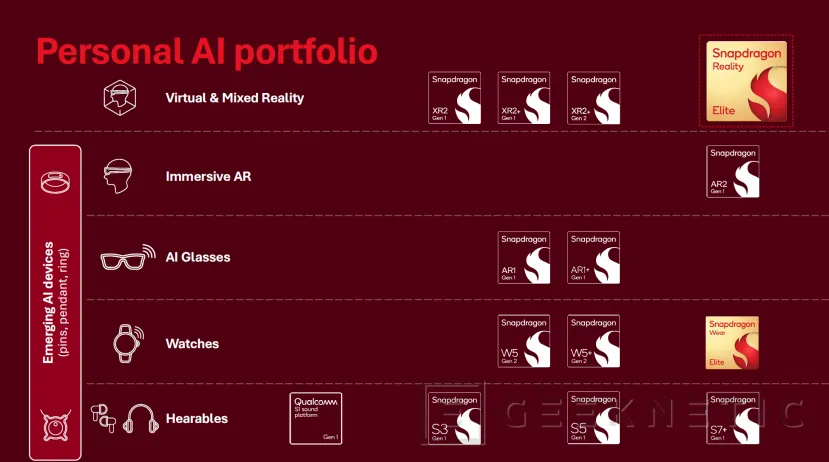
Within the company’s catalog, it will be the Snapdragon AR2 Gen 1 who continues to maintain the market niche of immersive augmented reality glasses, followed by the AR1 and AR1+ Gen 1 for screenless AI glasses.
The smart watches have their own Qualcomm platform, the Snapdragon Wear Elite for high-end, with W5+ Gen 2 and W5 Gen 2 for intermediate models; while the headphones have the Snapdragon S7+ Gen 1 platforms for the highest-end models, followed by the S5 and S3.
Second generation of the Smart Ring Controller
Along with these platforms, there also comes a new type of device that is seen more and more: smart rings. They are, as their name suggests, a ring-shaped wearable in which monitoring sensors are integrated, such as pulse, blood oxygen, UV radiation or movement sensors, in order to control activity, sleep and status without having to go to larger devices such as watches.
Qualcomm has the second generation of the Smart Ring Controller with the Snapdragon S7+Gen1 and the development of Kiwear. It offers low-consumption WiFi and Bluetooth Low Energy connectivity to achieve low latencies in real environments with all types of wireless networks in the environment.
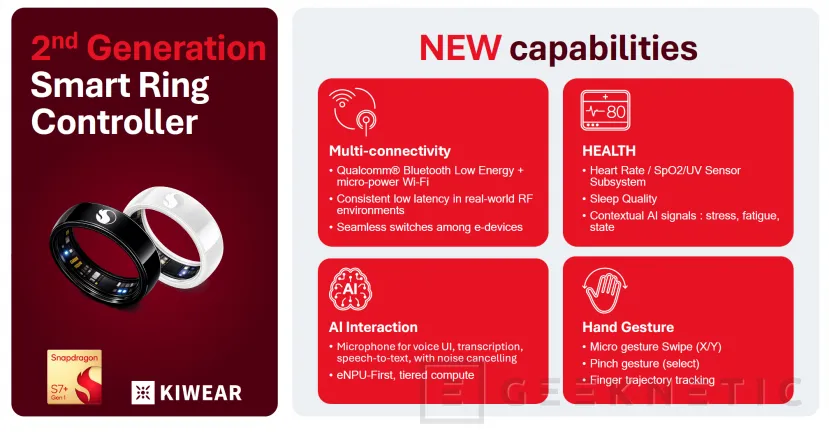
It is capable of managing pulse sensors, blood oxygen (SpO2), ultraviolet, sleep monitoring and signals of stress, fatigue or general condition thanks to the use of contextual AI. This AI also has microphone support, so it can transcribe speech to text with noise cancellation, and all with an integrated eNPU for local processing.
This controller also includes support for hand gestures such as swiping, pinching to select items, or pointing with finger paths.
