
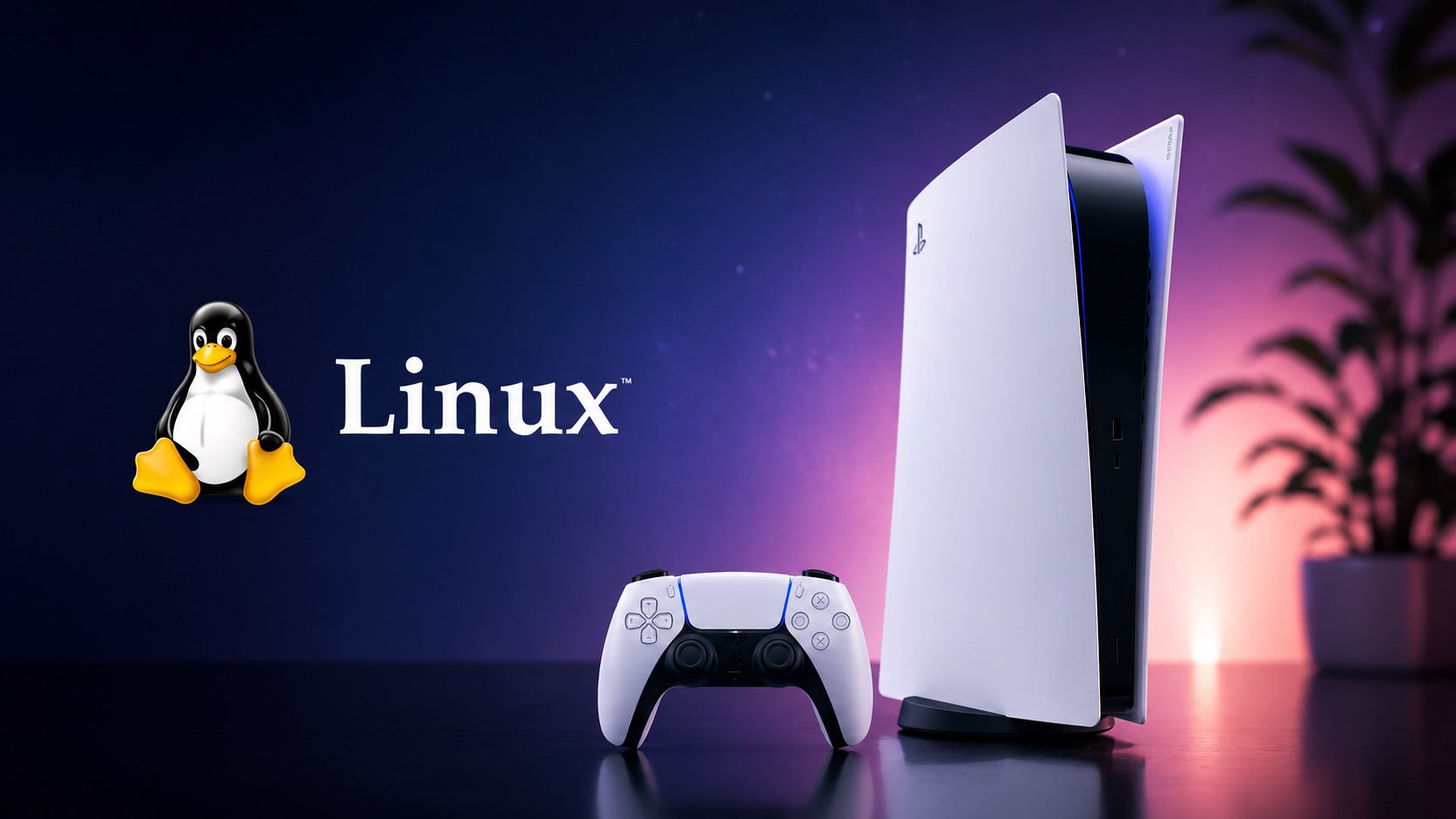
Sony console becomes a desktop PC
The PlayStation 5 is no longer exclusively a gaming machine. Andy Nguyena security researcher known in the homebrew scene as TheOfficialFloW, has just openly published the PS5-Linux project: a loader that allows you to install and run a complete Linux distribution on Sony console hardware. What until recently was a technical demonstration reserved for a small group of developers, now available on GitHub so that any user with compatible hardware and firmware can try it out.
It should be made clear from the beginning that this is not a function enabled by Sony nor is it part of any official program.
What consoles and firmwares are compatible
The project does not work on any PlayStation 5. In its current state, PS5-Linux is only compatible with PS5 “Phat” models (the originals, the largest) and only under very specific firmware versions: from 3.00 to 4.51. Firmwares in the 3.xx range (3.00, 3.10, 3.20 and 3.21) are supported, but without support for M.2 storage, while versions 4.xx (4.00, 4.02, 4.03, 4.50 and 4.51) do allow the use of an M.2 drive installed in the expansion slot.
Firmwares 6.xx or higher are completely ruled out. 5.xx firmwares could be supported in the future, although in that case Linux would run inside Sony’s GameOS virtual machine, which would imply reduced performance and limitations yet to be determined. Firmwares 1.xx and 2.xx could be incorporated later, although the developers themselves have indicated that it is not a short-term priority.
How it works inside
The process relies on two chained exploits. The first, called umtx2, allows the initial execution of code on the system. The second exploits a vulnerability in the console’s hypervisor to unlock the hardware. From there, the loader boots an Ubuntu image that exposes the full capacity of the PS5’s silicon as if it were a conventional desktop computer.
Once in operation, the Linux system has access to the console’s eight Zen 2 cores with its 16 processing threads at up to 3.5 GHz and the RDNA 2 GPU operates at up to 2.23 GHz. The video output works via HDMI in resolutions of 1080p, 1440p and 4K at 60 frames per second. All USB ports remain operational, allowing you to connect keyboard, mouse and network adapters, necessary for the system to access the Internet, since integrated WiFi is not supported in this implementation.
The project also includes terminal tools to control the fan profiles and boost modes of the processor and GPU. The developers expressly warn that It is essential to activate the fan profile when using boost modeas the console’s cooling system was designed for the consumption patterns of Sony’s operating system, not for prolonged desktop workloads.
It is not permanent: the exploit must be run again
One of the most relevant limitations is that PS5-Linux is a softmod, not a permanent installation. The console’s internal SSD is not modified at any time, which means that when you restart the PS5, it boots normally again into the Sony operating system. To return to Linux, the user must repeat the exploit loading process from the beginning. There is no conventional dual boot mode.
Regarding peripheral compatibility, DualSense controller does not work natively via Bluetooth integrated, although it can be used through an external Bluetooth adapter connected by USB. The absence of native support for the official driver is one of the most striking pending points of the project.
What you are already capable of doing
Despite the restrictions, The PS5 hardware under Linux already allows you to run games through Steam and emulators fluently. The setup is powerful enough to run Steam games and emulators with ease. The GTA V ray tracing demo was not an isolated case; The overall performance on the console’s hardware is at a level comparable to that of a mid-high-end PC, something that is not surprising given that the PS5 incorporates AMD architecture in both CPU and GPU, very similar to that found in many current desktop computers.
This makes a PS5 with old firmware an interesting alternative for users looking for a desktop Linux platform at a reasonable price, especially in a context in which discrete graphics cards continue to be priced high.
