
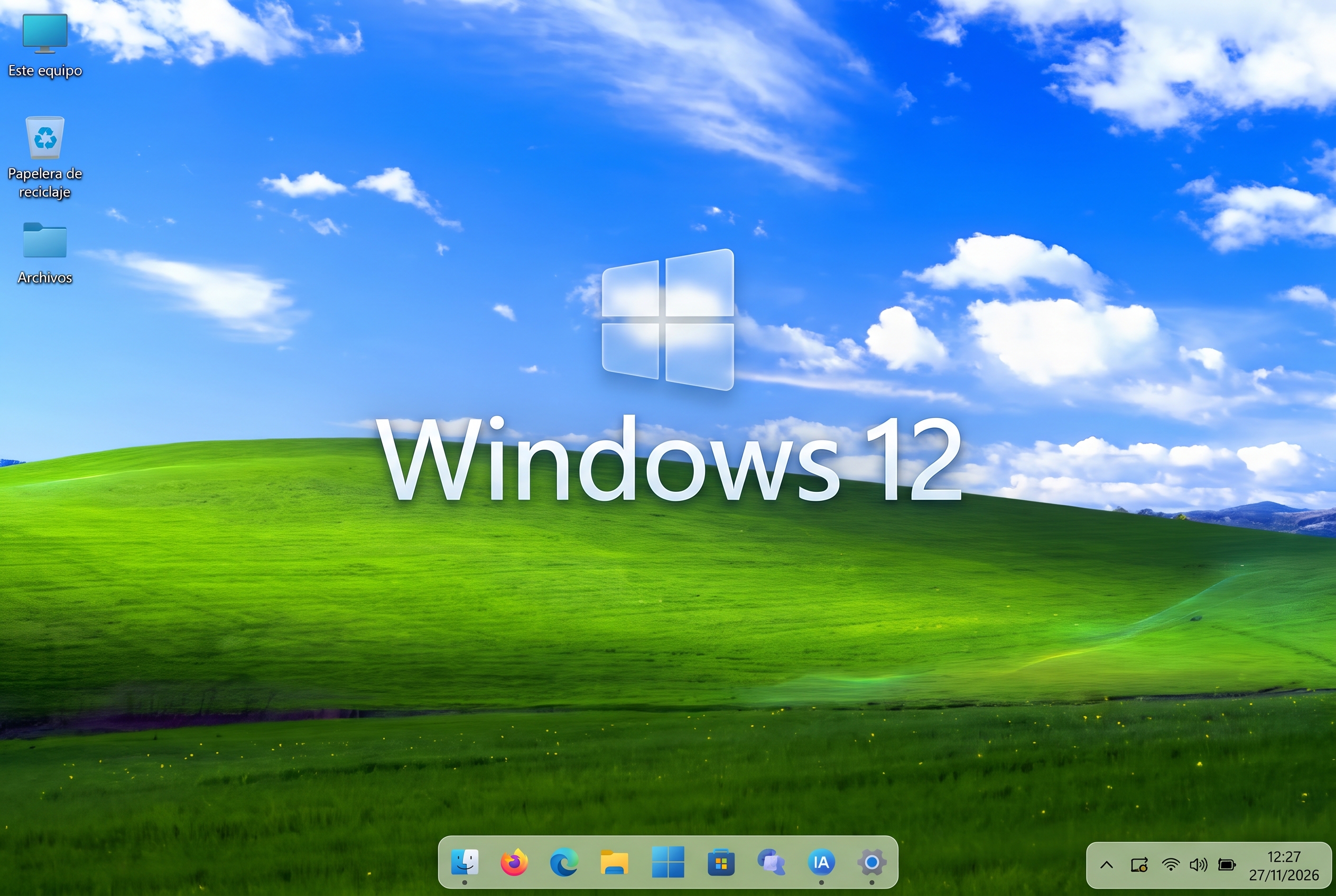
The head of Windows is asked when Windows 12 will arrive and he responds by talking about the pending problems of Windows 11
Windows 12 could arrive when all the AI pieces are ready. And only when Microsoft can truly integrate them into the system interface. This is the opinion of Bob O’Donnell, chief analyst at Technalysis Research, and for now Microsoft has not set a date for that moment. Neither did Pavan Davuluri, head of Windows, in an interview with Axios during Ignite 2026, in which he made it clear that the company’s efforts remain focused on Windows 11, a system with more than 1 billion users.
Davuluri did not close the door on a new Windows, but he did explain that the company still has many tasks to deliver. On the one hand, polish the basics, that is, make sure the system runs fast, does not fail and is well finished. It is something that has been achieved little by little since the K2 plan was activated.
On the other hand, build the technological base on which the AI applications of the future will work and verify that users find them useful. With all that resolved, Microsoft would have what the manager describes as the “permission” to move forward.
Companies have just left Windows 10 behind
For O’Donnell, Microsoft has already assumed that it needs to solve its stability and security problems before a version change, because what is expected is that the system works “robustly and securely at all times.” However, although this is a good starting point, it adds a factor that weighs heavily in the professional field.
Many companies have recently completed their move from Windows 10 to Windows 11 and for them a version jump of this magnitude represents a considerable disruption. So, for now, the company should be cautious and wait for the latest version to really take hold.
Local AI needs more memory than PCs have
The other side of the coin is in the hardware. Davuluri hopes that the models between 10,000 and 20,000 million parameters Bring more advanced AI features to the PC and see local AI growing among programmers, creators, and data professionals.
But running those models requires a lot of memory. Configurations of 32 GB, 64 GB or even 128 GB are essential. And that dependence on memory has come in the midst of an escalation in the price of RAM. At the moment, these experiences are concentrated in specialized equipment such as the NVIDIA DGX Spark or the Mac mini, which O’Donnell cites as examples of machines in which complex tasks are already automated with local models.
At this point, the analyst believes that Microsoft and the manufacturers gave too much importance to the NPUs, the chips dedicated to AI, when what weighs the most in these applications is the memory, along with the GPU and the CPU. It also points out what would be the next important advance for a possible Windows 12. Basically, it suggests that the system itself decides which tasks are solved by the local model and which by the cloud, which would allow costs to be lowered without transferring that choice to the user.
Meanwhile, work continues on Windows 11. The taskbar recently returned to being able to be placed on any side of the screen, and Microsoft continues to move parts of the system to WinUI, although its own engineers acknowledge that the framework still has outstanding bugs to resolve.
