
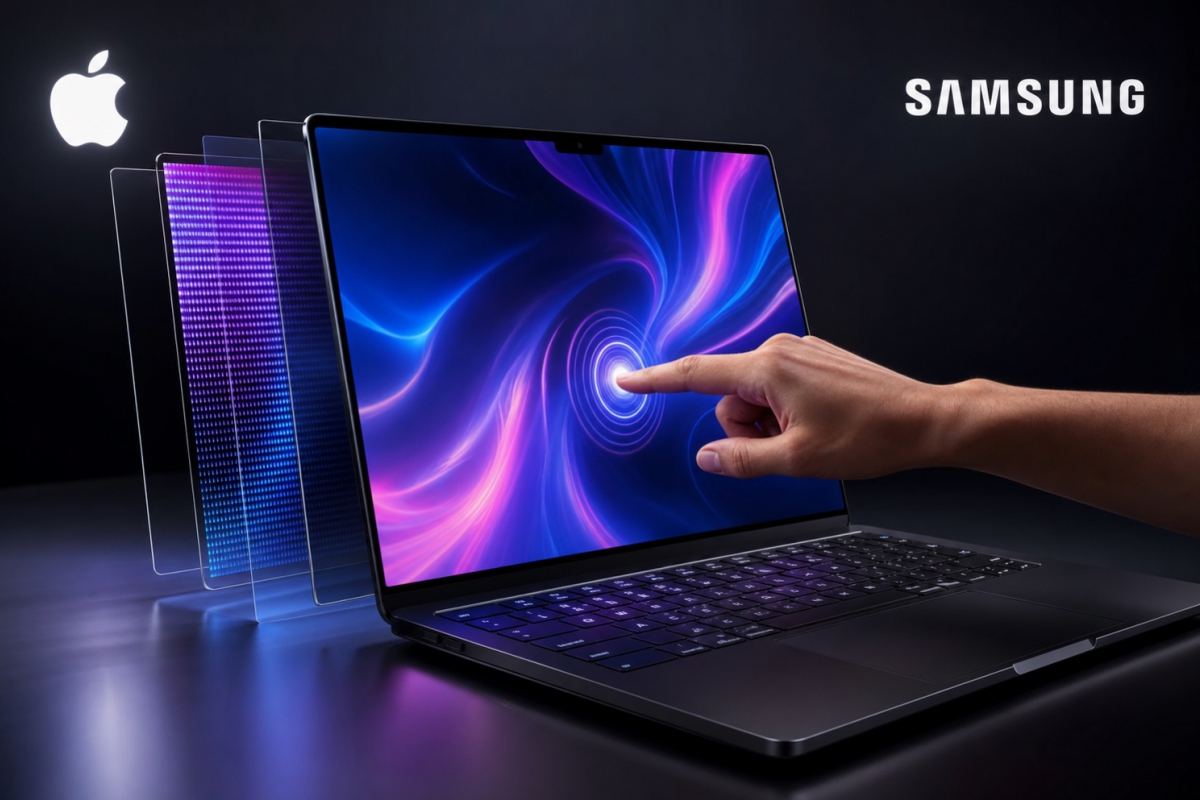
The MacBook Pro with OLED touch screen will arrive with panels manufactured exclusively by Samsung
The arrival of the touch screen to MacBook Pro It is one of those rumors that have been circulating for so long that they had almost lost credibility, but the supply chain is beginning to move in a very specific direction. According to the information collected, Samsung Display is emerging as the exclusive supplier of OLED touch panels for the next MacBook Pro, leaving both LG Display and BOE, the other two major manufacturers that had also competed for the contract, out of the equation.
The data is not minor if the size of the order is taken into account.: There is talk of more than 2.5 million panels, a figure that would fit with a large-scale launch and not with a limited or experimental edition. Apple had been evaluating different suppliers for this update for some time, and the fact that Samsung is left with the entire contract indicates that the South Korean company has resolved better than its rivals the technical challenges required by putting a touch layer on a laptop OLED panel without penalizing thickness or consumption.
Two confirmed sizes: 14 and 16 inches
The touchscreen MacBook Pro would be expected in the two usual configurations of the Pro range, 14 and 16 inchesthus replicating the approach that Apple has maintained for several generations with its professional laptops. No details have been leaked about whether both sizes will share the same relative resolution or if there will be differences in maximum brightness, refresh rate or the thickness of the glass used for the touch layer.
What does seem quite settled is the calendar: There is an announcement that could arrive at the end of this year or, at the latest, at the beginning of next year.. That timeframe coincides with the usual refresh cycles for the MacBook Pro range, which typically receives screen and silicon updates in stages rather than all at once.
Why has it taken so long to get here?
The touch screen has been, for a long time, one of the great absences in the Mac ecosystem. Apple has always argued that the combination of trackpad and keyboard is more ergonomic for working while sitting in front of a laptop than raising your arm to touch the screen, an argument that the company has repeated in different presentations and interviews over the years. However, competitive pressure from touchscreen Windows laptops, many of them convertible into tablets, has been growing steadily.
The technical leap is not easy either. Integrating a touch layer into a large format OLED panel means adding additional components without increasing the total thickness too much or sacrificing image quality, two priorities that Apple is not willing to give up in its professional range. That is where Samsung Display’s experience with high-end OLED panels comes into play, both in the mobile and television segments, which would have given it an advantage over LG Display and BOE when it comes to meeting the quality standards required by Apple for a product of this caliber.
What it costs to manufacture 2.5 million panels
Producing two and a half million OLED touch panels is no small task, even for a manufacturer the size of Samsung.. This figure forces us to reserve specific production lines for months, coordinate the supply of materials such as cover glass and touch sensors, and maintain strict quality control to avoid failures of dead pixels or color uniformity that would be unacceptable in a premium product like the MacBook Pro.
That volume also gives a clue about Apple’s intentions: It would not be a limited run for a niche model, but rather an update that would reach the entire Pro range in a general way. If confirmed, it would represent one of the most relevant design changes in the recent history of the MacBook Pro, comparable in magnitude to the leap that was once represented by the arrival of the Mini-LED screen or the redesign of the range with the M1 Pro and M1 Max chip.
For now no reference price has been leaked for the future MacBook Pro with a touch screen, something logical given that there is not even official confirmation of the launch from Apple. When the company does publish figures, presumably in dollars for the US market, we will have to wait for the conversion to euros and, above all, for the official figures for the European market, which usually remain above the simple direct conversion due to VAT, tariffs and local distribution margins.
If the agreement with Samsung Display is confirmed, the premium laptop components industry would have a new dominant player in a very specific segment: that of large-format OLED touch screens, where until now the highest volumes corresponded mainly to convertible Windows laptops and not to a product with the commercial weight of the MacBook Pro. Apple’s official confirmation, when it arrives, will be the one that clears up the doubts that still remain about specific specifications and exact launch date.
