
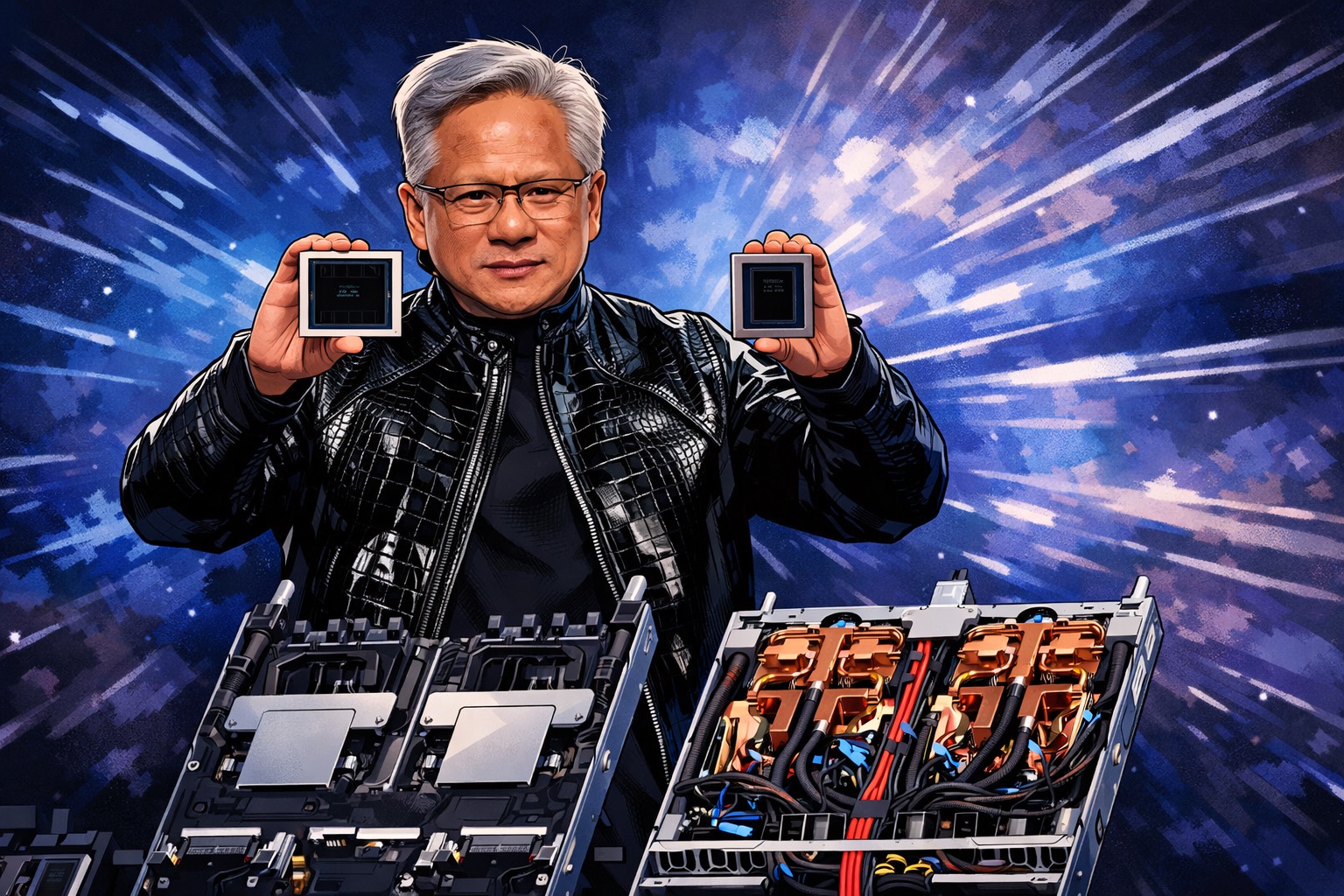
The surprise NVIDIA chip that Jensen Huang has dropped for GTC 2026 is already heating up the market
There are ads that arrive with slides and others that arrive with a well-placed phrase, the kind that make half the sector raise their eyebrows at the same time. That is what has happened with Jensen Huang: the CEO of NVIDIA has slipped that in GTC 2026 there will be a chip reveal that does not fit into the script that many take for granted. And when the company that sets the pace for AI hardware plays dumb, noise becomes signal.
Context matters, because GTC is not just any eventto. The 2026 edition will be held from March 16 to 19 in San Jose, with a keynote on the 16th. It is the showcase where NVIDIA usually shows the roadmap, platforms and data center vision. On that landing strip, a surprise chip sounds less like a trick and more like a strategic piece.
GTC 2026, the showcase where NVIDIA moves the calendar
NVIDIA is selling GTC 2026 as a conference focused on physical AI, agents, inference and AI factoriesthe term used to describe data centers designed to train and serve models at scale. This mix of technology and business always culminates in the same point: Huang’s keynote. Products are announced there, yes, but the pace of the market is also set, because many purchasing decisions align with what is shown on stage.
That’s why the teaser has weight. If the CEO insists that there will be a surprise, he is implying that not everything will be continuity. And that, in 2026, usually translates into changes in efficiency, interconnection or packaging of computing and memory so that the models continue to grow without the cost skyrocketing.
Why an unexpected chip fits the current moment
The industry reaches 2026 with a much discussed roadmap: Blackwell as present, Ultra steps as a transition and, later, the Vera Rubin platform as the next big leap. The relevant detail is that NVIDIA is no longer talking only about GPU. Increasingly, the discourse relies on complete systems: CPUs, networks, racks and software, because final performance depends as much on moving data as it does on computing.
Furthermore, at the beginning of January, Huang used CES 2026 to reinforce a message: The next generation is in full production and promises to multiply performance in AI loads compared to previous generations. With that ground prepared, a surprise in GTC may be the way to prevent the market from thinking that everything has been said for 2026.
The clues: memory, network and the electric bill
Without official details, the exercise is to look at where the shoe presses today. The first axis is memory. The AI leap is not only explained by more GPUs, but also by more bandwidth, and the transition to new generation HBM memories is at the center of any powerful platform of 2026.
The second axis is the network and interconnection. Large deployments are obsessed with latencies: if the cluster scales, any bottleneck between nodes ruins the aggregate performance. In that sense, a surprise chip could aim to integrate communication functions or improve per-rack performance rather than per-chip performance.
The third axis is the one that rules even if it does not appear in the demos: energy and density. If the limit is the building’s infrastructure, an improvement that reduces consumption per token served may be more valuable than a theoretical performance spike.
What it means for buyers and competitors
The immediate impact is calendar. For large infrastructure buyers, knowing that there is an unforeseen announcement in March forces them to adjust decisions: no one wants to close a huge order and discover weeks later a more efficient option or one better suited to their type of load. In a market where the cost is calculated by inference almost as if it were an electricity rate, small leaps in efficiency move millions.
For the competition, the gesture also has meaning: NVIDIA continues to play for systemic advantage. If the surprise is linked to the platform and not to an isolated piece, the message is that the battle is not won with silicon alone, but with hardware and software integration in packages that arrive ready to deploy.
The key date: March 16, 2026
With GTC 2026 set for March 16-19the point of maximum attention will be the keynote on the 16th. NVIDIA already presents it as the space for announcements in AI, computing and robotics, and it is where Huang usually turns a roadmap into headlines.
Until that day comes, the prudent thing to do is to separate desire from evidence: there is a visible agenda (platforms, focus on AI factories, production moving forward) and a promise of surprise. But even without details, the move already serves its purpose: It returns the focus to the San Jose scene and leaves the industry looking at the entire system, not just the next GPU name.
