
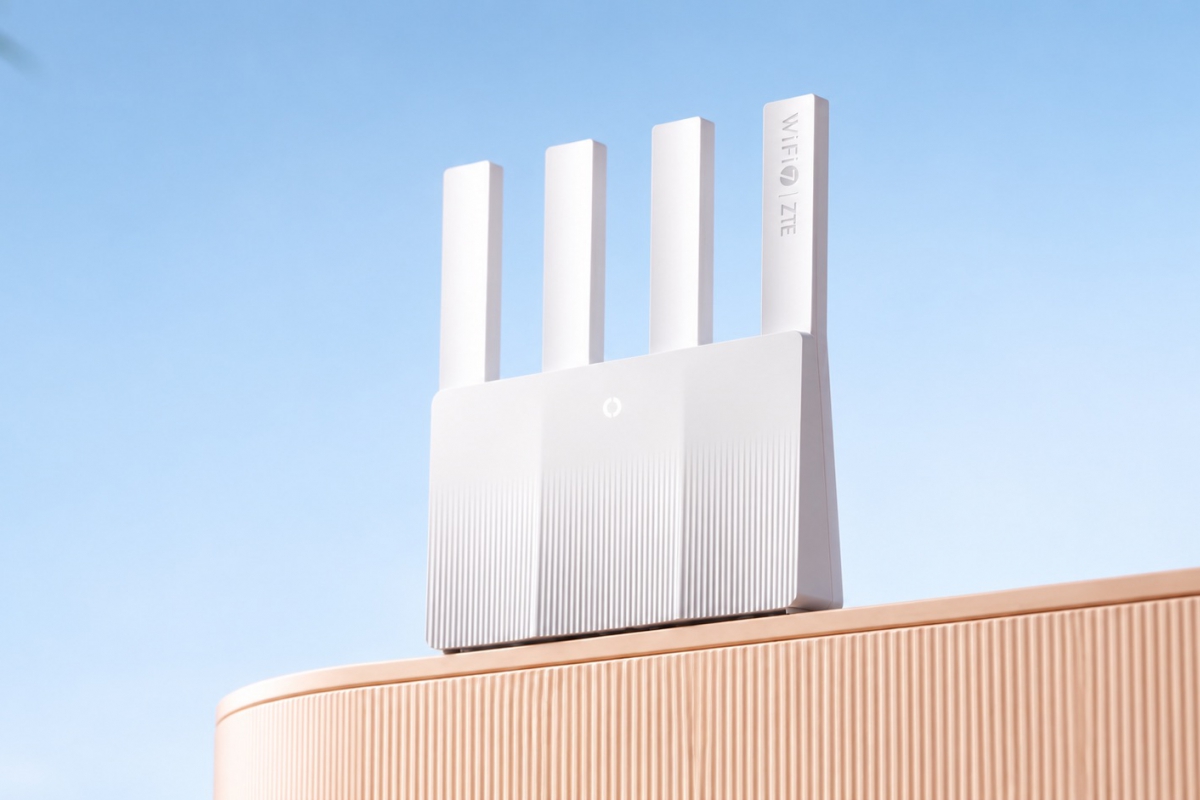
The ZTE Xuntian BE3600 allows you to connect two Internet lines and use one as a backup
ZTE has put in its catalog the Xuntian BE3600 Qingyun Editiona home router with WiFi 7 and dual WAN. The device allows you to connect two Internet accesses and use them to distribute traffic or have a backup connection.
Two Internet connections with Gigabit ports
Dual WAN support allows you to configure two broadband connections on the same router. Load sharing distributes traffic between them, while failover allows a second access to be used when the main one stops working.
In a home with two contracted lines, the distribution can be used so that the connections of different devices use both outputs.
This function does not imply that a single download will automatically add the speed of both lines. Each physical port has a Gigabit linka limit that should be distinguished from the advertised wireless capabilities.
Conventional balancing distributes connections, while adding both accesses for the same session requires other techniques. Therefore, connecting two 1 Gbps lines is not enough to promise an individual 2 Gbps download. Nor has a measurement been published of the throughput that this ZTE can process when using the two WANs.
The backup modality responds to another need: preserve an Internet outlet when the main one fails. Its usefulness depends on the second connection still working. Two accesses that share an infrastructure failure can be interrupted at the same time, even if they are connected to different ports.
The provision of three connectors also conditions the installation. If two are used as WAN, there is one physical port left for the local network. To connect several computers, a NAS and other equipment by cable, it would be necessary to extend that connection using a switch.
Gigabit links correspond to 1,000 megabits per second, equivalent to a theoretical maximum of 125 megabytes per second before deducting protocol headers. It is a reference for wired transfers, not a guaranteed file copy speed. The available information does not list 2.5GbE ports.
The router also supports Internet and IPTV transmission over the same Ethernet cableafter configuration. The feature makes it easy to leverage an existing physical connection for both services.
This can be useful when there is only one cable running to the room where the TV and set-top box are located. Sharing the lines avoids needing an independent route for each service, although the installation must adapt to the configuration required by the operator.
ZTE mesh and band aggregation using MLO
In networks with multiple devices, ZTE incorporates Mesh partnership with its own brand routers. The information published also contemplates the use of devices from other brands as access points. This operation is not equivalent to a guarantee of Mesh interoperability between manufacturers.
An additional access point can provide coverage to another area of the home, but sharing the network name does not demonstrate that Mesh coordination exists. Before reusing an old router, it is worth distinguishing access point mode from incorporation as a node managed by the ZTE system.
The wireless part uses WiFi 7 and supports MLOwhich allows you to use several wireless links with compatible devices. The router features a vertical design with a wavy surface.
MLO supports different modes of operation. Some allow you to transmit and receive using multiple radios, while others switch between links.
The result also depends on the client, its wireless chip and system support. The product information does not specify the MLO mode implemented or provide comparative tests for latency or speed. The name WiFi 7 is not enough to confirm a 6 GHz band either.
The sheet describes its own fourth-generation control chip, with a two-core CPU and a quad-core NPU, accompanied by an independent WiFi chip. No performance tests have been provided that allow this configuration to be translated into real speeds of use.
The initial price of 199 yuan corresponds to the Chinese market. The documentation consulted does not include a commercial calendar for Spain.
