
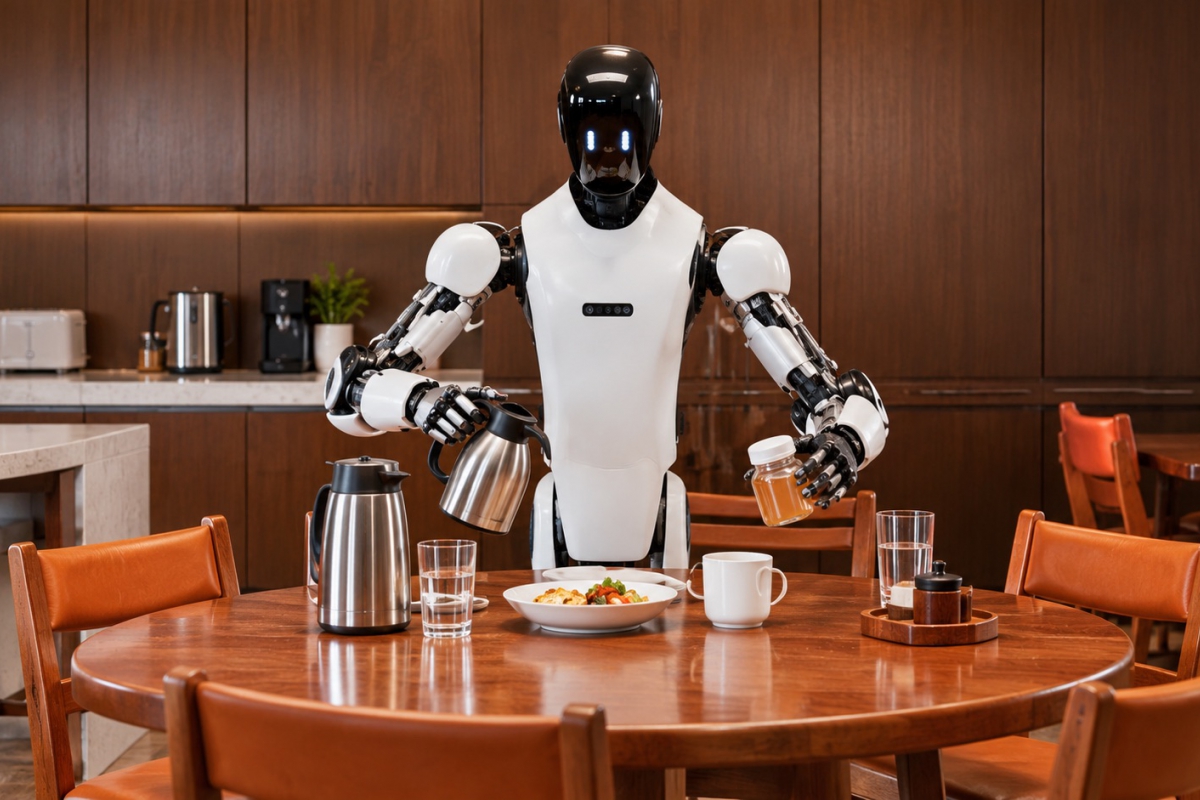
AGIBOT presents 150 hours of data to teach its robots to decide what to do based on the environment
This October 22, AGIBOT presented the fourth installment of AGIBOT WORLD 2026its collection of data obtained with physical robots. The new part is called Physical Reasoning and focuses on situations in which the robot must decide what to do based on the state of its environment, rather than repeating a fixed sequence of movements. The company announced a first delivery of 150 hours of real robot logs.
The publication is part of AI WAVEa schedule of seven presentations announced by the Chinese company. A Shanghai media outlet reported today on the opening of this fourth installment. The public page for the general data set was accessible, although it did not allow specific Physical Reasoning files to be clearly identified; It is important to distinguish the announcement from the independent verification of each download.
The same objectives may require different actions
An instruction directed to a robot is not always enough to set the sequence of movements. If you need to replenish three drinks in a minibar, you first need to check how many there are and which ones are empty. Only then can you decide what to remove and what to add. The fourth installment of AGIBOT WORLD 2026 uses situations of this type to train decisions conditioned by the initial state.
Another example described in the presentation consists of locating toiletries distributed among several drawers. The task requires identifying objects and remembering which ones have been reviewed so as not to repeat the search. In both cases, executing an isolated movement well does not guarantee completing the assignment. The robot needs to relate the objective to the information it finds.
According to the description released in Shanghai, the set proposes variations of the same task with changes in the number of objects, the concealment relationships, the available space and the progress achieved. That design seeks that a model learns to choose the next action under different conditions. The company divides the scenarios into three levels of difficulty, called Easy, Medium and Hard.
The documentation presented speaks of nine types of reasoning. Among those mentioned are selection by attributes, conditional judgments, evaluation of whether an action is possible, goal search, planning long tasks, and process memory. These categories describe the data collected; They alone do not prove that a trading robot already solves all these problems without intervention.
Annotations connect the decision with the movement
The advertised content includes instructions that express the entire goal of each task and annotations that separate stages, subtasks, and steps. It also incorporates descriptions of actions and spatial references through boxes, points or lines. with them Objects, contact places and planned routes are identifiedalong with the result of the execution.
This information allows you to train two parts of behavior that must be coordinated.. One decides what action corresponds to the situation; the other converts it into robot movements. In the replenishment or search examples, both decisions change as the robot discovers the true state of the objects. The objective of the collection is to provide records in which this relationship can be studied.
AGIBOT had published previous installments of WORLD 2026 dedicated to other problems in robotic learning, such as imitation and reinforcement learning. Physical Reasoning adds emphasis on choice between possible actions. The brand maintains that this data will be used in a future agent system and in a new generation of its base model; has not yet presented independent evaluation results that allow measuring the improvement attributable to this fourth installment.
The figure of 150 hours corresponds to the first batch of real data announced for the topic of physical reasoning. Not to be confused with the overall size of AGIBOT WORLD 2026, which contains materials from previous deliveries. The general repository hosted on Hugging Face did not show a folder or documentation clearly identified as Theme 4. For this reason, the existence of the presentation is proven, while effective access to the specific files of this batch remains pending direct verification.
AI WAVE will continue with six more presentations
The programming communicated by AGIBOT places the October 23 the presentation of Genie Studio 2.0; Afterwards, the G2 Max robot, the Genie Master system, a Genie Sim update, a base model and a collective learning system. These are announcements scheduled for later dates, not products that should be considered launched today.
The company also plans a demonstration of six G2 robots in a store between November 2 and 3. According to their schedule, they will work for 24 hours on tasks such as replenishing products, preparing food and attending to other store operations. That test has not yet been performed. Their results, when available, will allow us to observe how robots perform in a specific situation, although they will not replace an independent evaluation of the data set announced today.
