
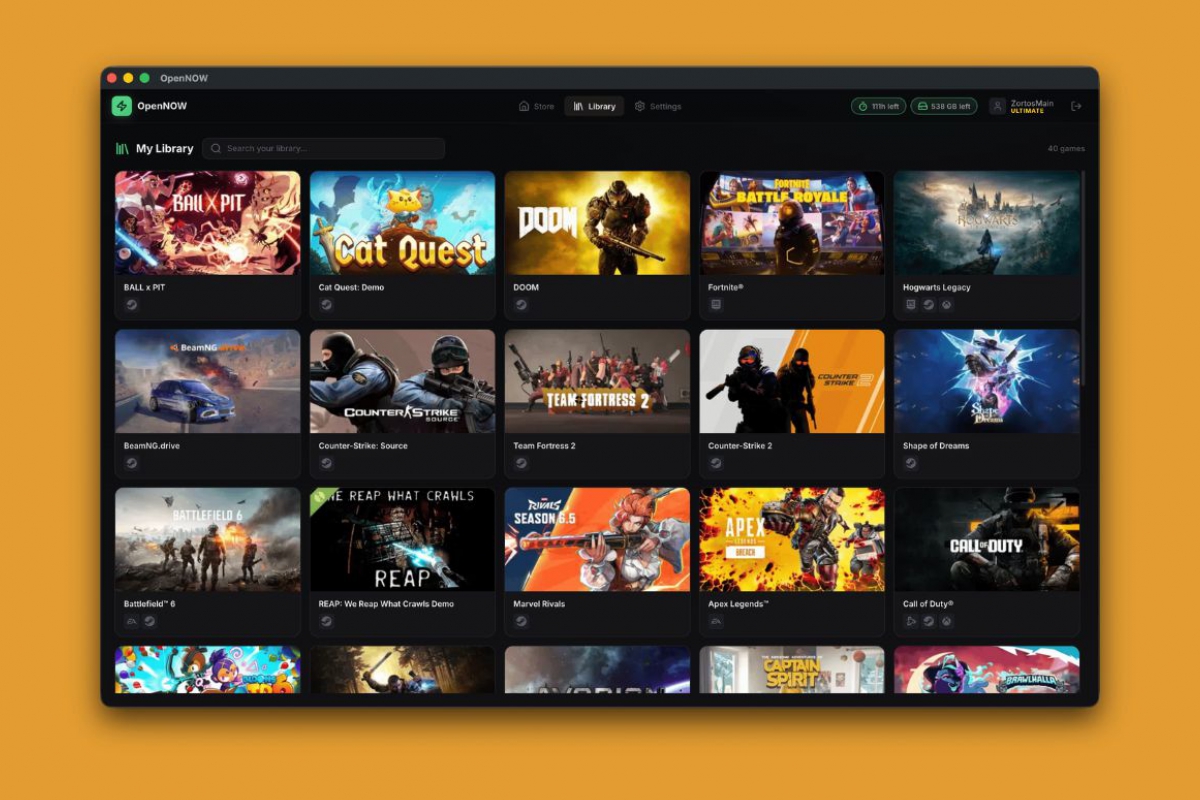
OpenNOW brings GeForce Now to open source territory with less telemetry and without kicking you out for inactivity
GeForce Now now has an unofficial alternative client that introduces a very interesting reading about where cloud gaming can evolve when the community decides to touch what the provider does not want to touch. Is called OpenNOWis published on GitHub and allows you to connect to NVIDIA’s cloud gaming service using an official account, but with some changes that the original client does not offer, starting with two very visible ones: less telemetry and the removal of the AFK limit.
The function that will attract the most attention to many users is precisely that. The official GeForce Now client cuts off the session if it detects a few minutes of inactivity, a limitation designed to prevent unnecessary resource consumption when no one is playing. OpenNOW eliminates that behavior, so you can leave a game open in the background without the system automatically kicking you. It is a small detail, but quite significant in a service where the management of time of use and resources is a central part of the business model.
The other big complaint is privacy. Its creator assures that this client does not collect tracking or telemetry datasomething that can attract users less comfortable with the amount of information that proprietary clients usually collect. Here it is advisable to maintain some caution, because we are talking about a community development and not an official NVIDIA tool, but the simple fact that such an alternative appears already says a lot about a part of the GeForce Now audience: not everyone wants a closed experience completely defined by the platform.
An open alternative for an increasingly ambitious service
OpenNOW also adds other minor features, such as mouse sensitivity adjustments, pasting from the clipboard, and native support for Linuxplus work in progress for Linux Arm64. That reinforces its profile as a tool for advanced users, just at a time when NVIDIA is expanding GeForce Now to more screens, more formats and more use cases. We saw it recently when the company brought GeForce Now to 90 FPS in virtual reality and reinforced its commitment to premium experiences.
That contrast is interesting. NVIDIA continues to push the service towards an increasingly polished, more closed and more segmented model by plans, while OpenNOW represents the opposite logic: more control for the userfewer artificial restrictions and the possibility of modifying the client to taste if you know how to program. The base service does not change, because you still depend on the infrastructure and the NVIDIA account, but the way to access it does change.
It must also be taken into account that GeForce Now has already become a huge ecosystem, as we remembered when NVIDIA boasted of exceeding 4,500 compatible games in the cloud. When a platform reaches that scale, it is normal for parallel tools, alternative clients and small layers developed by the community to emerge to adjust the experience to more specific audiences.
More freedom, but also fewer comforts and more responsibility
That does not mean that OpenNOW is going to replace the official client. As you can imagine, it has clear limitations. For example, it does not offer integration with Discord, it lacks support for certain specialized controls such as simulation controls, and it is not aimed at mobile phones, televisions, or a general audience. It is a tool for the most expertsnot a universal gateway to GeForce Now. And as with almost everything that lives on GitHub, it requires a somewhat more active relationship with the software than that offered by an official downloaded and closed app.
Still, the fact that it has reached the market is relevant. OpenNOW does not change NVIDIA’s strategy, but it does satisfy users who want to enjoy cloud gaming with less surveillance, fewer limits and more room for customization. With an increasingly closed app ecosystem, this is a much-needed breath of fresh air.
