
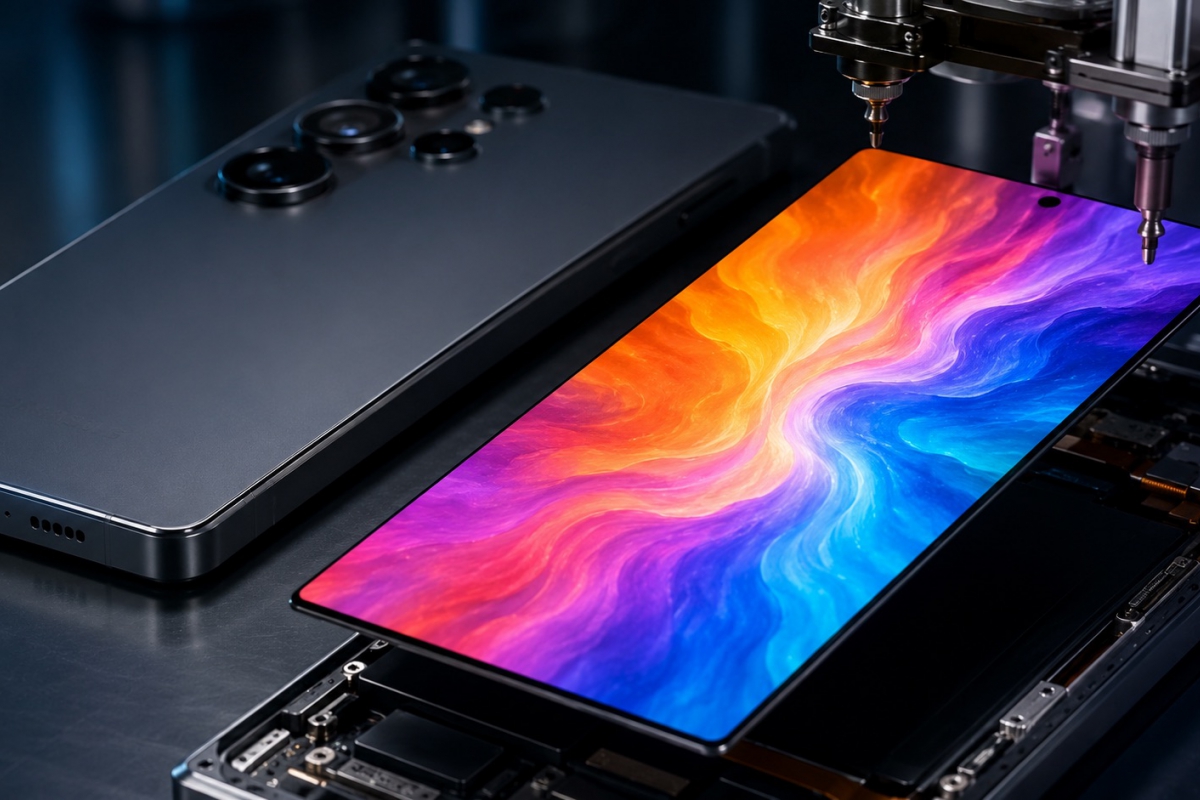
BOE offers Samsung its OLED screens for the Galaxy S27 at a price $5 lower than Samsung Display
The relationship between Samsung Electronics and its display suppliers is at a time of particular tension. According to certain information, BOE, the largest Chinese display panel manufacturerhas submitted a proposal to Samsung Electronics to supply the standard Galaxy S27 OLED displays to a price five dollars lower per unit than what Samsung Display offersthe screen division of the Samsung group itself. The proposal is not a mere market exploration: Samsung Electronics has already sent BOE a formal request for pre-listing information, known as RFI, and since last month it has been evaluating samples from the Chinese panel.
The Galaxy S27 is planned for early 2027, and the series will include four models. The debate over which screens will equip the standard version of the phone occurs against a backdrop of increasing cost pressure. The OLED for the base model does not require the most advanced features of the range (which usually go to the Ultra models), since the specifications of the standard version have not changed significantly in recent years. That makes it stop BOE is technically achievable to satisfy the requirementswithout the difficulties that would entail trying to fit your screen into the most demanding positions in the range.
BOE no longer has a patent obstacle
One of the historical impediments for BOE to supply OLED displays to Samsung was the patent conflict with Samsung Display, especially regarding the Diamond subpixel technology. That obstacle disappeared late last year, when both sides reached a patent licensing agreement that gives BOE access to that technology. From that moment on, the technological barrier to providing a standard OLED to the Galaxy S27 is significantly lower.
Internal sample evaluations, according to people in the sector, have yielded positive results to date. An internal evaluator indicated that the BOE panel has not received negative ratings during the tests carried out so far. It is also said that since the Galaxy S27’s standard OLED requirements are similar to previous generations, BOE would not have major technical difficulties in complying with them.
BOE economic motivation
The BOE proposal is not only due to an offensive commercial strategy. Behind there is also defensive pressure: Chinese OLED panel manufacturers are having a difficult year. The rise in memory prices has led Chinese smartphone companies to reduce their production plans, which has reduced display orders and made it difficult to keep the utilization rate of OLED factories at full capacity.
BOE operates three 6th generation OLED production lines for smartphones (named B7, B11 and B12) and has also built a new 8th generation line for IT called B16. The company has not yet managed to register profits in its OLED business, so securing a contract with Samsung, even at a discounted price, would represent both operational relief and a relevant strategic milestone.
Concern in the Korean ecosystem
The possible adoption of BOE panels in the standard Galaxy S27 has raised concerns in the Korean industrial ecosystem. Suppliers of materials and components that are part of Samsung Display’s supply chain warn that if BOE wins the contract, its customer base and its ability to generate revenue with Samsung Electronics will be reduced. Furthermore, the BOE supplier chain in China has a very high local presence, which means that the money from this contract would not impact the Korean industrial fabric.
There is another worrying angle: If Chinese suppliers increase their direct collaboration with Samsung Electronics as an end customer, the transfer of technical knowledge implicit in that relationship could contribute to reducing the technological gap between Korean companies and their Chinese competitors. It also points to the possibility that certain litigation over patents for materials or components may remain unresolved or minimized as a side effect of the collaboration.
A precedent that Samsung has already used
It wouldn’t be the first time Samsung has used the threat of competition from alternative suppliers as a price negotiation tool. In the mid-range segment, the Galaxy A57 is already being produced with OLED displays coming from both Samsung Display and CSOTanother Chinese manufacturer.
The diversification of suppliers in mid-range models has resulted in a drop in the price of panels in these references. The question now is whether Samsung is willing to take that same step in the high-end, where the margins and relevance of each component are considerably higher.
Samsung and BOE have tried this approach on several occasions in the past, without any supply agreement being finalized. The Galaxy S27 could change that dynamic, although the final decision has not yet been made.
