
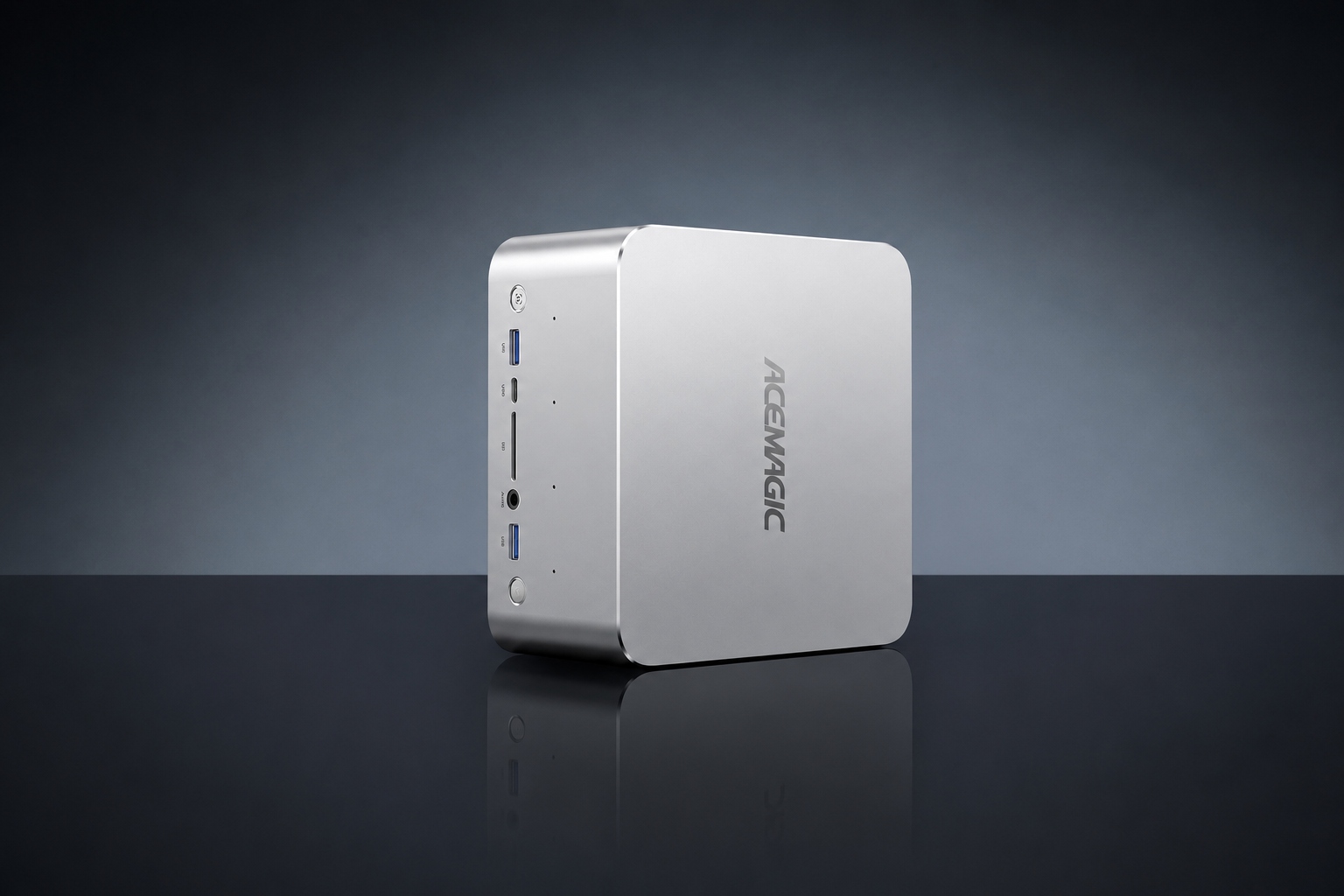
Acemagic presents the F9A, a mini workstation with the Ryzen AI MAX+ 395 capable of moving AI models with 120 billion parameters
Acemagic has presented the F9Aa mini PC aimed at local artificial intelligence inference that fits in a volume of just 2 liters. The manufacturer positions it as a workstation designed for AI developers, video creators and professionals who need to run large language models without depending on cloud servers. For now, the company has not confirmed price or availability date, scheduled for the coming weeks.
The team assembles the AMD Ryzen AI MAX+ 395a processor with 16 cores and 32 threads with Zen 5 architecture and integrated RDNA 3.5 graphics, accompanied by an XDNA 2 NPU capable of reaching 50 TOPS on a dedicated basis. Adding CPU, GPU and NPU, Acemagic places the total system power at 126 TOPSa figure explicitly designed to run models with up to 120 billion parameters locally.
Acemagic F9A technical sheet
| Acemagic F9A | |
|---|---|
| Processor | AMD Ryzen AI MAX+ 395 (16 cores / 32 threads, Zen 5) |
| Integrated graphics | AMD RDNA 3.5 |
| NPU | XDNA 2, up to 50 TOPS (126 TOPS combined with CPU and GPU) |
| Memory | Up to 128 GB unified LPDDR5X-8000 |
| Storage | 2x M.2 PCIe 4.0 x4 NVMe |
| High performance expansion | 1x Oculink (PCIe 4.0 x4), 2x USB4 (40 Gbps) |
| Additional connectivity | 1x HDMI 2.1, 2x Ethernet 2.5GbE, 3x USB-A 10 Gbps, SD 4.0 reader, 3.5 mm jack |
| Audio | Array of 4 far-field microphones + 2 2 W speakers |
| Wireless connectivity | Wi-Fi 7 + Bluetooth 5.4 |
| Lightning | Bottom RGB ring with customizable modes |
| Dimensions | 158 x 158 x 85 mm (~2 liters) |
| Chassis | CNC aluminum unibody, anodized finish (silver or space gray) |
A device designed for local inference, not just for the office
The central argument of the F9A is the unified memorywhich can be configured up to 128GB on LPDDR5X-8000 and is shared between CPU, GPU and NPU. It is precisely that shared memory, combined with the power of the NPU, that allows Acemagic to talk about models with up to 120 billion parameters running locallywithout depending on a high-end discrete GPU or cloud services.
The manufacturer goes one step further and proposes the use of multiple computers in cluster to deploy even larger models, explicitly mentioning DeepSeek-R1-671B as an example. It is an approach that makes sense for IT teams that need to set up an internal knowledge base without enabling a dedicated server room, something that until now required much more voluminous and expensive infrastructure to maintain.
Oculink and double USB4 to scale the equipment according to the workload
The other asset of the F9A is its expandability. The port Oculink It offers full PCIe 4.0 x4 bandwidth, well above what a conventional Thunderbolt 4 connection allows for external GPUs. In practice, this allows you to connect a full desktop GPU, compute accelerator, or capture card without the connection bottleneck limiting performance, which is relevant for both large model inference and 8K video rendering.
Added to that are two ports USB4 at 40 Gbpscapable of moving external NVMe storage and up to four independent 8K monitors simultaneously. It is a configuration aimed at workstations with multiple screens, common in real-time financial analysis, professional video editing or software development, where losing performance due to bandwidth limitations is especially costly.
The equipment is completed with a set of four microphones with noise reduction and beamforming, capable of clearly capturing voice up to three meters away, designed for real-time meeting transcription and AI voice commands, as well as a dedicated physical button to launch Windows Copilot without the need for keyboard combinations. These are details that point to a mixed use between an AI station and a remote workstation, rather than a simple mini office PC.
Acemagic has not yet detailed the pre-installed operating system, warranty or initial availability markets, data that will likely accompany the price announcement in the coming weeks.
